


January 07, 2011
— Open Blogger Dead horse, meet stick: the dominoes keep lining up:
Europe is living in denial. Even after the economic crisis exposed the eurozone's troubled future, its leaders are struggling to sustain the status quo. At this point, several European countries will likely be forced to abandon the euro within the next year or two.European leaders tell us that this is impossible. There is no legal mechanism, they say, for exiting the euro. But the collapse of the euro is simple arithmetic: Once a country's debt-to-GDP ratio gets high enough, it becomes impossible for it to generate enough future taxes to repay its existing debt and interest costs. This week, Portugal became the latest country to threaten the integrity of the eurozone when it saw the yield on its Treasury bills soar, based on investors' fears that it would be unable to pay its debt.
The only way out of this conundrum is for countries with insurmountable debt burdens to default on their euro-denominated debts and exit the eurozone so that they can finance their continuing fiscal deficits by printing their own currency. Here's a hint for Europe's politicians: If the math says one thing and the law says something different, it will be the law that ends up changing.
Actually, that last line is something that Obama and the Dems should keep in mind. Not that we should be feeling cocky in all this. ..fritz..
Posted by: Open Blogger at
06:17 AM
| Comments (58)
Post contains 243 words, total size 2 kb.
— Gabriel Malor Now this is what I'm talking about. Read the advance of George Will's Sunday column about Congressman Fred Upton's plans to challenge the Obama Administration on several fronts.
[L]ast month, the Democratic-controlled Federal Communications Commission, on a partisan 3-2 vote, did what a federal court says it has no power to do: It decided to regulate the Internet in the name of "net neutrality." The next morning, a man who can discipline the FCC said: Well, we'll just see about that. "We are going to be a dog to the Frisbee on this issue."
Also on Upton's list is, of course, repeal of ObamaCare:
But Upton has a bigger repeal in mind. He thinks enough Democrats will join all 242 House Republicans in voting to repeal Obamacare, and that repeal will come within 25 or so votes of the 290 necessary to override a presidential veto. This will intensify pressure on other Democratic members -- imagine their town hall meetings -- who could provide the veto-proof margin.
He's also interested in deregulating Medicaid and stopping the EPA's climate change power grab.
Update: Changed the post. The original Will column implies that Upton, as chair of House Energy and Commerce will seek to repeal the lightbulb ban law that we've talked about previously. But that didn't sound quite right to me and it's because Upton was a champion of that bill in the first place. Upton may have the power to push repeal, but there's no indication to me that he actually intends to.
Bummer.
Posted by: Gabriel Malor at
03:42 AM
| Comments (108)
Post contains 270 words, total size 2 kb.
— Gabriel Malor There are no self-proclaimed villains, only regiments of self-proclaimed saints.
Posted by: Gabriel Malor at
03:02 AM
| Comments (121)
Post contains 18 words, total size 1 kb.
January 06, 2011
— Maetenloch Happy Thursday all.
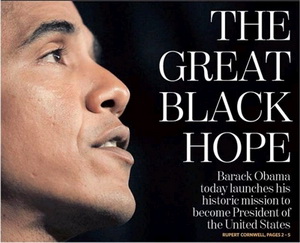
Barack Obama - The Self-Manufactured Black man
He was born only half black, didn't grow up in a black family, and didn't really know any black people until he was nearly an adult, yet now he's considered the epitome of the successful American black man. This was not an accidental transformation.
As an American boy growing up in Indonesia and Hawaii in the aftermath of the civil rights movement, Obama was in a confusing position. He looked black, but he didn’t know any blacks. He was descended from slave owners but not from slaves. Most disorientingly, Hawaii—where he was brought up by his white grandparents—lacked even those lingering remnants of racism, the exposure and expunging of which was, by the 1970s, the main preoccupation of the burgeoning establishment that had grown out of the civil rights movement.
Where the average resident consumes 12.76 drinks per month. And remember - that's the average even after you include small children, the elderly, people in comas, Mormons, Muslims, and those awaiting liver transplants. Runner-up drinking towns were Fargo, San Francisco, Austin, and Reno.

Posted by: Maetenloch at
05:43 PM
| Comments (499)
Post contains 772 words, total size 7 kb.
Whoops -- It's Old!
— Ace Ah, Reille. Your patience is about to be rewarded. You got a little antsy there in 2007 or thereabouts, but by and large you kept quiet, stayed bought off, even though Fred Baron wasn't paying you that much.
Now here's your prize-- John Fucking Edwards. Lucky girl!
Upside? The kid will have a father. For a while.
Dangit! This is actually an old story... sometimes these get sent around the internet, with no date on them, and people (like me) take them for current.
As commenters havedash and lillikoi point out, details in the article -- like a reference to the "divorce being final" in the future -- make it clear it's old. Like, a year old, maybe more.
What remains true is that 1) John Edwards is a dick and 2) Reille Hunter looks like an old moccasin with fake boobs.
Posted by: Ace at
02:11 PM
| Comments (314)
Post contains 180 words, total size 1 kb.
— Ace DATUM: Washington Post headlines article, Notable passages of Constitution left out of reading in the House
What the article actually describes: The "notable passages" left out of the reading are the parts of the Constitution which are no longer part of the Constitution -- that is, the parts which have been replaced/written out by subsequent amendments, and are therefore not in fact "part of the Constitution," except in a purely historical way. In the same way that two legs may be said to be part of the history of a one-legged man.
What you're supposed to think: Several things. If you just read the headline, you're supposed to think those sneaky Republicans are hypocrites and liars for saying they love the Constitution when they're deliberately omitting parts of it that they don't like, reading a false Constitution, one that probably also says something like Article 3: Jesus is King.
If you read beyond the headline, and realize how fucking stupid an article this is, you are then supposed to rescue the article from its own dishonest headline by realizing the Constitution can be changed!!111eleventy!, despite what those Bible-thumping shotgun-pumping cousin-humping Christers think, and so we shouldn't be worried about further changes, and in fact also shouldn't bother reading it in the House at all, because hey, it can change, so what's it mean? Nothing! Why bother reading something that doesn't mean anything?! That's silly, that's what that is.
(You are specifically not supposed to notice the changed parts of the Constitution were changed according to the precise mechanism authorized within the Constitution (the amendment process), which makes these changes actually solemn, constitutional ones, and therefore have a different character than the "let's make shit up as we go" changes urged by liberals.)
DATUM: Almost as dumb is Vanity Fair's attempt to claim the mere reading of the Constitution cost We, the People $1.1 million dollars in lost Congressional productivity. (Not mentioned: All opening day ceremonies are nonproductive, yet we still do them; How much money, as Ed Morrissey writes, did Nancy Pelosi waste in talking about a now-fired former Democratic House?; and also, time spent by Congressmen reading the Constitution saves us billions of dollars they otherwise would have spent.)
DATUM: Another Washington Post piece, this one from yesterday, makes the claim that conservatives are overly reverential about the nation's foundational document.
And the Founders said: Let there be a constitution. And the Founders looked at the articles and clauses and saw that it was good.For more than 200 years, Americans have revered the Constitution as the law of the land, but the GOP and tea party heralding of the document in recent months - and the planned recitation on the House floor Thursday - have caused some Democrats to worry that the charter is being misconstrued as the immutable word of God.
"They are reading it like a sacred text," said Rep. Jerrold Nadler (D-N.Y.), the outgoing chairman of the House Judiciary subcommittee on the Constitution, civil rights and civil liberties, who has studied and memorized the Constitution with talmudic intensity.
Nadler called the "ritualistic reading" on the floor "total nonsense" and "propaganda" intended to claim the document for Republicans. "You read the Torah, you read the Bible, you build a worship service around it," said Nadler, who argued that the Founders were not "demigods" and that the document's need for amendments to abolish slavery and other injustices showed it was "highly imperfect."
"You are not supposed to worship your constitution. You are supposed to govern your government by it," he said.
What's interesting to me is that liberals have long postured as Defenders of the Constitution, Lovers of the Constitution. They now seem willing -- bordering on eager -- to repudiate that former posture and admit they kinda hate the Constitution (because they hate the sort of people who love it).
Nadler speaks of the Republicans seeking to "claim" the Constitution. But Jerry Nadler could claim it for himself, too: But notice, he chooses not to. In fact, he almost recoils from it.
So, yeah, as between one group that cherishes the Constitution and another group that is increasingly hostile to it -- openly hostile -- yeah, I'd say it's sort of up for grabs; whoever wants it, has it, but liberals don't seem to want it. They seem to wish it would all just go away.
Let me tell you why I "worship" the Constitution. I do not believe it contains "all answers" within it. But I do believe it sets the ground-rules for how we shall conduct our democracy, what's in bounds, what's out of bounds, and (the biggest category) what is fair game for democratic debate; and more importantly, the precise method by which we will change these ground-rules (amendments). He who controls the rules controls the game, and it's critical in any society to have the rule-making not subject to an intellectual's whim and partisan's gamesmanship: Arguments about the rules often means the game stops being played, and as the game we are talking about is functioning, peaceful, remarkable democracy -- and an abandonment of that particular game could be catastrophic -- I'd strongly advise everyone to play by the rules as plainly specified in the rule-book and not attempt to make up new rules to advantage themselves for short-term gain.
Because this particular game is extremely important. We are blessed in America to have a politics with almost no political violence -- but that blessing isn't luck, and whether it comes from God or man, it is surely secured and maintained by the actions of man. And this constant agitation from the leftist side of things to go outside the rulebook (but only when it benefits them!) is a dangerous game.
So yeah, I think a little bit of worship is in order. To be honest, it matters less what the specific rules are than the rules, whatever they are, be scrupulously followed by all. To do otherwise is to treat a peaceful, stable democracy as if it's something we should take for granted, which can never devolve into blood and evil.
Look around the world; it's the peaceful, stable, respectful democracies which are the exception and the rule of blood and hate which is the rule. There's nothing that says it has to stay that way.
We all know what the rulebook says the rules are. The amendment process is not unclear. So yes, let's maybe be a little reverential about observing the rules that have kept this a functioning, peaceful democracy for 230 years.
Thanks to Dave @ Garfield Ridge and Cortillaen.
Posted by: Ace at
01:50 PM
| Comments (127)
Post contains 1134 words, total size 7 kb.
— Ace At Hot Air, clarifying, I guess, the debate about whether the House would cut $100 billion or just $60 billion (pro-rata for what's left of the fiscal year); the full $100 billion, he says. I think.
But I still think the references to $60 billion are more right. Maybe the House will cut $100 billion, in its own bill. But they probably have just signaled what level of cutting they'll negotiate down to with the Democrat-held Senate.
Posted by: Ace at
01:09 PM
| Comments (73)
Post contains 87 words, total size 1 kb.
— Ace I think this is more of a "resignation" than a resignation.
The woman who'd fired Juan Williams, Ellen Weiss, has resigned, and the CEO who defended her action, Vivian Schiller, has been denied her bonus.
The board expressed confidence in CEO Vivian Schiller's leadership but voted to forgo her 2010 bonus because of "concern over her role in the termination process."
Kind of like the RatherGate, eh? We can't officially find any fault with your actions. Oh, and by the way, you're now retired.
Juan Williams reacted to the news by stating he was "shocked and saddened," and "sorry that such a professional has parted ways from NPR."
Wait, no he didn't. He's calling her a punk.
"It's good news for NPR if they can get someone who is the keeper of the flame of liberal orthodoxy out of NPR," he told Fox News, which gave Williams a bigger role in the wake of his firing."She had an executioner's knife for anybody who didn't abide by her way of thinking," he said. "And I think she represented a very ingrown, incestuous culture in that institution that's not open to not only different ways of thinking, but angry at the fact that I would even talk or be on Fox."
In related news, some graves need to be pissed on.
Corrected: I misread and conflated two different people -- Weiss, who's resigning, and Schiller, who keeps her job but loses her bonus -- into the same person. Sorry. Vivian Schiller (the woman most people know because she was more public during this) stays on, sans bonus.
Thanks to Y-not for pointing that out.
Please Don't Cut Our Funding! See! We took care of this! We're all better now! We Softhands and FaceWorkers are so totally looking forward to working with you conservative Strongs and Lifters!!!!
Posted by: Ace at
12:30 PM
| Comments (122)
Post contains 357 words, total size 2 kb.
— Ace In a comment to the last post, Reactionary wrote:
I've long believed that a key failure of modern society is the widespread disdain for honest labor. There should be no shame in doing a "regular" job and doing it well. However, among many there is the assumption that any person who doesn't work in data or abstractions is a dullard.
I have a series of related points to make about this. I think I've made them before but I also wrote my liberal aristocracy thing six hundred times before so I guess there's no harm in repetition.
I was reading about Victorian London a while ago (I'm into Jack the Ripper and Sherlock Holmes and gaslights and Marias so I like that period in history) and the writer discussed the evolution of the "working class" versus the "middle class" (or professional class, as it is more and more termed today).
She made the point that the two classes were largely separate -- they lived in separate neighborhoods, wore different clothes, spoke with different accents, and so on -- and that, generally, the middle class was considered "higher" than the working class, but she also noted that there wasn't a very good reason to say it was "higher."
Except that one class worked with its "mind" and the other class with its hands.
But did one class work with its mind?
She noted, for example, that a Bank of England clerk would be a member of the middle/professional class, despite the fact that what he did all day was hand-write numbers into ledgers and do simple arithmetic and some filing work and the like, whereas, say, a carpenter actually did real thinking, real planning, at his job, with elements of real creativity.
And yet it was the Bank of England clerk who was considered a "mind" worker and the carpenter merely a hand-laborer.
Now, of course, there were plenty of middle/professional class people who did work with their minds -- doctors, theologians, professionals, lawyers, nurses and so forth -- but there were an awful lot of such people who didn't, or only did to a trivial degree, and of course there were plenty of working-class people who didn't work much with their minds at all. Low-level factory workers, ditch-diggers, etc.
So there was an element of truth to the mind/hand distinction -- but it was a relatively small element of truth, more disproven by contrary example than confirmed by rule.
And even in terms of wages -- this I thought was interesting -- there really was no distinction between them, except that the working class person usually made a little more money than the average member of the middle/professional class. Sure, what we'd call true professionals made more, but not a huge amount more, and, at any rate, there were comparatively few of those compared to the large number of clerks and such.
Yet, despite there being no genuine distinction between them to demonstrate that one class was "higher" than the other, the distinction nevertheless took root, and middle class girls would marry middle class boys and working class girls working class boys. Which is the real test of a true, defined class -- do they mix enough to intermarry? If not, they're pretty well defined classes. Which is sort of one of the criteria used to determine whether one animal is merely a different variety than another or a whole different species. Can they mate?
At any rate, that distinction has obviously persisted, even in America, with the ingrained sort of idea that a low-level associate producer making crap money and rote choices on an MSNBC daytime talk show was somehow "above" someone making real command decisions in his occupation, like a plumber. And this sort of idea is very important to that low-level producer at MSNBC, because by thinking this way, he puts himself in the league of doctors and engineers.
Doctors and engineers don't think the same way -- they don't think "Ah yes, I am in the same social class as that low-level line producer on MSNBC" -- but they are widely outnumbered by the more marginal members of that purported class, and those with the numbers make the rules. more...
Posted by: Ace at
11:16 AM
| Comments (248)
Post contains 2231 words, total size 13 kb.
— Ace Back in the nineties, Mickey Kaus' great big idea was championing social equality, and suggesting to liberals they reduce their focus on pure money equality.
In The End of Equality, he argues persuasively that the most serious threat to American democracy today comes not so much from the maldistribution of wealth as from the decay or abandonment of public institutions in which citizens can meet as equals. Equality of income, he says, is less important than the goal of social or civil equality.He points out that foreign observers used to marvel at the lack of snobbery, deference, and class feeling in America. There was "nothing oppressed or submissive" about the American worker, German economist Werner Sombart wrote in 1906. "He carries his head high, walks with a lissom stride, and is as open and cheerful in his expression as any member of the middle class." A few years later, the British historian R.H. Tawney noted that America was "marked indeed by much economic inequality; but it is also marked by much social equality." It is this culture of self-respect, Kaus suggests, that we are in danger of losing.
The trouble with our society is not just that the rich have too much money, in Kaus's view, but that their money insulates them, much more than it used to, from the common life. It is the "routine acceptance of 'professionals' as a class apart" and the "smug content" of the affluent and educated for the "demographically inferior" that poses the greatest threat to civic life, according to Kaus.
His idea never caught on, I think because what he is really discussing is sort of a moral or ethical thing, and only marginally a political one. When we speak of politics, we are usually talking about legislative outcomes, coalitions for and against legal forbiddances and encouragements through subsidies, and he strains to suggest methods of adding the "legal compulsion" element to his idea (hey, let's reinstitute the national draft because it encourages social mixing and a shared egalitarian experience), but mostly what he's talking about is only quasipolitical. He's talking, largely, about just treating people with dignity.
But maybe there's a bigger reason Kaus' book didn't generate much of a movement, apart from some respectful reveiws: Are liberals really interested in that? I'm not suggesting just that social equality is a lower priority for them than Kaus would urge. I'm suggesting that to many liberals, the whole idea of social equality is a bad thing, something they're actively against. Because, I submit, it's particularly critical to many liberals, to their sense of self-valuation, that they are in fact apart from, and above, the Common.
I was reminded of this watching an old Penn Gilette clip on YouTube, discussing a nasty, smug put-down of the Tea Party by Seth MacFarlane. MacFarlane's argument is, of course, that the Tea Party is racist. And how does he know that? Because they agitate against what he claims is their own economic self-interest (poor, uneducated, and easy to command, as the Washington Post once wrote about conservatives), and since they're clearly in need of a government hand-out but vigorously opposed to that handout, what else could possibly explain their truculence but racism?
But that's just same-old same-old. Penn addresses this but that's not his main concern. His main beef is with MacFarlane's next statement, something along the lines of And I should want the Tea Party to succeed, because what they want -- lower taxes, smaller government -- is actually in my best economic interest!
Which causes Penn to explode. "WHAT?" You're capable of rising above your own perceived economic self-interest, and choosing an outcome you feel is better for the nation as a whole while being less good for you yourself, but you will not even entertain the possibility that Tea Partiers are similarly capable?
Skip to 6:23 for Penn's discussion on this.
Posted by: Ace at
09:33 AM
| Comments (186)
Post contains 1122 words, total size 7 kb.
40 queries taking 0.2276 seconds, 148 records returned.
Powered by Minx 1.1.6c-pink.

