


January 26, 2012
— Ace Venture Socialism and Trickle Down Government-- catch the fever.
An Indiana-based energy-storage company, whose subsidiary received a $118.5 million stimulus grant from the Energy Department, filed for bankruptcy Thursday.Ener1 is asking a federal bankruptcy court in New York to approve a plan to restructure the companyÂ’s debt and infuse $81 million in equity funding.
....
“While it’s unfortunate that Ener1, the parent company, has entered a restructuring process, the new infusion of $80 million in private capital demonstrates that the technology has merit,” Energy Department spokeswoman Jen Stutsman said in a statement.
Sure does! Why, that new infusion of $75 million (or whatever) into Solyndra, curiously timed to get the company past the 2010 elections, sure worked magic there, too!
And lookie here! We have another election coming up!
Via Iowahawk.
Posted by: Ace at
10:56 AM
| Comments (91)
Post contains 150 words, total size 1 kb.
— Ace Like on "Chuck," OgreGunner says.
University (BU) and ATR Computational Neuroscience Laboratories in Kyoto, Japan, recently demonstrated that through a person's visual cortex, researchers could use decoded functional magnetic resonance imaging (fMRI) to induce brain activity patterns to match a previously known target state and thereby improve performance on visual tasks.Think of a person watching a computer screen and having his or her brain patterns modified to match those of a high-performing athlete or modified to recuperate from an accident or disease. Though preliminary, researchers say such possibilities may exist in the future.
"Adult early visual areas are sufficiently plastic to cause visual perceptual learning," said lead author and BU neuroscientist Takeo Watanabe of the part of the brain analyzed in the study.
Visual Cortex, not cerebral cortex.
Posted by: Ace at
10:45 AM
| Comments (74)
Post contains 163 words, total size 1 kb.
— Ace Before I get to my blab-blab, here's Jonah Goldberg on the Unconquerable Newtzilla, and Politico on the Drudge/Coulter/"Establishment" efforts to stop him.
("Establishment" is in quotes there because I do not subscribe to the Foundational Myth of the Newt campaign that anyone who opposes him is establishment, and we oppose him because we're afraid he'll "shake up Washington."
My fear -- and most people's fears -- is that he won't shake up Washington, because Obama's reign of terror will continue into 2017.
I'm not super-afraid of Newt's policies -- though I'm not crazy about Draft Boards for Immigrants or some of the other policy widgets -- I'm afraid of his inability to get into a position to actually implement them.)
Anyway, on debating skill:
Who did you think won the 2008 debates?
I don't know if I'm hopelessly in the tank or what, but I thought Palin beat Biden, and I thought McCain beat Obama in their debates.
Before you say "McCain didn't take it to Obama" or "McCain failed to make an issue of Fannie/Freddie" -- I agree. I'm not saying he deployed every weapon available to him. I'm not saying he showed much backbone or fight.
He was bad.
And yet, I think, he won.
And so did Palin.
I think.
Most of the commenters here at the time seemed to agree.
I thought so at the time and said so. I was mystified that snap polls always showed Obama and Biden winning.
People are too dumb, mostly, to parse. For example, when Obama was winning in the polls, do you know what they also claimed?
The polls said that not only was Obama winning, but that people thought he would be:
-- Better on reducing the deficit
-- Better on protecting America from Al Qaeda
-- Better at having voluntarily spent 6 extra years in a hellish Vietnamese prisoner of war camp so that his comrades could go home first
I made up that last one, obviously, but the point is that when people said "I like Obama more" they did not actually parse between this attribute and that one. They did not say "Well McCain would be better on defense policy, but Obama's better on giving me goodies."
They just said that Obama was better at everything.
And this included the debates. The public favored Obama/Biden, and felt that Palin was dumb and McCain was Bush, and even in debates where they actually had (I thought) prevailed over their stutterin' prick opponents, they just said "Obama won."
Any serious car fan debating, I don't know, the Corvette vs. the Mustang, is going to probably parse out things like "Well, the Corvette has a better growl and better tires, but the Mustang is better from zero." Or whatever. You know what I mean. They care sufficiently about the question to think hard about the advantages of one and the advantages of the other.
On the other hand, if you're a dope, as I submit most people are as regards politics, you know, the people who "start paying attention" two weeks before a presidential election, you're not interested in the question enough to bother thinking about it like this.
You just pick one. Let's say the Corvette. Which is better at cornering? The Corvette. Which is faster? Corvette. Which is cheaper? Uh, I don't know, must be the Corvette.
In fact, I know a lot of that must be going on with me, and I watch this stuff a lot. I don't favor Newt, so the debate performances that impress so many other people leave me cold. All I see is Think Outside the Box question evasions ("My plan for health care? I want to cure polio, not treat it") and Coulter-esque media-bashing, which is fine and all, but I don't favor Coulter for president (or any position of responsibility, actually) either.
Based on my fellow conservatives' positive reaction to Gingrich's debate performances, it must be that he's actually winning these.
But if you hooked me up to a lie detector, I'd say "I'm not impressed" and I'd pass the test. Because I'm not lying. I just don't think he's doing that great.
In other words, my underlying, overarching impression of Gingrich colors, unavoidably, my evaluation of his debate performances, such that I wind up not parsing between the two.
Rather than parsing between my evaluation of Gingrich as a candidate and as a debater -- two different things, which I could find tend towards opposite conclusions -- it winds up that they both point the same way for me.
The same way those dumb moderates who pay attention three weeks outside an election found that every question and every debate favored the guy they had decided to support.
Just something to keep in mind. In all likelihood, who the public thinks "won" a debate is pretty much going to track with who they've decided they're supporting, no matter what happens in the actual debate.
By the Way: Since I posted this, whoo doggie, has Drudge gone anti-Newt. It's now officially ridiculous.
I have a theory about the Drudge/Coulter hate, by the way.
My theory is that Drudge and Coulter were seriously emotionally invested in the Clinton Impeachment thing more than most partisans. As invested in it as we all were (and I was seriously invested myself), they were even more invested in it.
It wasn't just politics to them. It was personal -- this was Their Thing.
Now, Newt's affair complicated the narrative for them on this.
It could be that they are so angry about that, blaming Newt for letting Clinton escape (which is a silly notion; he was getting away anyway), that they are especially hostile to Newt, for destroying their Big Project.
Posted by: Ace at
09:22 AM
| Comments (371)
Post contains 978 words, total size 6 kb.
— Ace CAC writes in an email, regarding Walker's head-to-head numbers with a variety of potential Democratic rivals:
Scott Walker (R-inc) 50%
Tom Barrett (D) 44%Scott Walker (R-inc) 49%
Kathleen Falk (D) 42%Scott Walker (R-inc) 49%
David Obey (D) 43%Scott Walker (R-inc) 50%
Tom Cullen (D) 40%Of these Obey isn't likely to run himself though he hasn't ruled it out. Numbers from Marquette U- PPP was showing a trend in favor of Walker last year ending with a final WI 2011 poll giving Walker a narrow edge, that apparently has expanded significantly.
They also polled Obama-Romney and found Romney trailed Obama by 8. Mind you in January 2008 McCain who lost the state by 11 was leading Obama, also Wisconsin was a very close loss (and polled so) in both 2000 and 2004 for the GOP.
Walker seems more and more likely to survive the effort by unions to out him.
The article on the poll is here.
Brian writes to contrast Walker's approval numbers (51-46) with Gray Davis' (20-70). Gray Davis lost that recall, of course, but look at those numbers.
Walker's numbers seem to be improving. Let's hope they improve further.
Posted by: Ace at
08:30 AM
| Comments (112)
Post contains 217 words, total size 2 kb.
— Ace Maetenloch linked this in the ONT last night. It seems like it should be discussed by people who aren't drunk.
He sets up two hypothetical towns -- "Belmont," upper middle class, and "Fishtown," working class; both are mostly white -- and uses thej to illustrate data from the latest General Social Survey.
In Belmont and Fishtown, here's what happened to America's common culture between 1960 and 2010.Marriage: In 1960, extremely high proportions of whites in both Belmont and Fishtown were married—94% in Belmont and 84% in Fishtown. In the 1970s, those percentages declined about equally in both places. Then came the great divergence. In Belmont, marriage stabilized during the mid-1980s, standing at 83% in 2010. In Fishtown, however, marriage continued to slide; as of 2010, a minority (just 48%) were married. The gap in marriage between Belmont and Fishtown grew to 35 percentage points, from just 10.
Single parenthood: Another aspect of marriage—the percentage of children born to unmarried women—showed just as great a divergence. Though politicians and media eminences are too frightened to say so, nonmarital births are problematic. On just about any measure of development you can think of, children who are born to unmarried women fare worse than the children of divorce and far worse than children raised in intact families. This unwelcome reality persists even after controlling for the income and education of the parents.
In 1960, just 2% of all white births were nonmarital. When we first started recording the education level of mothers in 1970, 6% of births to white women with no more than a high-school education—women, that is, with a Fishtown education—were out of wedlock. By 2008, 44% were nonmarital. Among the college-educated women of Belmont, less than 6% of all births were out of wedlock as of 2008, up from 1% in 1970.
Industriousness: The norms for work and women were revolutionized after 1960, but the norm for men putatively has remained the same: Healthy men are supposed to work. In practice, though, that norm has eroded everywhere. In Fishtown, the change has been drastic. (To avoid conflating this phenomenon with the latest recession, I use data collected in March 2008 as the end point for the trends.)
The primary indicator of the erosion of industriousness in the working class is the increase of prime-age males with no more than a high school education who say they are not available for work—they are "out of the labor force." That percentage went from a low of 3% in 1968 to 12% in 2008. Twelve percent may not sound like much until you think about the men we're talking about: in the prime of their working lives, their 30s and 40s, when, according to hallowed American tradition, every American man is working or looking for work. Almost one out of eight now aren't. Meanwhile, not much has changed among males with college educations. Only 3% were out of the labor force in 2008.
There's also been a notable change in the rates of less-than-full-time work. Of the men in Fishtown who had jobs, 10% worked fewer than 40 hours a week in 1960, a figure that grew to 20% by 2008. In Belmont, the number rose from 9% in 1960 to 12% in 2008.
I'm skipping the part on crime; see it at the link.
This is surprising. Those who bitterly cling to their religion ain't who the media thinks:
Religiosity: Whatever your personal religious views, you need to realize that about half of American philanthropy, volunteering and associational memberships is directly church-related, and that religious Americans also account for much more nonreligious social capital than their secular neighbors. In that context, it is worrisome for the culture that the U.S. as a whole has become markedly more secular since 1960, and especially worrisome that Fishtown has become much more secular than Belmont. It runs against the prevailing narrative of secular elites versus a working class still clinging to religion, but the evidence from the General Social Survey, the most widely used database on American attitudes and values, does not leave much room for argument.For example, suppose we define "de facto secular" as someone who either professes no religion at all or who attends a worship service no more than once a year. For the early GSS surveys conducted from 1972 to 1976, 29% of Belmont and 38% of Fishtown fell into that category. Over the next three decades, secularization did indeed grow in Belmont, from 29% in the 1970s to 40% in the GSS surveys taken from 2006 to 2010. But it grew even more in Fishtown, from 38% to 59%.
These numbers don't match The Narrative, which may be why the media was so utterly befuddled when reporting on the Tea Party. First thing out of the gate, they tried to report them as being Very Religious and, of course, Quite Poor and Uneducated.
Then they realized the Tea Party was actually wealthier than the mean, and began reporting on them being arch-plutocrats. Oddly, at this point, they dropped the "Very Religious" meme, I guess because It Did Not Compute that someone could be pretty wealthy and pretty religious.
Basically they just started to babble. On a dime they went from "Poor Jesus-Trash, let's mock them" to "Rich people, let's mock them."
I'm a little confused by the article, because it seems like he begins starting with an indictment of the New Upper Class (which he seems to scorn), implying that they've lost touch with the Working Class. But then he shifts, it seems, to a Upper Middle Class which he contrasts favorably with the Working Class.
Given the data points he cites, I'm not sure he can make the case the starts out making -- after all, if "Belmont" produces so many better outcomes, culturally, than "Fishtown," why would someone want to keep touch with the habits and practices of "Fishtown"? Seems like the more important question is "How do we get 'Fishtown' to take notice of the habits of 'Belmont'?"
Or is he actually saying that the true Upper Class is the most religious, and the Working Class much more secular?
Maybe it's just that the data won't support the typical screed about an out-of-touch elite or whatever but he tries to hammer the numbers into compliance. I'm not sure. But given his data, while I was all set to read a "Let's mock people who watch Mad Men" (even though I've seen the show myself) it's really, ultimately, "Hey, shouldn't people who aren't watching Mad Men try to change so they'd be the sort of people who would watch Mad Men"?
There's an old saw that goes thus: The Middle Class does most of the stuff they're supposed to do, because they are socially mobile, in both directions. Their status could rise; their status could also fall. They are then insecure in their position, which is a good thing, as it keeps them on the ball.
The elite class can afford to indulge themselves a bit, because seriously, they'd have to really try super-hard to fall into poverty. At worse they'd fall down a few pegs in the social ladder, and they've got a lot of cushion there.
But the true lower class -- not the striving class, but the lower class that doesn't hope for much improvement, and self-identifies as lower class and proud of it -- also mimics the bad indulgences of the elites, for similar but different reasons: They think they can't really fall too much farther (being near the bottom), and also doubt their ability to rise much, so it really doesn't matter all that much.
But of course it does; a steady salary of $35,000 per year is a lot different than a salary of $20,000 per year.
Thus the old conservative saw that at the top and bottom of society, you find similar moral habits; but those at the top can afford the high costs of their indulgences, whereas those on the bottom -- and especially their children -- cannot.
Interesting food for thought. The data wound up going in places I didn't expect. I am chastened to find I've bought into The Narrative myself. But despite all the rhetoric about the virtuous and industrious non-elites, it turns out that it is, in fact, probably better to be more elite.
Which I guess should have been obvious, even absent the numbers.
Posted by: Ace at
08:01 AM
| Comments (220)
Post contains 1409 words, total size 8 kb.
— Ace Reporters have two problems: They're liberal, and they're lazy.
Before the SOTU, Obama's people leaked portions of the script. They announced to the media the tone they were seeking was "optimistic" and "Reaganesque," so the media would understand the tone they heard after they'd heard it.
They'd actually given the media its story for them.
I joked in the live-blog that we'd soon be seeing the headlines...
NYT: IN A SOARING, OPTIMISTIC SPEECH RECALLING REAGAN...
Whoopie Goldberg: That was so optimistic. Joy Behar: Almost Reaganesque.
Time: In a 65 minute speech brimming with optimism and Reaganesque flourishes...
Washington Post: Although Republicans sat on their hands throughout, Obama's mood was light and optimistic throughout the speech. At times, one might have mistake him for another Great Communicator -- Ronald Reagan.
Brian Willims: Certainly it was one of his most optimistic, Reagan-like performances...
Those were jokey semi-predictions. But here's the reality, at The Hill.
Confident Obama Struts His StuffA relaxed, confident Barack Obama hit a pitch-perfect high note last week at the famed Apollo Theater in New York.
President Obama sang, “I’m so in love with you” — from Al Green’s hit “Let’s Stay Together” — and showed the world just how comfortable — if not sanguine — he is as he heads into the election year.
Note a lot of these words, like sanguine, just mean optimistic.
....Both public appearances illustrate the assuredness and moxie the president has exhibited in his quest for another term. They also highlight a stark contrast with Mitt Romney, who has appeared unconfident and downright clunky in recent weeks, as he has dealt with a series of missteps having to do with his wealth and income tax filings.
Observers say itÂ’s probably no coincidence a seemingly self-satisfied (and singing!) Obama has emerged in recent weeks, given a string of political victories and signs the economy is improving.
“Their internal polling is probably showing that things have steadied a bit and is giving him a bit of a boost,” said Tobe Berkovitz, a professor at Boston University who specializes in political communications.
Their internal polling is probably showing that??!!
What if I drew the opposite conclusion and said it's probably showing him doing horribly with independents, the same as public polls? And so they had attempted to change the story by projecting "Reaganesque" "optimism"?
Could I get quoted in The Hill for my "probably"?
Of course not; Obama told them which story to write, and they're writing it.
I didn't watch the coverage to see if my optimistic/Reaganesque joke became the reality. If you noticed, please let me know, include the link or the quotes.
Posted by: Ace at
06:54 AM
| Comments (314)
Post contains 446 words, total size 3 kb.
— Monty

Liberals love to haul out the World War II government-spending canard. In their minds, it fits both their FDR-as-a-secular-saint belief system and their Keynesian spending argument. Yet America in 1941 was not much like America is now. In most ways that count, our country is a completely different place than it was then. (The past is a foreign country, as the old saying goes; they do things differently there.) Then, the population was predominately rural rather than urban; then, the workforce was heavily concentrated in both agriculture and manufacturing; then, the population was about half the size that it is now; the population also had a much smaller cohort of the elderly; the welfare state was still in its infancy in 1941; and even prior to the war, AmericaÂ’s industrial might dwarfed nearly every other nation in the world. The American GDP growth curve was on the verge of a skyscraper rise then (though we didnÂ’t know it at the time), whereas now...not so much.
Here's the thing about World War II: Allied victory was not at all preordained. Had Adolf Hitler been a bit less paranoid and megalomaniacal*, Nazi Germany might well have won that war. Japan never had a prayer of defeating America, but if the Nazis had prevailed in Europe America would have been hard-pressed to defeat Japan in the Pacific theater -- we would have lost the British and ANZAC forces as allies as well as the Russians -- and there’s every possibility that the US Navy would have simply withdrawn from the Asian theater to protect Hawaii and the mainland. That war was a much more closely-run thing than many people realize. America faced enemies that were much more formidable than the ones we have now: Nazi Germany and Imperial Japan. “Defeat” in that war carried much more profound implications than “defeat” at the hands of a ragtag Taliban or Al Qaeda terrorist band in Iraq. The public monies spent during World War II were not expended as some wrong-headed "stimulus" effort -- it was an existential battle against powerful enemies.
(*All Hitler had to do to win that war was NOT pre-emptively declare war on the United States after Pearl Harbor. I doubt that FDR would have been able to convince the American public to fight Nazi Germany when after all it was Japan who had attacked us. That would have given Germany enough time to strangle Britain, consolidate their hold over western Europe, and concentrate their forces on the Soviet Union. The European war would have been over by 1943, and the Nazis would have had more than a decade to retrench before America could have seriously challenged them.)
In related DOOM-y news: 20% of young Germans have never heard of Auschwitz. So it's not just American kids who are historically illiterate.
more...
Posted by: Monty at
04:40 AM
| Comments (314)
Post contains 1146 words, total size 9 kb.
— Gabriel Malor Happy Thursday.
President Obama is slipping. The State of the Union brought in 13% lower ratings than the last year and 27% lower than the year before that.
Gov. Brewer and Obama have a tense confrontation at the airport in Phoenix. She didn't just take it quietly.
Posted by: Gabriel Malor at
02:53 AM
| Comments (237)
Post contains 55 words, total size 1 kb.
January 25, 2012
— Maetenloch How Deep in the Elite Cultural Bubble Are You?
So Charles Murray of the AEI has a new book out, Coming Apart, where he claims that there's now a great cultural divide separating American upper and lower classes.
America is coming apart. For most of our nation's history, whatever the inequality in wealth between the richest and poorest citizens, we maintained a cultural equality known nowhere else in the world—for whites, anyway.
Over the past 50 years, that common civic culture has unraveled. We have developed a new upper class with advanced educations, often obtained at elite schools, sharing tastes and preferences that set them apart from mainstream America. At the same time, we have developed a new lower class, characterized not by poverty but by withdrawal from America's core cultural institutions.
And to see exactly how isolated you are in the upper class bubble they have a helpful quiz:
And as is de rigueur for these kind of posts here is my score:
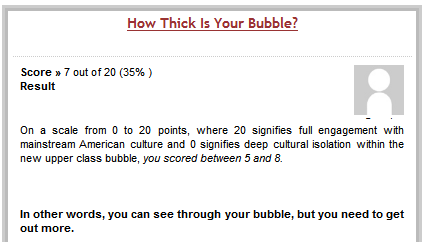
So I guess I am an effete Nancy-boy.
Well I blame society. And the appalling lack of field-trips to the local village offered at the Snottingham School. Yes and that plus the fact that the lighthouse tends to keep out the hoi polloi as well as the riff-raff.
Perhaps I should sponsor a festival of some sort where I can allow the locals to come over to the island and perform their native activities and such and then I could award various prizes. Yes that sounds absolutely perfect. Consider the Great Divide question now resolved. more...
Posted by: Maetenloch at
05:43 PM
| Comments (1113)
Post contains 1118 words, total size 9 kb.
— Ace Here are the nominations. I didn't see any of the Best Picture nominees, except for Thor.
Made you look. No the only one I saw was Moneyball. Which was good.
The rest of them are like the fake movies named on Seinfeld when Elaine keeps renting Vincent's art-house goon movies.
“The Artist”“Midnight in Paris”
“The Descendants”
“The Tree of Life”
“Hugo”
“Extremely Loud & Incredibly Close”
"Rochelle, Rochelle: A Young Girl's Erotic Journey From Milan to Minsk"
"Sack Lunch"
Okay, those last two are just from Seinfeld. Hard to tell, though.
Like, some of these nominations were shocking or something.
This site like parodies the movie posters or something. I don't know what half of these are about, so I don't get most of the jokes.
Posted by: Ace at
04:38 PM
| Comments (357)
Post contains 161 words, total size 1 kb.
40 queries taking 0.1737 seconds, 148 records returned.
Powered by Minx 1.1.6c-pink.

