


April 05, 2012
— Ace What if they threw a War on Women and no one came?
BrownÂ’s lead narrowed by a statistically insignificant one point, during a month in which the media-narrative was a moderate RepublicanÂ’s nightmare.... Elizabeth Warren, the prominent, feminist Harvard professor, seems particularly well positioned to seize this narrative and find a sympathetic audience in the Bay State.Yet Massachusetts voters who bought this claim were essentially those who already supported Warren or would eventually come around to her regardless. Even more troublingly for Warren and Democrats who see this war-on-women rhetoric as the path to victory, the mandate debate appears to have given more of a boost to Brown than to Warren.
More than half of those who have increased support for Brown in the past month say the health care, birth control mandate debate influenced their vote “a great deal” or “some” compared with only 39 percent of those who recently increased support for Elizabeth Warren.
Here's a strange contradiction:
Fifty percent of voters said they would be more likely to vote for a candidate who says: “It’s wrong for government to compel people to violate their religious beliefs” (compared with 30 percent who’d be less likely). Yet 49 percent of surveyed Massachusetts voters would be more likely to vote for someone who “would require religious organizations and employers, even those who have religious objections, to pay for health care plans which include providing abortion-inducing drugs, sterilization and contraception” (compared with 33 percent who would be less likely).
Here's my explanation: People strongly support their own freedom -- and no one else's. How else to read poll results showing a majority agreeing that "people" shouldn't be compelled to violate their religious principles, but organizations may be? All voters are people, and none are "organizations."
A pollster explained this phenomenon years ago. Anytime you put the proposition in front of voters that they ought to be able to make more choices (even choices that restrict other people's freedom!), they are strongly inclined to support that proposition.
Although Republicans "freedom" rhetoric is itself attractive to voters, we have to make sure that the public -- which apparently supports freedom in an utterly unprincipled, Only For Me sort of way -- understands that we mean to increase their personal freedom, and not some other person's (or company's).
Because Obama can make headway with the idea that be taking away some other people's freedoms, he can give a particular voter more options. And that voter, being unprincipled and selfish about this, just might go for that pitch.
Posted by: Ace at
08:44 AM
| Comments (275)
Post contains 454 words, total size 3 kb.
— Ace Yeah, you wouldn't want to have been sure before your first report.
He finally gets the point I made a couple weeks ago-- if you are expecting to hear a word, you'll hear it. So this time he doesn't say what word he expects the audience to hear.
It does sound like cold, though.
Then again, it's sounded like coons, punks, and even phones (suggested by Dan Riehl).
Maybe the broader point is that when a word is unintelligible, it's unintelligible. And you shouldn't try to frame a man for racial murder based on your guestimates about it.
Posted by: Ace at
07:57 AM
| Comments (292)
Post contains 132 words, total size 1 kb.
— DrewM Oh my.
Developers want to build a high speed rail line from Southern California to Las Vegas. Naturally, they want some sweet, sweet federal money for it. All the usual suspects, including Nevada's Senator Pat Geary, er, Harry Reid are on board. But those crazy WaPo right wingers say, not so fast.
The proposed line’s advertised public benefits are the same as those claimed for all high-speed rail projects: reduced carbon emissions, less air and auto traffic, and, of course, jobs, jobs, jobs. What makes this one unique is that it would be a non-stop route whose Western end, Victorville, would function as a gathering point for people from all across Southern California. They would park their cars and then board the train for Vegas. In theory, that’s no different from driving to an airport and leaving your car. And once you reached the train, it would take only 80 minutes to hit Vegas, as opposed to a minimum four-hour drive each way.In theory. But if this train is such a good idea, business-wise, how come private banks aren’t lining up to finance it? Previous high-speed rail projects around the world have been plagued by poor ridership, requiring government subsidies to continue operation. You might save travel time by taking the train instead of a car — as long as you’re content to depend on the train’s schedule.
...
As for jobs, any that the Vegas train creates will come at the expense of alternative uses of the money — upgrading the Northeast Corridor to accommodate higher-speed trains comes to mind — not to mention My Party Ride and other competing businesses, large and small. The new line might be a boon for Victorville, but the shift in traffic could hurt neighboring Barstow. If the casino moguls want a train, let them build it with their own money; taxpayers shouldn’t have to go along for the ride.
This is like a rightwing indictment of one of Obama's signature programs. And the logic extends to other areas such as "green energy".
Now they don't call for ending public financing for all high speed lines but as they admit, their rationale extends beyond this one project.
Vice President Choo-choo Train Biden will be very sad.
Posted by: DrewM at
07:16 AM
| Comments (186)
Post contains 408 words, total size 3 kb.
— Dave in Texas When the tornadoes and storms were ripping through the Dallas Ft. Worth area on Tuesday, someone on an American Airlines flight to Boston was stuck on the tarmac when the hail started coming down and pounding the aircraft.
I don't know how big the hail was, but the splashes get pretty interesting around 1:20. And the hammering sound speaks for itself.
It's amazing that so many tornadoes hit this densely populated area, that so few people were injured. I've heard about 2 F2s and at least one F3. Gabe attributed it to early warning, I kicked in that a local weather guy on the most popular AM station in the area was warning about this crap on Tuesday.
At any rate it could have been way worse. This morning the big story is lost pets from the tornadoes. Which is bad, but not as bad as it could have been.
Posted by: Dave in Texas at
04:56 AM
| Comments (195)
Post contains 195 words, total size 1 kb.
— Gabriel Malor Happy Thursday.
Actor Don Cheadle slammed NBC yesterday on Twitter for its deceptive Zimmerman coverage. Twitchy has the story.
If you haven't watched the RNC's video that Lauraw posted yesterday, go watch it now. Lauraw had some notable things to say about. For my part, I was struck by just how poor Obama's delivery of this speech was both times he gave it. Stop. Stutter. Restart. Stacking the speeches up like that should put to rest the liberal fantasy that Obama is a great orator. (Yes, I know it likely won't.)
Google has gone public with its augmented reality glasses. The project is not-so-cleverly named "Project Glass."
Zug zug, Mac-heads. The Flashback trojan has captured over half a million Macs and counting. If you use a Mac, you might want to check that checked out.
Posted by: Gabriel Malor at
02:56 AM
| Comments (261)
Post contains 143 words, total size 1 kb.
April 04, 2012
— Maetenloch
Note that due to a death in the family I will be away until next week.
The Falklands War: 30 Years Later
It was almost exactly 30 years ago today that Argentine forces invaded the Falklands Islands leading to the Falklands War. By June Britain had defeated the Argentinian Navy and Air Force and finally retook the islands. But it was a far closer run thing than many recognized at the time. And tensions are once again rising in the South Atlantic but both countries are much weaker than they were:
Both sides today field such smaller fleets of ships and aircraft that it's hard to imagine commanders risking them in a stand-up fight. The Royal Navy escaped by the skin of its teeth in the Falklands - "six better fuses and we'd have lost," as the quip held - and neither it nor the Argentines could absorb the same losses today.
And Philip Ewing draws some lessons from war that still apply:
The fight you plan for may not be the fight you get: The Royal Navy of the early 1980s was shaped with an eye to protecting transatlantic convoys in World War III against the Soviets, not expeditionary amphibious campaigns. Among other things, this meant its air defenses were not ideal - commanders had to pair frigates and destroyers in miniature pickets to compensate for the gaps in the other ships' sensors. That also meant Argentine pilots could fly in low and score hits on the British fleet in San Carlos Water, although, luckily for the British, several of their bombs did not explode.You've got to fight with what you have: The Royal Navy got rid of its last traditional aircraft carrier in 1978, leaving it only with the "Harrier carriers" HMS Hermes and HMS Invincible when the Falklands erupted. The Hermes was very old and the Invincible was originally designed for anti-submarine warfare - and neither could field the vital airborne early warning aircraft the navy once had. So commanders had to make do with repurposed ships flying a handful of repurposed aircraft to defend the task group with very limited domain awareness. It worked, but only just.
Your losses are going to be worse than you think: ...The war cost more than 100 Argentine aircraft, according to John Roberts' history of the Royal Navy, "Safeguarding the Nation," as well as its cruiser General Belgrano, a submarine and other vessels. And a single loss can have disproportionate consequences, as with the sinking of the cargo ship Atlantic Conveyor, which carried the helicopters British troops were counting on to carry them across the Falklands. Without them, they had to walk.
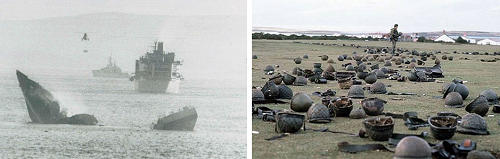
Also: Why Thatcher defended Gen. Pinochet when he was arrested in London in 1999. It turns out that she was repaying a debt for his vital assistance in 1982.
more...
Posted by: Maetenloch at
06:12 PM
| Comments (562)
Post contains 890 words, total size 9 kb.
— Ace Via Instapundit, apparently the New York Times didn't mean it when it apologized about the Duke Lacrosse Rape Hoax.
Before the Patrick Witt case, I had some experience writing about how the New York Times handles cases of sexual assault allegations against high-profile college athletes--the Duke lacrosse case. After all that damage had been done, and after more than a hundred articles had been published in the New York Times, two Times editors, including Bill Keller, issued some half-hearted apologies for how the paper had mishandled the case, and "mishandled" is a generous word for what the Times did.I had always worked under the assumption that when an institution apologizes, it also takes steps to ensure that it doesn't commit the same kinds of mistakes again. But the Times obviously has a different standard of apology than I do. And in the Patrick Witt case, the same sorts of mistakes were made in coverage -- a presumption of guilt when the allegation is sexual assault, and a decision to ignore critical procedural issue -- because they don't fit the preconceived storylines.
For those of you who aren't familiar with the details, a one-minute summary. Witt was a quarterback, and a very good one, at Yale. He was also a finalist for the Rhodes Scholarship. It turned out that his interview for the Rhodes coincided with the day of the Harvard-Yale game. After some thought, he decided to withdraw his Rhodes candidacy and play in the game, which, alas, Yale lost. But it was a kind of feel-good story of a high-profile college athlete putting his team's needs ahead of his own. And then for more than two months, the world forgot about Patrick Witt, as it should have, until the Times and a reporter, Richard Perez-Pena, swooped in with a nearly 2,000-word article splashed over the front page of the Times sports section detailing that the Rhodes fellowship had suspended Witt's candidacy, because it had learned that he had faced an allegation of sexual assault.
The story left everything else to insinuation, but any reader would have come away with the following conclusions: One, that Yale and Witt had conspired together to present a false explanation of why he had chosen to withdraw. Secondly, that Witt was something of a habitual criminal. And thirdly, that he likely had done it. Nearly one-tenth of the article was devoted to two extraneous and minor alcohol-related arrests of Witt, the inclusion of which in the piece seemed to have the sole purpose of smearing his character. This story received a good deal of public criticism, including from me. And in response, the Times sort of doubled down on the story--exactly what they did in the Duke lacrosse case. They did not reassign Perez-Pena, as they had not reassigned Duff Wilson, their lead reporter in the lacrosse case. But they did authorize the public editor, Arthur Brisbane, to do his own reporting. This is a very odd journalistic strategy: a public editor doing reporting that the paper's own reporter had chosen not to do.
You have to read the whole thing.
We still don't even know what the accusation consisted of, though Yale's definition of sexual assault is a bit broader than you low-functioning troglodytes might guess -- apparently at Yale it's a possible sexual assault if you cause someone "worry."
What the hell does "worry" mean? I'm guessing it means something like "a woman slept with you because she was worried if she didn't you'd be violent and/or rape her and/or do something or fail to do something harmful to her interests."
Could that possibly happen? Sure.
Can you lodge a complaint over a "worry"? Nope. At some point, when we're discussing criminal behavior, some actual criminal behavior has to exist.
Or am I just too retrograde?
But we don't even know what the allegation is, because the woman isn't talking. She didn't go to the cops; she wanted it handled informally.
But if you Google "Alex Witt Sexual Assault" you'll get 33,600 hits.
Posted by: Ace at
04:12 PM
| Comments (281)
Post contains 712 words, total size 4 kb.
— LauraW Volume II
(Volume I)
All you need in order to be an Obama speechwriter is to have completed ten minutes of actual work in 2009, and be proficient with a copy machine thereafter.
What a clown. Wouldn't you alert your speechwriters if you've delivered this speech already?
But it seems likely he doesn't remember having said all this before, because he's just reading aloud and never really internalized the meaning the first time.
Posted by: LauraW at
01:34 PM
| Comments (374)
Post contains 81 words, total size 1 kb.
— Ace I didn't know this.
Good article about how strained the relationship is between Obama and Harper (and Obama and Mexico, too).
And also, how the media hides the story here. They don't want to report another Obama failure. So they don't. They just pretend.
But Harper says Obama's Keystone decision will cost you cash money.
The Winnipeg Free Press reported that Canadian Prime Minister Stephen Harper warned Obama the U.S. will have to pay market prices for its Canadian oil after Obama's de facto veto of the Keystone XL pipeline. Canada is preparing to sell its oil to China.Until now, NAFTA had shielded the U.S. from having to pay global prices for Canadian oil. That's about to change.
I didn't know that. That's always a tough thing to say, because if you're writing and people are reading, you're supposed to know at least the very basics of stuff.
But I always thought the increased cost of Canadian oil would be an indirect thing -- with no ease for Canada of selling it to us, they don't give us a price break.
But it turns out that Keystone would have directly affected the cost of Canadian oil.
And Obama chose -- chose -- for the US to pay higher prices.
Via John Sexton, writing at Breitbart's BigPeace:
PM Harper: And the truth of the matter is that, when it comes to oil in particular, we do face a significant discount on the marketplace because of the fact that we're a captive supplier. We have made it clear to the people of Canada, one of our national priorities is to make sure that we have the infrastructure and the capacity to export our energy products outside of North America.
Canada was in a poor negotiating position with us on the price of their oil, as they were a captive supplier. And, it turns out, they were nice enough to be okay with this situation. They weren't looking to change it.
But Obama has announced that Canada cannot rely on us to simply take their oil at below market prices.
And now, he says (at the link) this is irrevocable.
In terms of the second part of your question, would approval of this change our mind, uh, the answer is no. Look, the very fact that a "no" could even be said underscores to our country that we must diversify our energy export markets. But as I say we have taken a significant price hit by virtue of the fact that we're a captive supplier and that just does not make sense in terms of the broader interest of the Canadian economy.
Sexton says Solyndra is no longer Obama's biggest energy blunder.
That boondoggle cost us a mere half a billion dollars. This is going to cost us a lot more, year after year after year.
Thanks to LauraW (@laurww on Twitter).
Thus Spake Biden: Our energy policy is the very best it's ever been.
No, really.
In related news, Fisker, which got government funding to build cars in Joe Biden's Delaware, might not (brace yourself) build cars in Joe Biden's Delaware at all.
Not unless it gets additional government money (or private, they allow-- but they do mention sweet, sweet government cash).
Fisker Automotive Inc. said it is delaying production of its next-generation family sedan and may not build the vehicle in Wilmington, Del.," Detroit News reports here. "CEO Tom LaSorda," ex boss of Chrysler, said "Fisker may move production outside the United States" if it doesn't raise enough additional government or private money to build here."
Thanks to @drewmtips and Kenneth.
Status Update: Real.
more...
Posted by: Ace at
12:55 PM
| Comments (286)
Post contains 650 words, total size 4 kb.
— Ace Well, Vulcan is a gang. In a way. If you think about it.
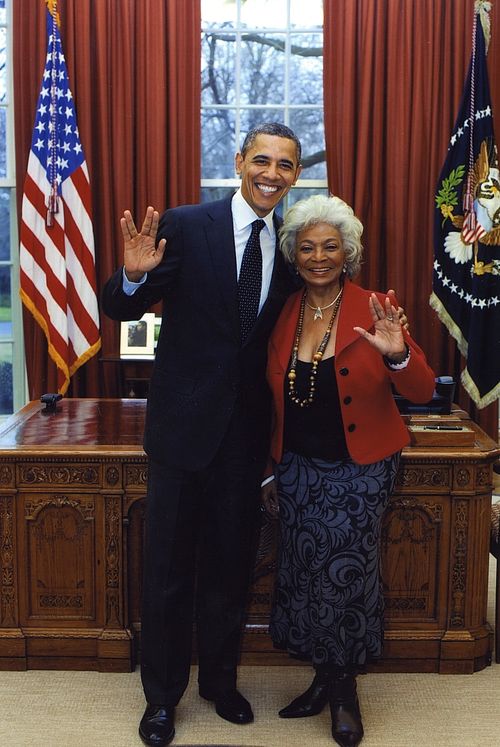
Barack, I knew Mr. Spock.
I worked with Mr. Spock.
Mr. President, you are no Mr. Spock.
That's the timeless Nichelle Nichols, of course, and by timeless, I mean 80.
I guess I gotta say that she looks pretty good for 80.
Via Komplicated.
Posted by: Ace at
12:19 PM
| Comments (217)
Post contains 71 words, total size 1 kb.
43 queries taking 0.3118 seconds, 151 records returned.
Powered by Minx 1.1.6c-pink.

