


January 23, 2013
— LauraW And not a single calorie will follow you home from the intertube. Pinky swear.
Sorry that Maet cannot host again this evening. I lost won the coin-toss, so it will be another poor quality substitute-host-post for you swine beloved sweetlings.
Sorry.
Speaking of substitutions, anybody remember this?
So sweet.
Posted by: LauraW at
05:34 PM
| Comments (755)
Post contains 236 words, total size 2 kb.
— Ace
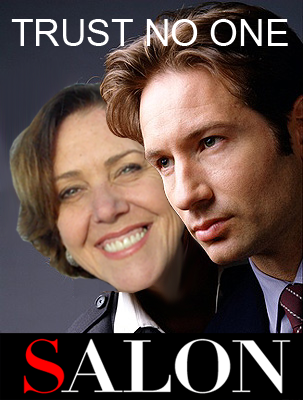
Photoshop of by @johnekdahl,
including Salon's "Editor at Large" Joan Walsh
2013 CorrectionsOn Jan. 22, Salon republished an article from one of our content partners, the Weeklings, that was sympathetic to unfounded 9/11 conspiracies. The article slipped through our usual review process, and was clearly not up to our standards; we removed it as soon as it was brought to our attention by readers. Salon has a long history of debunking fringe conspiracists — around Sept. 11, and more recently, Sandy Hook — and are proud of those efforts. We regret this oversight.
The support of 9/11 Trutherism wasn't a single sentence buried in the 17th paragraph of the piece. It was the entire precis of the article; indeed, it appeared right in the headline itself.
Give truthers a chance?Not all conspiracy theorists are as crazy as Alex Jones and the Sandy Hook Truthers would have you believe.
And then it's right there in a big fat paragraph that explains the headline:
What concerns me about the repudiation of the Hookers is that the 9/11 Truthers are being tarred with the same “crackpot” brush [as other conspiracy theorists]. Yes, many of the September Eleventh conspiracy theories are implausible, and too often veer, as conspiracy theories unfortunately tend to do, toward the anti-Semitic. But unlike with Sandy Hook, 9/11 conspiracy theories flow from a scientific fact: whatever the 9/11 Commission Report might claim, fire generated by burning jet fuel is not hot enough to melt steel. As with JFK’s “Magic Bullet,” the official version asks us to pretend that the laws of physics do not exist.
And then this:
Another criterion, when evaluating conspiracy theories, is the “Cicero test”; we must ask ourseves: Cui bono? It’s not enough to suggest that the official record is wrong; without a motive for the deceit, absent some obvious beneficiary, there can be no conspiracy. To wit: there are any number of reasons any number of people could have benefited from the removal of JFK from office. The attacks of 9/11, similarly, had countless ripple effects, sparking a massive re-investment in the U.S. military, two wars that cost trillions of dollars, and that legislated erosion of our privacy with the Orwellian name, the Patriot Act, to name but three. Many, many organizations, corporations, states, and individuals benefited, directly or indirectly, from the events of that day.
So the "Sandy Hook conspiracy" falls because there is no good answer to the "Cui bono?" "Cicero test" (as these Mensa Chapter Presidents term it), but the 9/11 Truth conspiracy does pass the test.
So, you know: 9/11 "Truth" is respectable and stuff.
And even in the conclusion:
So: the Sandy Hook conspiracy theory has neither basis in fact nor motive. It is, in a word, bunk. But that does not mean that all conspiracy theories are automatically wrong, or that we should believe whatever the government tells us without question. The JFK “truthers” were eventually vindicated, and the government lies all the time. Keep an open mind! Like the proverbial broken clock, even Alex Jones is right sometimes.
This is not some stray remark. Again, this is the whole point of the article, as telegraphed in the headline.
Now Salon says:
The article slipped through our usual review process, and was clearly not up to our standards; we removed it as soon as it was brought to our attention by readers.
Does their "usual review process" include reading even the headlines?
So you didn't "review" the headline, and you also didn't bother to check the conclusion, either?
It was only "brought to their attention by readers"? A category -- "readers" -- which appears not to include a single staffer or editor at Salon?
Would it be more honest for Salon to just confess they don't have a "review process"?
If you can't even be bothered to skim the headlines of the pieces you publish, you don't have a "review process."
Posted by: Ace at
02:39 PM
| Comments (238)
Post contains 655 words, total size 5 kb.
*If They Want To
— Ace I don't know -- seems to be a curious sort of "equality." You're equal only if you volunteer to be.
There are a lot of issues here, and women's rights are just one of them. Another issue is whether humankind's inborn squeamishness about women suffering disfiguring or lethal trauma will cause problems in warfighting or decisionmaking about warfighting.
Of course we're squeamish about men suffering such horrific wounds, too. But one question that's always been open is "Would America be willing to fight any war if women started coming back scarred and maimed?"
Lot of big changes going on, including an end to the special exemption for some units if they said morale or readiness would suffer if they included openly-gay troops.
But at least we know the very best people are managing our military, people to whom the military and its history and its excellence have always been dear, people who themselves have a wealth of military experience themselves.
Socrates* talked up the Reign of the Philsopher Kings three** thousand years ago. Thank goodnesss that exalted age has finally arrived.
* Or Aristotle.
** Or four. Look, I don't know. What do you want from me? Three thousand, four thousand. If you care so much about Socrates, why don't you marry him already?
If you care so darned much, look it up.
That's how you learn things, looking it up. I'm really helping you to learn by not confirming these things myself. Oh, I could do what other people do, and spoonfeed you ever single verified fact.
But I run an Interactive blog. It's my job to make you think -- and also, to make you look up things yourself. I pepper my posts, quite deliberately, with what I call "little mysteries for my readers to solve."
Little mysteries like: Was it Aristotle or Socrates who said that, and further, who cares?
Or: How do you actually spell Sharyl Attkisson? I kind of give you a Multiple Choice test every time the name comes up, giving you four or five versions of the spelling, permitting you, the Engaged Reader, to select the spelling that makes the most sense to you.
Other bloggers don't have that level of respect for their readers. I alone do.
Like Michele Obama said, the age of you just being content to accept things is over. Michele Obama -- and I -- are hear to make you work.
Brave new world, baby. Brave new world.
Posted by: Ace at
01:58 PM
| Comments (416)
Post contains 432 words, total size 3 kb.
— andy Really, Chicago Tribune? Really?
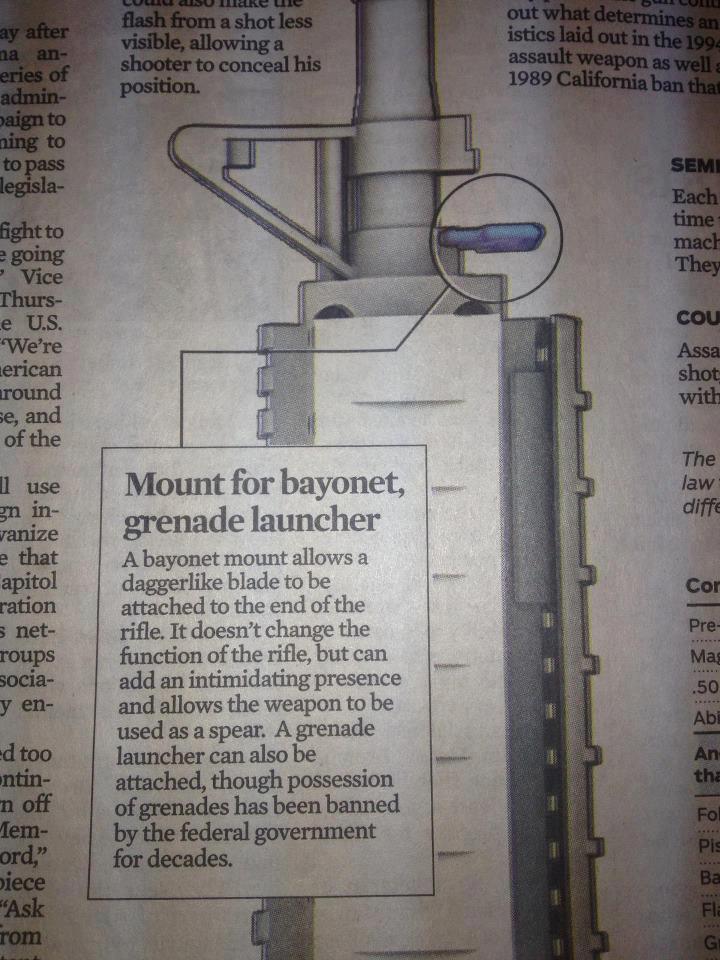
Now, everybody knows that's not a "Mount for bayonet, grenade launcher". I know what you're thinking, but it's not a sling swivel either ...
I'm sure you morons and moronettes will put me some more knowledge about what that sinister protrusion might be in the comments.
Posted by: andy at
01:16 PM
| Comments (372)
Post contains 63 words, total size 1 kb.
— Ace One thing I liked in Dredd (among numerous things) was the tire-repair-style gel he used to plug his wound (followed by a quick stapling of it via a medical-staple gun).
Not a super novel idea. But neat.
It's so un-novel, in fact, it's real, or close to it.
You can tourniquet an arm or leg but you can't tourniquet a headwound, or neckwound, or chestwound, or gutwound. Only a surgeon can dig in, find the ruptured artery, and clamp it.
Thus, an injectable foam might soon stop bleeding from such injuries (long enough to get the wounded man to a surgeon, at least).
To address this issue, Arsenal Medical in Watertown, Massachusetts, has designed a substance that fills the abdominal cavity and forms a solid foam that can slow internal bleeding. It starts with two liquids. “Mixing those two liquid components causes a chemical reaction that drives the material throughout the abdominal cavity,” says Upma Sharma, head of the foam-technology research at Arsenal. The idea is that the foam would put enough pressure on the site of the injury to slow bleeding for up to three hours so that the soldier could be transported to a hospital. There, a surgeon would remove the block of foam and tend to the soldier’s wounds."
Based on my reading, that's only for gut-wounds, but I guess they'll move on to the other sorts of wounds eventually.
Via Instapundit.
More: Unvetted, but tsrblke sounds like he knows what he's talking about.
It works for gut wounds, because those are the bulk of wounds involving internal bleeding with lots of open space and are really dangerous.The other two areas you see a lot of internal bleeding that's dangerous are brain (not a lot of workable space) and Lungs (lots of workable space...that's used for breathing.
You do get internal bleeding in other places (arms, legs, etc.) that's bruising, it's sometimes dangerous, sometimes not, but as pointed out you can always sacrifice the leg/arm/whatever, to save the body (not so much with "everything below the waist."
For external bleeding (i.e. cuts, slashes gashes) you have the tourniquet option for really large damage or various styles of things like high-tech band-aids and medical glue for small to medium sized things.
Unnecessary?
What if you don't have time to bleed?
-- Jesse Ventura
Posted by: Ace at
12:49 PM
| Comments (147)
Post contains 400 words, total size 3 kb.
— Ace They took the post down -- but Twitchy has some screencaps and this "money graf:"
What concerns me about the repudiation of the [Sandy Hook conspiracy theorists] is that the 9/11 Truthers are being tarred with the same “crackpot” brush. Yes, many of the September Eleventh conspiracy theories are implausible, and too often veer, as conspiracy theories unfortunately tend to do, toward the anti-Semitic. But unlike with Sandy Hook, 9/11 conspiracy theories flow from a scientific fact: whatever the 9/11 Commission Report might claim, fire generated by burning jet fuel is not hot enough to melt steel. As with JFK’s “Magic Bullet,” the official version asks us to pretend that the laws of physics do not exist. This opens the door for alternative versions, however ridiculous, that must at least be considered...
Ahem.
Look, I don't mean to sound like a smarty-pants here, but here's a scientific fact this ignoramuses want to check out:
Many solids change suddenly into liquids as they hit their melting point. Water ice, for example.
But water ice is just one kind of solid. There is an entire class of elements -- we call these "metals" (and no I'm not trying to be silly-- they're really called "metals") which change from solid to liquid gradually and gracefully, rather than abruptly.
There is a sharp distinction between water ice and water liquid -- the things have entirely different properties. But metals transition slowly as heat as applied. Metals do not suddenly go from a perfect crystalline solid to a perfect amorphous liquid as water does.
Rather, at high temperatures well short of their actual melting point, they slowly begin losing some properties of a solid and start gaining some properties of a liquid.
For example: You can't bend ice. Ice does not bend. Ice breaks.
But you can bend metal. Metal is deformable, without actually breaking.
And as metal gets hotter, it becomes more and more deformable. It begins losing its rigid, fully-solid aspect and gains a more... well, let me put this in terms Salon can understand: Metal becomes bi-statal, or liquid-curious.
This is because metal atoms are not held together in a rigid crystal structure, in which one atom forms a bond with the next, as in water ice, but rather some kind of (and I admit my memory fails me) loose system in which electrons are shared like a river and one atom can float gracefully past the next, if external force or heat is applied.
I don't know why I have to explain this. It's been explained six thousand times before. The "melting point" of steel -- whatever it is, say 4000 C -- is the point at which steel becomes a pool of red-hot liquid.
But for "metals," that "melting point" is a sliding scale -- at 800 C, it becomes more pliant, and begins to sag and lose integrity, at 1200 it actually starts drooping if there is weight on it, at 1600 it might start drooping and buckling under its own weight, etc.
There are a lot of people who suddenly think they're Chemical Engineers but never got round to the part of the chemistry textbook -- and it's like chapter 4, not chapter 40 -- that explains that metals have all sorts of special properties, including, inter alia, conductivity, deformability, and, especial, gradual transition between solid and liquid forms.
You don't even have to work with metal to understand this: a perfectly common substance, called glass, has this same "liquid crystal" property, and will also buckle, warp, bend, droop, and deform when heat is applied, long before it actually pools into a liquid.
But carry on, Salon. You're... You're what you are. You're what you always have been: Dumb and arrogantly so.
I look forward to all the media coverage which will surely flow from this recent discovery, that whole swathes of the Dumb Left are prone to paranoid and ignorant conspiracy theories, and are also Anti-Science.
Any moment now. I can hear the water churning behind the floodgates.
Rebuttal:
Have you ever worked in the metallurgy profession, Ace? That's what I thought.-- Terry Moran
Cleaning Up: I kept using the term "deformable" because, try as I might, I could not recall the correct terms.
The correct terms are "malleability" (capability to bend or deform to external force, rather than breaking and shattering) and "plasticity" (capability of slowly, gradually transitioning between solid and liquid). Metals have both; plastics and glass, for example, have only the latter. Glass and plastics are plastic, but not very malleable.
I think that's the proper chemical terminology, anyway.
Not to blow Salon's mind too much, but this property of "plasticity" is so common in the world that we actually named long-chain carbon molecules with highly plastic properties "plastic."
More Wit:
The Periodic Table is a living breathing document with emanations and penumbras-- Jones in CO
Posted by: Ace at
11:58 AM
| Comments (521)
Post contains 854 words, total size 6 kb.
— Ace If you're bored about my communist view of politics (in the below post), you can watch the hearings on CSPAN3 (live stream here), and comment below.
Posted by: Ace at
10:06 AM
| Comments (260)
Post contains 38 words, total size 1 kb.
— CAC After seeing dozens of youtube ads for a short Sundance film called The Apocalypse, I have to admit my curiosity got the better of me. NSFW probably from the gore, and don't think too much about it afterwards, but a nice break from the more depressing state of affairs. more...
Posted by: CAC at
10:21 AM
| Comments (168)
Post contains 61 words, total size 1 kb.
— Ace As I've noted, I'm so taken with class-analysis as a method of understanding why people think the way they do I'm almost a communist myself -- a strange sort of communist, I guess, but there you go.
The Marxists had a special hatred of the petite bourgeosie, which I think was the lower middle and middle-middle class-- not the upper middle class, the doctors and wealthy businessmen and such.
And they hated this group, the petite bourgeiosie, for being strong defenders of the capitalist system, and a very tough sell for communism.
The reason, the Marxists speculated, the petite bourgeiosie was so anti-revolutionary was that they were only newcomers to the middle class, and were anxious members of that class, meaning that they could, possibly, lose their status of "Middle Class" at any moment due to some bad luck -- a firing, a scandal, the death of the breadwinner of the family.
And thus being "bitter clingers" (as it were) in that class, they were especially proud to have the status of the class, and were especially skeptical of any system that would take that status from them. That is, being a bit anxious about their class differentiation from the lower classes, they were especially hostile to any agenda which would result in their being mixed with and undifferentiated from the lower classes.
I don't think I have to buy into all of that to recognize that there is some truth in that -- people who are least secure in their position in a group will tend to be the most aggressive about defending the outer contours separating that group from others. And people who are only recently enjoying the privileges of a thing will be the most reluctant to see those privileges go away -- people who have enjoyed them for a long time become jaded and stop appreciating their good fortune. (Thus, many, many wealthy layabout aristocrats become enamored with communism.)
Reporters wish to be part of the New Aristocracy, but their incomes aren't high enough to put them comfortably in that group (some reporters make a lot, but most make so-so money) and certainly their education and accomplishments aren't enough to put them in the same class as undeniable members of the New Aristocracy, like, say Steven Spielberg.
Thus they (and other bitter clingers to the lowest rungs of this would-be New Aristocracy) are the most aggressive about enforcing the Barriers to Entry into the group -- they consider themselves part of the New Aristocracy, but only barely, and because they are only barely part of the New Aristocracy, they fight especially hard to keep the riff-raff out, and are the most obnoxious about flashing the Tribal Signifiers that identify them as part of the New Aristocracy.
Actually there is one group that is even more aggressive about such things-- people who really aren't in the New Aristocracy at all, having neither the income, the fame, nor accomplishments to actually be in that group, but who aspire to be part of it.
This is where you find most of your liberals, actually. They're aping the attitudes and beliefs of the group they aspire to be part of as a way of gaining a sort of backdoor entry into it-- maybe a wannabe-writer who's never actually written anything isn't really part of the New Aristocracy, but he sure wants to be, and thus he winds up imitating the New Aristocracy in every way he can. Making lots of money and becoming famous is hard to do, but saying things like "Rand Paul has no qualifications to speak on foreign policy" is a much easier way to show that he belongs in that company.
I think about this a lot because of all the anger on the left-- they don't seem to be just talking about politics. So what are they talking about? Why is it so emotionally charged with them all the time?
If it's emotional, it must be personal, and if it's personal, one next wonders what makes it so personal. And what makes it personal is that liberalism is not, for many, about politics, but about identifying themselves -- and their egos -- with Better People whose august company they aspire to join.
And when you contradict their liberal beliefs, then, you're not just having a dispute about politics; you're contradicting the very thing that gives them self-worth, their tenuous connection, somehow, to celebrities and famous professors. They're not celebrities and famous professors themselves, of course, but by aping the attitudes and mores of such persons, they are identifying themselves as being essentially the same as such persons, and they derive a great deal of comfort for their egos from that connection.
So when you denigrate liberalism, you're knocking the very thing that Elevates them into the Upper Classes. (In their minds, subconsciously.)
And thus: It is indeed personal.
Posted by: Ace at
09:45 AM
| Comments (357)
Post contains 820 words, total size 5 kb.
— Ace The Watchdogs of the Press. The Fourth Estate, keeping a vigilant watch on Government Power.
Or, for the past four years: Defending Government Power like it's their dad and attacking anyone who says something bad about their dad.
Either/or.
So Rand Paul had a strong statement to Hillary, not a question, really, but at least he told her she was incompetent. (Video below the fold.)
Which immediately prompted this dismissive sneer from Obama's Palace Guard:
Curious: What is Rand PaulÂ’s foreign policy background? Did he serve in the military? Did he study, live, do business or charity overseas?
— Terry Moran (@TerryMoran) January 23, 2013
What's Terry Moran's credentials to opine on foreign policy? Or anything? Those who play the credentials card ought to have some credentials themselves, no?
I can only repeat myself so many times: Reporters treat the business of reporting, and their laughable J-school degree, as conferring a general expertise on everything. The very fact they are reporters is what gives the expertise on all subject matters that might drift into their purview.
But we have thousands of English majors reporting on Business, and prognosticating on economic matters; and thousands of Art majors reporting on science and "global warming."
And getting it mostly wrong.
Instapundit is fond of citing the Gell-Mann Amnesia Effect, as explained by Michael Crichton:
“Briefly stated, the Gell-Mann Amnesia effect is as follows. You open the newspaper to an article on some subject you know well. In Murray's case, physics. In mine, show business. You read the article and see the journalist has absolutely no understanding of either the facts or the issues. Often, the article is so wrong it actually presents the story backward—reversing cause and effect. I call these the "wet streets cause rain" stories. Paper's full of them.In any case, you read with exasperation or amusement the multiple errors in a story, and then turn the page to national or international affairs, and read as if the rest of the newspaper was somehow more accurate about Palestine than the baloney you just read. You turn the page, and forget what you know.”
Reporters suffer from the Gell-Mann Amnesia Effect most of all -- the moment they start typing up words that someone else (an expert in the field) said, mangling those words, misstating major principles announced in those words, they quickly forget they were B+ students in Recreational Pottery: Practical Application and Theory and begin behaving as if they're experts simply because they've occasionally spoken to (and completely misunderstood) experts.
I speak of the attempt to create a New Aristocracy a lot. Obviously this maneuver -- questioning of credentials -- is functionally equivalent to noting that someone is of a Lower Class without proper Education or a Vocation which involves Mind Work (rather than dirty, dumb Hand Work) and hence is not qualified to even have an opinion on Lady Briggs-Stanton's impending nuptials to the thrice-divorced Duke of Beaufort.
Posted by: Ace at
09:26 AM
| Comments (154)
Post contains 514 words, total size 4 kb.
40 queries taking 0.1671 seconds, 148 records returned.
Powered by Minx 1.1.6c-pink.

