


June 08, 2004
— Ace *tuk tuk tuk tuk*:
Fewer executives expected economic conditions 12 months in the futures to be better than now, at 59 percent compared with 69.6 percent in the first quarter.
But bear in mind, that's because current economic conditions are sizzling.
For that reason, the overall CEO Confidence Index fell to 111.9 in the second quarter this from 113.9 in the first, although it is up from 100 in the second quarter a year ago.
More than 80 percent expected revenues to increase over the next 12 months and more than 70 percent expected profits to improve -- roughly the same as in the first quarter.
As a result, 59.7 percent expected to hire workers steadily over the course of this year and almost half said higher wages would be the main method of retaining or luring employees.
"Firms planned in the second quarter to hire more employees, increase wages and spend more on investments in new productive capacity," said Richard Curtin, a consultant to TEC International on the survey and head of the University of Michigan's consumer surveys.
As for the Fed beginning to raise its official rate from a 46-year low of 1 percent now to 2 percent by the end of the year, 49.2 percent said there would be no impact on their business, while 41.1 percent said it would have a mild negative impact.
Confidence is a big part of this deal; we need it to sustain and extend the recovery. We also need it to get George W. Bush elected. It's all fine and dandy that he's creating jobs like gangbusters, but if the public doesn't "get" this fact, then it does him no good at the polls.
Furthermore:
Thirty-four percent (34%) of Americans now rate the economy as good or excellent. That's up from 31% before Friday's employment report. Since Friday, the number saying that the economy is in poor shape has fallen from 32% to 28%.
That's not much movement, but it is movement in the right direction.
Modest cowbell:

Posted by: Ace at
09:57 AM
| Comments (1)
Post contains 385 words, total size 2 kb.
— Ace An obesity researcher says that conventional wisdom about overweight is wrong, which is always a great way to start a conversation about anything. Conventional wisdom is usually jackass wisdom. Give me contrarian wisdom.
He makes two points:
First, ignore all the liberal obesity nannies, who, like any other sort of liberal, make statements in order to 1) create panic 2) get government funding 3) exert undeserved influence over other peoples' lives and 4) demonstrate that they are better than you. (Anyone who presumes to be a critic on any issue also presumes to be superior to the thing being critiqued.)
Okay, he didn't say that. But he did say we are not in the midst of an "obesity epidemic":
The obesity arena "is so political, so rife with misinformation and disinformation," he said.
Dr. Friedman points to careful statistical analyses of the changes in Americans' body weights from 1991 to today by Dr. Katherine Flegal of the National Center for Health Statistics. At the lower end of the weight distribution, nothing has changed, not even by a few pounds. As you move up the scale, a few additional pounds start to show up, but even at midrange, people today are just 6 or 7 pounds heavier than they were in 1991. Only with the massively obese, the very top of the distribution, is there a substantial increase in weight, about 25 to 30 pounds, Dr. Flegal reported.
As a result, the curve of body weight has been pulled slightly to the right, with more people shifting up a few pounds to cross the line that experts use to divide normal from obese. In 1991, 23 percent of Americans fell into the obese category; now 31 percent do, a more than 30 percent increase. But the average weight of the population has increased by just 7 to 10 pounds since 1991.
Dr. Friedman gave an analogy: "Imagine the average I.Q. was 100 and that 5 percent of the population had an I.Q. of 140 or greater and were considered to be geniuses. Now let's say that education improves and the average I.Q. increases to 107 and 10 percent of the population has an I.Q. of above 140.
"You could present the data in two ways," he said. "You could say that the average I.Q. is up seven points or you could say that because of improved education the number of geniuses has doubled."
He added, "The whole obesity debate is equivalent to drawing conclusions about national education programs by saying that the number of geniuses has doubled."
The bad news for O-Flub is that he thinks that weight is as strictly genetically-coded as height, and that we can no more impact our bodily weight to a significant extent than we can gain three inches.
Posted by: Ace at
09:49 AM
| Comments (4)
Post contains 475 words, total size 3 kb.
— Ace
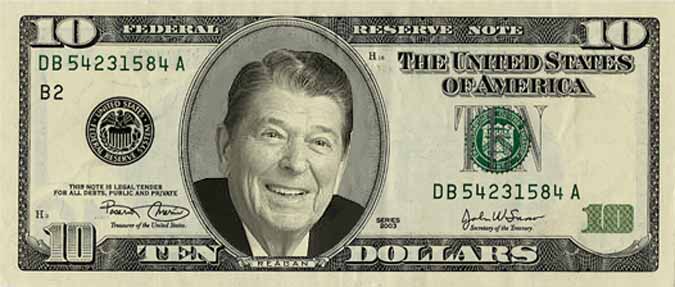
click bill for story
And Rich Lowry makes some obvious points that nevertheless deserve restatement.
Also worth reading: "How Debates Get Settled." The bullet point: They get settled by succeeding so well that the other side gives up arguing about it.
Reagan settled at least one debate. He half-settled a couple others, which George W. Bush is hoping to put to rest himself.
Posted by: Ace at
09:33 AM
| Comments (6)
Post contains 81 words, total size 1 kb.
June 07, 2004
— Ace At least he's back for the moment.
Posted by: Ace at
01:09 PM
| Add Comment
Post contains 30 words, total size 1 kb.
— Ace Sorry to have blogged nothing today, but I've been busy, and also, there's hardly any news to comment upon except for Reagan's death and legacy (and of coruse leftist screeching about said legacy).
I'm a big fan of Reagan's, but I'm afraid I don't have much to offer in the way of additional praise. I can't really improve on the hundreds of Reagan eulogies in print today.
Plus, my general mode is attacking, not praising.
But here's something worth attacking: Christopher Hitchens.
Hitchens is of course a strong and articulate defender of the war on terror. But he is also a committed leftist-- less committed, perhaps, than he once was, but still and all, a man of the left.
I'm always amused to see the connection between political passion -- talk of ideals and principles and doctrines and other heady stuff -- and personal vindication in an argument -- which is an extraodinarily trivial concern.
I don't think that those on the left want Iraq to descend into chaos and civil war so much as they just don't want to ever have to admit they were wrong, and thus the strident continuing opposition to a war that was won a year ago.
Christopher Hitchens likewise doesn't ever want to admit he was wrong about Reagan, despite now vigorously embracing a neo-Reaganite American foreign policy waged by Reagan's ideological heir. (The Corner pointed this out, but I think it's sort of obvious.)
Hitchens isn't arguing about principle, because he's passionately defending two utterly-contradictory principles. He's anti-Reaganite foreign policy as practiced by Reagan; he's pro-Reaganite foreign policy as practiced by Bush. His real interest here is not vindicating an abstract principle, but in achieving the very concrete, but very childish, goal of claiming that he's been right all along.
And so it goes.
His piece is the typical sort of idiocy I've come to expect from Hitchens when he reverts to his Angry Young Leftist routine. We see this time and time again when, in between arguing for a vigorous prosecution of the war on terror, he asserts that Palestinians have the right to terrorize Israelis and Israelis really ought to just appease them.
But this proud man of the left would never admit a contradiction there. Let's just hit him where it really hurts-- in his intellectual vanity.
Ronald Reagan said that intercontinental ballistic missiles (not that there are any non-ballistic missiles—a corruption of language that isn't his fault)
-- Chris Hitchens, writing in the amateur webzine Slate
Ahem. Actually, Chris, there are lots of non-ballistic missiles. "Ballistic" refers to a missile entering a ballistic phase when it is no longer being actively propelled by burning fuel, but is instead simply following a trajectory established by the previous burning of fuel.
It's a missile, in other words, that has both an active-propulsion and passive-trajectory phase.
Most missiles, like the types fired from aircraft at other aircraft, never go into a passive-trajectory phase, and hence aren't "ballistic" during any point of their effective duration. (Unless, of course, you want to quibble that a missile which misses its target will eventually run out of propellent and then fall to earth in a ballistic path determined by its previous trajectory; but in that case, its ceased being a weapon, and is now simply detritus falling to the earth.)
Note to Chris: You don't know everything there is to know about military hardware just because you can look up the word "ballistic" in the Oxford English Dictionary. Sometimes words have more specific meanings in certain contexts -- sometimes we call this a jargon definition -- than the dictionary will share with you.
That's a petty quibble indeed. But it is actually more elevated that Hitchens' own pettiness.
Update: Hitchens' indictment of Reagan made my eyes glaze over with the repetitive, idiotic litany of evil the left always recites in nearly the same way every time the name Reagan comes up. Thankfully, I didn't see a "Ronnie Ray-gun" reference.
He did conclude his feast of bile with this tasty bon-bon:
Sen. John Kerry waited until the first week of June 2004 to tell us that he met Ahmad Chalabi in London in 1998 and that he didn't care for him then. That makes six intervening years in which the senator could have alerted us to this lurking danger to national security. But something kept him quiet. One must hope that that something wasn't the tendency to pile on. Cheer up, though. At least this shows that Kerry has no pre-emptive capacity.
Posted by: Ace at
12:36 PM
| Comments (13)
Post contains 761 words, total size 5 kb.
— Ace BlatherReview has the link, extensive quotes, and rebuttal. This is just a tease:
RICHMOND, Virginia (AP) -- The Rev. Todd Pyle thought it was the perfect spot to baptize 12 new members of his church. The river was calm and shallow, and there was a shaded area offshore for people to stand.
...
But officials at the Falmouth Waterfront Park, a public park just outside Fredericksburg, weren't pleased. They tried to break up the ceremony, claiming it might be offensive to nearby swimmers or other people using the park. Pyle was able to finish the baptism, but then he was asked to leave.
...
The incident has outraged free-speech advocates.
"These people are being discriminated against because of the content of their speech," said the Rev. Patrick Mahoney, who heads the Christian Defense Coalition. "It's one of the most egregious violations of the First Amendment I have ever seen."
Mahoney's group has threatened to file a lawsuit if the park refuses to allow future gatherings by religious groups, something for which the park admits it has no written policy.
...
"We don't want to tread on anybody's First Amendment or constitutional rights," said Brian Robinson, director of the Fredericksburg-Stafford Park Authority. "What we try to discourage is anything not formally permitted that just sort of occurs spontaneously."
Indeed. I'm sure if an anti-war protest just "occurred spontaneously," you'd be just as quick to deny them their free speech rights on the rather nebulous standard of "offending others."
Posted by: Ace at
01:10 AM
| Comments (11)
Post contains 273 words, total size 2 kb.
June 06, 2004
— Ace Madfish Willie was nice enough to tip me as to how to display the most recent comments, so that you can see what people are writing about.
The code doesn't quite work yet. The "entry" link links only to the main page, not to the post in which the comment was entered. I hope to fix that. For now, you'll just have to use a bit of deduction to figure out where a comment was entered.
Posted by: Ace at
12:54 PM
| Comments (7)
Post contains 84 words, total size 1 kb.
— Ace On the day a former President dies, the Washington Post strains to find the picture they feel best captures the man.
Their choice?
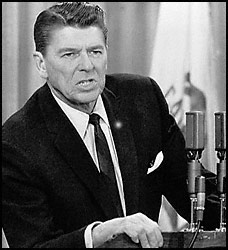
Yeah. Okay. A man handsome enough to have once been a movie actor. And the picture chosen for the frontpage of the WashPost website shows him apparently in a quaking rage and about to bite the head off a kitten.
The man spent 90% of his life smiling. But I guess the Washington Post's web-editor thought that a smiling Reagan would be just a little too pat. Better to show him as he really was, full of racist venom.
I never realized his teeth were somewhat bad. I'm sure it's just a coincidence that the Washington Post makes this fact clear on the day of his death.
Thank you, Washington Post.
Update: Apparently re-loading the page brings up five or six different Reagan photos. There's some sort of cycling of the photos; loading the page at one time brings up a photo with him and Gorbachev, another time with him and Nancy, etc.
The other photos are not objectionable.
Fine. So this is not the only photo running on the front page. It was, however, the photo that loaded for me.
What the hell is the extraodinarily-unflattering photo doing in the cycle?
Update: Some readers object to my objection, stating that the photo shows his "resolve." I disagree; I think it makes him look angry and feral.
Context matters. If this photo were from when he was informed of the Pan Am 103 bombing, one could understand the anger.
But it wasn't taken after such an anger-provoking event. The caption was something like, "Reagan prepares for a radio address in 1988." That was it. No reason for anger.
I can't quote the caption verbatim, because the photo has now been taken out of the cycle. I reloaded fifty times and didn't see it. The fact that it has now been removed from the cycle would seem to be evidence that someone at the Post realized how inappropriate and partisan it was.
Posted by: Ace at
12:03 AM
| Comments (8)
Post contains 352 words, total size 2 kb.
June 05, 2004
— Ace

R.I.P., Dutch.
For my part, all I can say is that I didn't appreciate Reagan when he was President, as I was young, irresponsible, and stupid. In other words, I was a liberal, or at least I thought I was.
But I still remember clearly my Reagan moment, the moment I realized that maybe this guy wasn't so stupid, evil, or crazy as often claimed. A lot of people had had their Reagan moment in November 1980-- that's how he got elected, after all. Mine took a while.
Right after the Libyans had blown up flight 103 (or whatever outrage they'd perpetrated), Reagan, of course, went on TV to announce that we were bombing Tripoli.
I remember listening to a radio station that night, the one I favored at the time, which was a college alternative/punk station. And I thought those DJ's were pretty cool. They played the Flying Lizards and Camper Van Beethoven and, once in a while, just to mix it up, even the Sweet's Barroom Blitz.
Anyway, they were all droning on and on as if it were a funeral for a king, how horrible it was that America was retaliating, how terrible it was that we had a warmonger idiot for President.
And I remember having a frenzy of cognitive dissonance. I wanted to agree with them, I wanted to believe the received wisdom of the hate-America left, I wanted to parrot the sophisticated blather of the intellectual swells. Or even the swells who ran dinky radio stations.
So even as I strained to get as outraged about the attack on Tripoli as they did (and of course I don't even need to mention they weren't outraged at all about the bombing of flight 103; they didn't even mention it between songs), I couldn't help noticing that the things they were saying, while undoubtedly true, were also undoubtedly the worst bullshit I ever heard in my young life.
They blew up an airplane, killing hundreds of Americans-- and the crime here was that we were bombing the bombers?
This is all so very terrible, said the good-boy liberal part of my brain.
Are you out of your fucking mind?! asked a different part of my brain, this part less socially-acceptable but also a great deal more sensible and vital.
Within a couple of hours of going back and forth, I decided the first part of my brain was a fucking hippie fruitcake, and really ought not be consulted on solemn matters of foreign policy.
I think that was the first psychic shock that disturbed me out of my complacent, sheep-like belief in liberalism. There would be more to follow (Michael Dukakis pretty much sealed the deal), but it was Reagan's defiant resolve against terrorism in 1986 that set me on the path to questioning the received wisdom of the left and then finally rejecting it.
Thanks for understanding what so many of your intellectual "superiors" couldn't or wouldn't-- that when bad men attack America, good men attack back. The enemy in war isn't "violence," as the left claims. The enemy in war is the fucking enemy. Period.
Thanks for that airstrike, Dutch.
I Read the NYT Obituary So That You Don't Have To: This is a Kausfiles schtick, but a good one. Here's a part I liked, regarding Reagan's job as a baseball radio announcer:
His commentary became an exercise of imagination; he never saw any of the games he described so vividly. Instead, he recreated them from telegraphic reports from Chicago. In his 1965 autobiography, Mr. Reagan described what happened the day the wire went dead: "I had a ball on the way to the plate and there was no way to call it back. At the same time, I was convinced that a ball game tied up in the ninth inning was no time to tell my audience we had lost contact with the game." He proceeded to give meticulous descriptions of what may be the longest series of foul balls in baseball history, even describing in detail the redheaded boy who scrambled for a souvenir ball. It was a story he loved to tell.
The rest of the obit is typical liberal crap. They use a very unflattering quote from liberal historian (of course) Lou Cannon to describe his famous, political-star-making speech on behalf of Goldwater:
On Oct. 27, 1964, a washed-up 53-year-old movie actor named Ronald Reagan made a speech on national television on behalf of a Republican presidential candidate who had no chance to be elected. . . . Most of Reagan's address was standard, antigovernment boilerplate larded with emotional denunciations of Communism and a celebration of individual freedom. His statistics were sweeping and in some cases dubious. His best lines were cribbed from Franklin Roosevelt, and he quoted from nearly everybody else as well."
Yes, yes. It was the speech that made him Governor of California two years later, and President of the United States sixteen years later. Obviously, it was pap.
No lines from this historic speech are quoted, of course.
And his years in office? Why, even in an obituary, the liberal take on Reagan is the only take offered:
Washington had not seen a president like Ronald Reagan for a long time. He showed no lust for power. He seemed to have no need to prove that he could work harder, or longer, on less sleep than anybody. Where his predecessor was criticized for involving himself in every detail, Mr. Reagan was a 9-to-5 president, a chairman of the board.
He delegated authority to his staff. Associates said he left details to subordinates and tended to rely on 3-by-5 index cards that they gave him for information he needed at meetings. He paced himself, got a good night's sleep and took afternoon naps when he could.
Ah. A dunce and a slacker who liked to take naps and knock off early.
Don't bother reading this crap.
Oh wait, you weren't going to bother anyway.
Posted by: Ace at
12:56 PM
| Comments (36)
Post contains 1070 words, total size 6 kb.
June 04, 2004
— Ace
Just because.
Posted by: Ace at
10:18 PM
| Comments (10)
Post contains 8 words, total size 1 kb.
41 queries taking 0.2003 seconds, 148 records returned.
Powered by Minx 1.1.6c-pink.

