


August 01, 2012
— Ace
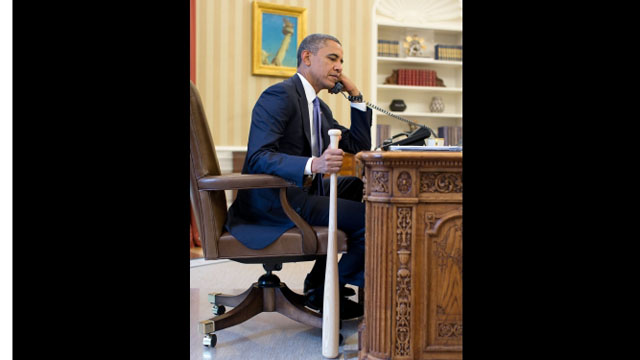
It's still a mystery why President Barack Obama was holding a baseball bat during his telephone conversation with Turkey's prime minister earlier this week.
And it just so happens that Turkey is involved with arming the Syrian rebels.
So given tonight's exclusive leak to Reuters, seems like the "mystery" of the baseball bat is solved.
Now, you're not supposed to put these things together and think, "Gee, our president really kicks a lot of ass" or anything. It just sort of happened.
Now if you do, for some reason, think to yourself, "Gee, if the president favors a muscular, baseball-bat-wielding, ass-kicking foreign policy, then he's a good man and I should vote for him," well go right ahead and think that.
See, that whole thing about a President using that to boost his popularity being a bad thing? Remember when we used to hear about that? The WarMaster Bush using photos from Air Force One to appeal to people's lizard-brain preferences for the martial?
That, like so much else we once knew, ended January 2009.
Now it's okay. Captain Kickass is just awesome as he moves pawns around the world's chessboard and it's perfectly all right to think he's awesome.
I'm Old Enough To Remember When Wag the Dog Wasn't Cool
It's a transformative presidency in so many ways.
Posted by: Ace at
05:39 PM
| Comments (194)
Post contains 253 words, total size 2 kb.
— Ace Just ponder that headline for a moment. Take it in.
I support the policy, by the way. (But more on that later.)
I just wonder if the Obama's National Security folks are using the same dictionary that I am, or if the page with the word "secrecy" on it is missing.
Remember when SEAL Team Six didn't exist? Or back when details of SEAL tactics were not supposed to be known by the world at large? Or back when it was a secret that the FLAME computer virus used the neat-o tactic of sending its data to nearby Bluetooth-equipped phones and laptops, to get the information transmitted from the secure (not connected to the internet) networks?
Yes, that was "secrecy" before Barack Obama needed a reelection boost, back when "secrecy" meant "we don't leak this information to our partisan agents in the media."
And now: Obama secretly orders secret help for our secret friends in the Syrian rebellion. It's in all the papers, like good secrets should be.
President Barack Obama has signed a secret order authorizing U.S. support for rebels seeking to depose Syrian President Bashar al-Assad and his government, U.S. sources familiar with the matter said.Obama's order, approved earlier this year and known as an intelligence "finding," broadly permits the CIA and other U.S. agencies to provide support that could help the rebels oust Assad.
...
The White House is for now apparently stopping short of giving the rebels lethal weapons, even as some U.S. allies do just that.
Rolling eyes. Either it's true and it's sooo typically Obama, or it's not true -- and this then is him "keeping a secret," even though it's preposterous that Syria wouldn't suspect we were sending arms.
As for why I support this: For one thing, so long as we're supplying armaments and not US armed forces, I don't consider it "war" so I don't think we need Congressional approval, necessarily. Reagan didn't seem he needed it for this sort of thing, asserting it fell under the Foreign Policy Power of the Executive in the US.
Further, Syria is a major bad actor, Iran's best friend. (Well... apart from Mother Russia.) If the Syran rebels succeed, not only will they rid the world of an anti-American despot, and not only will Iran's influence and reach be diminished, but the Syrians will likely spill many of the secrets of the old terrorist-supporting, Iran-allying regime to foreign governments, such as our own.
Further, the Arab/Muslim world is in desperate need of reform. I don't know how that will happen, or when it would happen; but I think we should generally favor attempts at freedom. Evicting a tyrant is not sufficient for a people to claim their human dignity and become friends of liberty (see Egypt), but it is almost certainly necessary for such a transformation to take place. Even if that transformation takes 40 or 60 years.
If Syria frees itself, it might also have the indirect but benevolent effect of freeing Lebanon as well (currently under rule by Hezballah, thanks largely to Syria's and Iran's determined promotion of that terrorist group).
I think the War on Jihadism is like the Cold War. Meaning: It is going to go on for so long that we will have to make judicious use of proxy wars and limited commitments. Looking back, I think Iraq and Afghanistan were mistakes in the way they were fought; we fought them at a very high tempo, with a lot of US troops, and lots of US treasure. (Meaning: If we take on Iran, which we must, it will first an airwar to decapitate the state and destroy the army, and then a speedy invasion with the sole purpose of capturing its nuclear materials and equipment (and "accidentally" shooting its nuclear scientists when they flee) and then evacuating the country. The public will not support an occupation or a "rebuilding," and I think it best to just accept that and plan accordingly. They will have to work things out for themselves. If you have only two enemy regimes that need subduing, a lengthy and costly and bloody rebuilding might make sense; if you realize that maybe you'll have ten such engagements in the coming decades, then such large commitments seem impossible.)
But that sort of very-high-tempo warfare is only sustainable for a six or eight years. If Jihadism could be knocked out relatively quickly -- like the Japanese Empire or Nazi Reich could -- it would make sense to use WWII style total commitment high-tempo warfare against it.
But I don't think it can be, which suggests to me we must employ strategies that can be sustained for a long period of time. Which means things like sending arms and intelligence to the enemy of our enemies.
My thinking on this is that Reagan Was Right on foreign policy, and the so-called foreign policy "neoconservatives" (of which I was one) were far too optimistic and idealistic about things. I think Gingrich said things like this: "I'm a hawk, but I'm a cheap hawk."
I think Bush's policy was simply too costly to serve as a model going forward.
Posted by: Ace at
03:43 PM
| Comments (357)
Post contains 875 words, total size 5 kb.
— Ace I know studies are all kind of bullshit but I kind of already believe this so, as people do with studies, I believe it just because it reinforces preexisting nonscientific biases.
This was part of the reason I was specifically recommending ereaders (not tablets, which are just compact computer screens; the difference is that an ereader is just a high-tech version of a printed page, with a high-tech sort of "ink" on neutral-colored unlighted slate). I think there's a health benefit to shutting off the TV and the computer. I just feel better when I turn off all the electronic stuff before it gets too late, and then read for a half hour or hour before sleeping.
And I say this as someone whose business actually relies on computer.
Too much strong night at light just screws up a lot of things, especially sleep.
One partial solution, recommended to me by a commenter or coblogger (forget who), is a free program called F.lux, which dims your computer screen as the sun sets in your time zone, and also skews the colors to rose (like dawn's fading light; and red light is less powerful and less stimulating than white or blue light). In the morning and day the computer's brightness is left at its normal power.
Seems to me this helps. But I still think the actual full shut-off is important.
The subjects of the study were actually hamsters, but eff you, I believe it anyway. I feel like crap when I revert to my typical ways of computer use deep into the night, and then start feeling better when I force myself into a more natural pre-computer rhythm. Which reminds me that I have been using the computer deep into night for weeks, and need to stop that habit again.
I just remembered this: I was obsessed as a kid with the movie LOOKER. I still think it's awesome and in dire need of a remake. That movie was all about the effect on light on the brain. So maybe I have had this idea in my head for 30 years, thanks to LOOKER.
Posted by: Ace at
02:28 PM
| Comments (226)
Post contains 392 words, total size 3 kb.
— Ace "Kiss my ass," a sign says in response to "You didn't build that."
Below, a Romney ad -- "These Hands" -- you've probably seen. I never thought this thing would have this kind of leg in it.
Also below, a Romney ad attacking Obama for the ending of GM dealerships -- the "Vampire Corporatism" Obama practices. Jen Rubin finds the ad confusing or something:
Is Romney saying that in a “managed bankruptcy” these dealershiips wouldn’t have closed? If he is saying these guys got hit because the politically-connected UAW got sppecial treatment, that would make sense. The ad doesn’t say that.In short, I don’t get the point of the ad.
Let me suggest the point of the ad starts as simple as tu quoque -- you did it too -- and then suggests more than that. Obama's whole attack on Bain is based on a deliberately infantile obtuseness about business. It's based on little-baby style thinking: People lost jobs. That's bad. If you fire someone that means you're a bad man.
But of course it's a great deal more complicated than that. Businesses prefer to grow and expand their operations and their employee base, opportunity and profit permitting; contractions are not sought, but are imposed by circumstance.
Romney's ad doesn't say that. But it certainly confuses Obama's baby-talk narrative. Because he must explain what makes his layoffs different from Bain's; the answer is that there is no difference. A business losing money must soon lose employees as well.
Some of Obama's people know this, but they trust that the typical Obama voter, who's been an employee all his life (and, disproportionately, a government employee, who has therefore never before even had to consider "What if my employer runs out of money?"), are too stupid to know this. Well, perhaps this ad might wake them up, as they ponder "Gee, why did the man fire those poor people?"
But more interesting than speculating about whether the typical Obama voter understands that a business either makes money or it shuts down is whether Obama himself knows it; certainly, most of his insipid rhetoric suggests that he believes people invest in businesses not to make profit and thereby improve their own (and their family's) economic status, but rather create companies as sort of a public charity for the strict purpose of employin' workin' folks.
No, employing working folks is a consequence of investment and entrepreneurship; but it's not the main goal.
Of course it's not. Only Obama voters, and maybe Obama himself, could possibly think that one breaks one's ass with a primary motive of benefiting of others.
I always want to ask these people: If you weren't drawing a paycheck from work, would you show up anyway, just for the benefit to the community and society? Government school teachers like to talk of "working for the children," and yet I can't seem to notice that checks in their name are sent out every two weeks.
Perhaps this ultimately just gets at the deliberate self-infantilization of the progressive left, wherein they actually do convince themselves that they themselves are "working for the public good" and that biweekly check is just some sort of fringe benefit they could either take or leave. And, having convinced themselves of this absurdity, they go on to deploy the delusion vindictively against others, accusing others of not working primarily for the benefit of others.
You know, like they do.
It's a wonderment to me that the Government Workers and Government Clients spend so much time and effort assiduously insuring that their incomes always rise, but then, when taxpayers, who are after all signing these checks, object that they'd like to see property tax rates capped so that they themselves can have a little more money themselves, say to the taxpayers: "How dare you."
The scary thing is that they seem to actually mean it. Like, it's not just theater. They are so gripped by their self-deception they're aghast at seeing someone else wish for a little extra money to spend as he pleases.
Maybe this is why they're so hostile to business people. Business people are pretty upfront about saying, "I'm working for myself," and are comfortable with both meanings of that sentence.
To people who have convinced themselves, psychotically, that they themselves are working "for the children" or "for the good of... the DMV," such a statement must seem very cold-hearted.
I think it's time we told the Government Clients that we no longer have the luxury of spending so much for their self-delusions and will no longer be signing off on their regularly-scheduled salary escalations.
Posted by: Ace at
01:45 PM
| Comments (167)
Post contains 792 words, total size 5 kb.
— Ace They're no longer stoked by Mr. Unprecedented. They lack bestokelment.
"Their relative disengagement represents a real threat to President Obama’s re-election campaign,” the pollsters wrote. “… We find consistent evidence that President Obama’s 2008 first-time voters are less supportive than other Obama voters, reflecting a decline in enthusiasm among a key voting bloc in the 2012 elections.”
They were promised love and Happily Ever After; what they got was twenty minutes of parasexual fumbling in the back of van bought at government auction and just a touch of Herpes. No wonder they have mixed feelings about that once-wonderful night. No one ever forgets their first time. Alas.
Posted by: Ace at
12:53 PM
| Comments (201)
Post contains 135 words, total size 1 kb.
— Ace In case you suspected that he wasn't.
Well, that should do the trick. Note this concerns his daytime talk show, which I did not even know existed; so... score one point for CNN's marketing team, I guess.
Broadcasting & Cable reported that the new program will emulate "Live! With Kelly," the show that Cooper guest-hosted a number of times to great reviews. There is still a possibility that Cooper may name a permanent guest host for his show.
Ooh, wow, a permanent guest host. It could be anyone! But, sadly, it will be Kathy Griffin.
This is really a sidebar item but I had to post something. Since this is a nothing post, let me combine it with the full audio from that Jon Lovitz/Dana Carvey exchange, which I talked about yesterday.
I owe someone an h/t for that but it's been so long I forget who.
I'll combine that too with Steyn's, and Rush's first, response to the Chic-fil-A facscism, "Just who in the hell do you think you are?" What country do you think this is?
Again, forget who sent that.
Correction: I'm told "Anderson" is syndicated -- wait, I mean "Anderson Live" -- and so it's not on CNN, but on, like, I don't know. Local stations or something?
My point still stands, whatever it was.
Posted by: Ace at
12:41 PM
| Comments (115)
Post contains 269 words, total size 2 kb.
— Ace And therefore -- he doesn't say this; this is the implication of it, as I read it -- Barack Obama didn't "save" us from any damn thing.
The Great Depression that Federal Reserve Chairman Ben Bernanke claims to have averted has been part of the background radiation of our economy since at least 2008.It’s just that like radiation — it’s invisible.
WeÂ’ve called it the recovery, the jobless recovery, the slogging recovery and more recently the fading recovery. WeÂ’ve measured modest growth in our nationÂ’s gross domestic product to record that our so-called Great Recession ended in June 2009. And now we are saying that if this disappointing growth suddenly disappears, as currently feared, we will be in a new recession.
There is nothing more depressing than hearing about a new recession when you havenÂ’t fully recovered from the last one. I take heart in suspecting that in a still-distant future, historians will look back with clarity and call this whole rotten period a depression.
The precise definition of a depression, of course, remains as debatable as anything else in the field of economics. By some definitions, it is a long-term slump in economic activity, often characterized by unusually high unemployment, a banking crisis, a sovereign-debt crisis, surprising bankruptcies and other horrible symptoms we can find in the headlines almost every day.
It is easy to avoid seeing all of these events as constituting a depression if you somehow have kept your livelihood intact all this time. But itÂ’s important to remember that not everyone has to stand in a bread line during a depression.
And then he lists the grim tidings that are easily seen by anyone with the eyes brave enough to look.
Some more on this: Other countries have gone through what we're going through now. Most famously Japan, with its "lost decade," a recession (or depression) severe enough to penetrate the popular imagination in far-away America and instantly end the "Red Sun Rising" fears Japan instilled in us just two or three years before.
Among the counties that have suffered a similar crisis: All of them recovered more strongly than the US is recovering now.
Now, Japan's crash and Lost Decade was an event of such magnitude that it (I hope I am not overstating) changed the trajectory of the country for the next half century, and not for the better. And we're doing worse than that.
This is the worst "recovery" by any nation since 1970, and it could be partly due to a category error: We're not recovering from a recession, we're still in the depths of a depression.
The ISM index of manufacturing activity showed a contraction for the second straight month, and the ADP jobs report shows another month of bare-bones employment.
The Fed understatedly notes that the "recovery" has "decelerated somewhat," much as a human body falling from a skyscraper's balcony might "decelerate somewhat" at street level.
Fed officials described the economy as having "decelerated somewhat,'' and reiterated their disappointment with the slow pace of progress in bringing down the nation's 8.2 percent jobless rate.
Ever notice how people flee to the clinical comfort of bloodless language when they're forced to speak of bloody things?
Here's a quote by Megan McArdle that has stuck with me since I read it soon after the beginning of the crisis (and have referred to it several times since then).
I don't want to push the Great Depression analogy too far, but what's surprising when you go back to primary sources from 1930 is the optimism. I don't mean to imply that everyone thinks things are just swell. But while you know that they are facing the worst economic decade of the twentieth century, they don't. They're expecting something more like the recession that followed World War I. People are cutting back, but they're still spending, particularly because companies are slashing prices to move inventory. It was the long grind of the years that followed, and the catastrophe of the second banking crisis, that scarred them permanently.
Depressions are so noted retroactively. Only after 8 or 10 (or more) years of persistently high unemployment, "recoveries" without recovery, false hope and new set-backs do people start to realize "This might actually be a depression."
The line of demarcation, as I understand it, between a depression and a recession is only this: You don't recover quickly from a depression, as you do from a recession. Thus, you really can't know you're in a depression until you fail, and fail, and fail some more at recovery.
And none of this, of course, excuses Barack Obama for his failures. His supporters might argue (were they honest enough to admit his failure) that given the situation, it was easy for him to miss the signs that this was a serious, possibly nearly permanent, wound to the economy.
Well, it might have been easy. But it's always easy to fail. It's harder to be successful than to fail, which is why we have -- at least previously -- rewarded success, so that people might have an incentive to attempt that which is difficult, rather than accepting the default, easy path of failure.
We didn't elect him to fail, whether it's easy to fail or not.
Every failure comes with a bodyguard of a thousand excuses or justifications. But, at least previously in our history, we have insisted on the hard success over the easy excuse for failure.
I sincerely pray we do not further reward this miserable failure for his incompetence. It would be the death of us.
And no post about the economy would be complete without something "unexpectedly" happening. Bloomberg obliges.
U.S. Manufacturing Unexpectedly Shrinks for Second Month
Yes, unexpectedly. We're all stunned.
And what does the press want to talk about?
Posted by: Ace at
11:42 AM
| Comments (253)
Post contains 1012 words, total size 7 kb.
— Ace Big lines for chicken sandwiches.
Here's why I'm not covering this: First, I was on vacation when it started and wound up hearing about it late.
But more importantly -- I'm just flabbergasted. I don't know where to begin. I think to address this properly requires a 15,000 word essay on the very most basic of American values, and I'm blown away that such an essay is even required.
And I do mean the most basic American values. I don't mean conservatism and I don't mean advanced constitutional theory.
I'll just link Ed Morrissey's column at The Week for now.
This is just beyond me. I have no words. Snark doesn't cut it. This is full-blown fucking fascism and it's goddamned outrageous.
And Here We Go: Bomb threat phoned in against a Chic-fil-A.
Posted by: Ace at
10:53 AM
| Comments (416)
Post contains 139 words, total size 1 kb.
— Ace Her suggestion is that the federal government spend an additional trillion per year on infrastructure. She does not say how she'd pay for this, and in fact all of her previous claimed agenda items relegate this newest item into the realm of the impossible -- she's already proposed a huge tax increase, but with new government mad-money dedicated to deficit reduction.
What happens when a Leviathan state has all the free money it could want? Well, let's look at China, the country Warren wants to emulate.
One of the more interesting searches you can conduct on Google is "ghost cities of China. Here, for example. Or here.
China's ghost cities are unlike any that have ever existed. The typical ghost city was once populated, but then abandoned, for one reason or another. China's ghost cities were never inhabited at all. China is building entire cities, capable of housing a million people or so each, with no one actually planning on living in them.
They're built empty, and they stay empty.
This is what happens when a state has all the money it could want and unlimited power to order economic activity to its liking, and can therefore do things that no one actually wants them to do. They are free to act upon bureaucratic dreams and civil servant caprice.
Below, a documentary on the Ghost Cities, and a famous Onion debate over the merits of similar policies. more...
Posted by: Ace at
10:26 AM
| Comments (176)
Post contains 265 words, total size 2 kb.
— Ace That poll was so vile I need a palate cleanser. more...
Posted by: Ace at
09:48 AM
| Comments (122)
Post contains 24 words, total size 1 kb.
43 queries taking 0.309 seconds, 151 records returned.
Powered by Minx 1.1.6c-pink.

