


February 22, 2014
— Open Blogger Good morning, morons & moronettes, and welcome to your Saturday Gardening Thread!
This thread brought to you by International Harvester:
And now for the Comedy Stylings of WeirdDave:
Well, it seems that this thread has become a regular part of the blog. Ace mentioned enjoying it in a post this week, so I thought maybe it was time to give an accounting of how we put this together, a behind the scenes look if you will. First of all, you need to know that I am completely superfluous to the process. Y- not is the heart of the garden thread, she’s Dr. Ray Stantz to my Peter Venkman. She comes up with content, I run around making fart jokes and hitting on Sigourney Weaver. For example, this week she sent me an email saying that she wanted to talk about compost. Eager to do my part I didn’t reply. Yesterday she sent me another email saying that she had written a very long post about compost, to which I replied “You mean it’s full of shit?” Yea, I dunno why she continues to work with me either.
Anyhow, if compost is the subject, then I suppose I better write about compost. IÂ’m sure that Y-not has lots of fascinating information below, talking about household waste, aging, rotation, fertilizer and when to add beer to your compost heap. I donÂ’t know about any of that stuff. I do however know how to use one particular aspect of decomposing organic matter to enrich your garden, so thatÂ’s what IÂ’m going to talk about.
WhatÂ’s the oldest strategy know to man for enriching soil? Something that goes back to the earliest chapter of Genesis? Simple. Bodies. What do you think Cain did with Able after he put paid to the smug son of a bitch? He buried him and planted wheat on his face, thatÂ’s what. That wheat grew strong and tall, long after Cain departed for Nod. You can compost banana peels, eggshells, coffee grounds and leaves all day long, but nothing gives dirt that extra growing boost like a human body. If you decide to utilize this ancient farming method, however, there are a few things to consider.
First of all, where do you get a body to bury? The obvious answer is to kill someone yourself. I donÂ’t recommend doing this. ItÂ’s illegal in more than half the jurisdictions in America, check your local laws. Plus itÂ’s messy, and for some reason, no matter how rhapsodic you wax about the tomatoes you plan on growing, itÂ’s hard to find someone to volunteer to be fertilizer (Germans seem to be more likely to be an exception to this rule for some reason http://en.wikipedia.org/wiki/Armin_Meiwes). Hobos seem to be an obvious solution, but being morons, weÂ’re contractually bound to eat them. Mortuaries have ridiculous security, and if you dig a body up from a graveyard itÂ’s sadly already lost a bunch of itÂ’s nutrients. Fortunately, there is an easy solution. Find your local wiseguy bar and prowl the trunks of the Lincolns and Caddies outside. I never have to pop more than three trunks before I find a fresh body. Grab it and steal away into the night. Be careful! If those guys catch you, someone will be stealing your body a day or so later to begin growing peppers on it, those mob guys have no appreciation for gardening at all. Check the body before you abscond, one year I grabbed a body that had been stored in nuclear waste and my vegetables grew twisted. The tomatoes were yowling all night long and the corn started walking around. I got most of them, but I think thereÂ’s still one hanging around the woods behind my house eating rabbits.
Now that you have your body, how deep do you plant it? Deep. No, deeper. Deeper. Keep digging, what are you, some kind of a pussy? I said deep! There are two reasons for this. Number one, the deeper the body is buried, the more soil it will fertilize. I recommend one body per 400 cubic feet of soil. Second, you need to leave room to put next yearÂ’s body on top of it, donÂ’t you? If you donÂ’t leave enough room for this, in a couple of years youÂ’ll have bones sticking out of the soil all over the place. This happened to me a while back, and when the cops stopped by and started asking questions.....awkward! Fortunately they bought my story that I was creating a diorama of the Battle of the Somme, but it was dicey there for a few minutes. Dig deep and avoid the hassle.
Finally, people often ask me if they should rotate their bodies year to year. I don’t recommend this for two reasons. Number one, it’s an awful lot of work. Why do more than you have to? Second, bodies tend to become disjointed over time. You start out be trying to simply move a body over a few feet and next thing you know the dog runs off with a femur or somebody’s finger bone is stuck in the back of your boot rubbing your ankle raw. No, it’s better to just set ‘em and forget ‘em. Decomposition is a wonderful thing, let it work it’s magic.
I hope these tips help if you decide to attempt the hottest new thing in gardening thatÂ’s also the oldest in the world. Happy gardening
And now from your co-hostess, Y-not:
When I was a little girl I would visit my grandmother who lived in a very old house in New England. I remember quite vividly that she always had an old coffee can by her sink where sheÂ’d put some of her kitchen waste. I always assumed it was because they had old plumbing that would seize up if an apple peel went down the drain, but now I realize she was probably composting!
Flash-forward four decades and IÂ’m living in a nice suburban neighborhood in a climate suitable for growing things and with some time on my hands. But my soil is a dark grey-brown clay. I want to grow some of my own food, especially those hard to find and/or expensive things like snacking peppers and herbs, but I am never EVER going to be willing to invest the time, brain-power, or energy to do much more than plant the things, water them, and keep the weeds down. That said, I like the idea of having a way to establish and maintain really high-quality soil for these plants. So whatÂ’s a girl to do?
I think one thing I should try to do this year is start composting. Although we set up some raised beds last year for edible things, my flower and shrub beds are still basically that horrible clay soil so they could use some attention. And IÂ’d like to refresh the raised beds with organic material, preferably at low cost. So this week I thought IÂ’d share some of the things IÂ’ve learned about composting and, as usual, solicit the horde for some advice about the process.
When I thought of composting I envisioned a big pile of leaves and other plant materials, probably/possibly in an open four-sided box. I also picture some strong person standing there with a yard fork turning the heavy material on a regular basis. Well, it turns out there are a bunch of different ways to compost, depending on your situation and your needs. Per the the University of Missouri extension website, there are five basic approaches:
Holding units are easy to build and good for small amounts of yard wastes, but they are the slowest to produce compost.
Turning bins can handle larger amounts of material and compost them rather quickly, but they are harder to build and require more labor to maintain. There are a couple of types: sets of adjacent bins affixed to the ground and barrels that are turned. The utility of the barrel-type seems to be a matter of some vigorous debate. In the interest of time and space, I'll simply provide a link to a side-by-side comparison of these types of composters.
Worm bins are great for food wastes, but they need to be maintained in a somewhat climate-controlled area, so they may not work for everyone. If youÂ’re interested in reading more, I thought this was a good FAQ list about worm composting. And hereÂ’s a fun page aimed at the kiddies, courtesy of the University of Illinois: The Adventures of Herman the Worm.
Heaps require no structure, so theyÂ’re very cheap. But if you want the composting to occur quickly, you need to turn them by hand and they are not very pretty. Seems to me dogs or other critters might tend to disrupt them, too.
Finally, WeirdDave's method: soil incorporation. This is basically burying small amounts of non-fatty food below 8 inches. Application and scale seem limited to me, although truth be told we inadvertently did a version of this with my childhood cat when I was a kid.
The good folks at Fine Gardening provide what I thought was an especially good primer on getting started, even providing some of the scientific basis for how composting works.
Per Utah State UniversityÂ’s extension site, the key aspects in maintaining your compost pile are:
Turn pile every 2 to 4 weeks, and keep pile moist to speed composting, allow air circulation and eliminate unpleasant odors.Build pile 3 to 5 feet tall, with an equal circumference. Small piles don't heat enough, and large piles don't receive enough air in the middle for good composting.
Apply a 1" layer of soil every 8 to 14 inches of organic waste to increase microbial activity
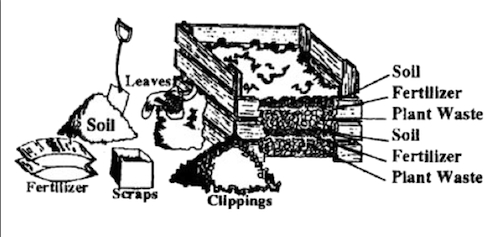
Another university, Texas A&M, has plans for building different types of composters, including the barrel type. This is the type that appeals to me the most because of the promise of efficient composting on a smallish scale that I could do myself without having to nag Mr Y-not to turn the compost pile every other week.
(Incidentally, TAMUÂ’s extension site also describe plastic bag composting, which sounds like a simple method but does require adding some chemicals, in part to counteract the effects of composting happening anaerobically.)
So, if you want to get started composting and you’re like me (weak and lazy) where would you get a “barrel style” composter?
Well, you could try to make it yourself. HereÂ’s a link to the Art of Simple blog an example of a pretty common design based on a large trashcan. It certainly sounds simple and inexpensive (although where do you find such a large lidded trashcan and plant dolly for $15, even at 2009 prices?), but I wonder about the feasibility of mixing your composting materials by rolling a ginormous trash can around your yard.
Or you could shop around. Mother Earth News (yeah, yeah, I know!) published their results from testing compost tumblers. And another outfit called Earth Easy describes the pros and cons of different designs.
Finally, Williams-Sonoma – yes, the place where a lot of us buy fancy-schmancy cookware – sells composters. As it turns out, W-S started an agrarian product line a couple of years ago. I have mixed feelings about it. So do a lot of people.
Some people are virulently opposed On Principle:
Really, though, Williams-Sonoma has done us a great favor. Remember back like, 10 years ago, when someone had to talk to you for a few minutes to figure out that you were a douchebag? Williams-Sonoma has managed to take conversation out of the douchebag vetting process. You walk into someoneÂ’s house, you see a flour grinder or other product from this line, and you know you are in enemy territory.
(Seems a bit over-wrought to me.)
Another blogger weighs in on the W-S agrarian line and comes off a lot less angry about it:
Some people in the hardcore DIY community (you know who you are) may have scoffed a bit at the idea of Williams-Sonoma, a genteel and polished mega-mall staple store, serving a market populated by of a bunch of anti-consumerist dirt-lovin’ neo-hippies. Dirty hippies get so confounded when everything they are doing is suddenly the height of suburban trendiness. (I mean dirty hippie with the greatest respect and affection, of course.)A fair amount of my bakeware, a Le Creuset pot and some of my knife collection came from an employee-discounted-stint as a holiday seasonal worker at my local Williams-Sonoma, and I have nothing at all against the store. So when the Agrarian line launched, I took a long virtual look at the Agrarian Collection, and – all pseudo-dirty hippie DIY-girl pride aside – I would totally buy some of this stuff.
Then she points to some things she would not buy from the agrarian line. For example their copper digging tools priced in excess of $300. I love this section:
If you actually need to, you know, garden, by digging and forking in the soil, stay away from tools made from one of the softest metals around.You know those late night infomercials where the knife cuts through the penny? And you know those machines at the zoo that take a penny plus a few quarters and press the penny into a fun keepsake embossed with a lemur? ThatÂ’s should give you an idea how soft copper is.
Sticklers will point out that a modern penny is actually mostly zinc. Zinc has a Young’s modulus – the measurement of how much a metal resists deforming – of 108 GPa; copper is quite close at 117 GPa. For comparison, steel, the material most good $30 shovels are made of, is nearly 80% harder at 210 GPa.
OK, I gotta say, I LIKE this blogger. Anyone who uses the term YoungÂ’s modulus in a garden blog (or anywhere outside of a physics lab) is A-OK by me! So NW Edible is my Blog of the Week.
So, to those morons and ‘ettes who have experience composting, what is your advice?
Next week, I think we should talk about raised beds. (I can't wait to see what WeirdDave does with THAT topic!) By the way, I bought mine*, although NOT from Williams-Sonoma, NTTAWWT.
*From Walmart!
Posted by: Open Blogger at
05:25 AM
| Comments (145)
Post contains 2409 words, total size 16 kb.
Posted by: Y-not at February 22, 2014 05:31 AM (zDsvJ)
That seems like the best alternative when the supply of fresh bodies is limited by neighbors moving away, 3rd cousins going off to college, etc.
Posted by: CharlieBrown'sDildo at February 22, 2014 05:34 AM (QFxY5)
Posted by: dogfish at February 22, 2014 05:35 AM (nsOJa)
Posted by: mindful earthworker at February 22, 2014 05:41 AM (Vs6FA)
Posted by: Gingy @GingyNorth at February 22, 2014 05:44 AM (N/cFh)
Posted by: I'd rather be surfin at February 22, 2014 05:45 AM (4S5LF)
Posted by: Timwi at February 22, 2014 05:45 AM (pdhxN)
Posted by: Gingy @GingyNorth at February 22, 2014 05:45 AM (N/cFh)
Posted by: Donkey at February 22, 2014 05:48 AM (Ggh94)
Posted by: BackwardsBoy, who did not vote for this shit[/i][/u][/b][/s] at February 22, 2014 05:50 AM (0HooB)
Posted by: I'd rather be surfin at February 22, 2014 05:56 AM (4S5LF)
Posted by: rickl at February 22, 2014 06:04 AM (sdi6R)
Posted by: EC at February 22, 2014 06:10 AM (doBIb)
Posted by: dogfish at February 22, 2014 06:20 AM (nsOJa)
Posted by: Bill at February 22, 2014 06:20 AM (uvyrw)
Posted by: grammie winger at February 22, 2014 06:21 AM (oMKp3)
Posted by: Mama AJ at February 22, 2014 06:22 AM (SUKHu)
Posted by: EC at February 22, 2014 06:24 AM (doBIb)
Don't waste time on doing the compost yourself.
Sure, have a pile of refuse that just sits there. 'Cause you're lazy. Let nature do the work, if she wants compost, let her make it. Takes longer, but less work for you.
Unless you live more than 4 hours from the nearest garden supply store, you're wasting your time otherwise.
Miracle Gro and a bag of chickenshit compost will beat the hell out of anything you can make.
Which is what I'm going to do today--dig out some buckets of dirt, sprinkle a layer of chickenshit compost, cover with a thin layer of the dirt, water, drink beer.
Got about month 'till planting time; we've one more good cold spell due; but I can sense the plants are starting to stretch an' wake as we've had several 80 or so degree days already.
Posted by: RoyalOil at February 22, 2014 06:24 AM (VjL9S)
Posted by: Y-not on the phone at February 22, 2014 06:24 AM (dezPb)
Whoa. WHOA.
Unless it's Piss Light you've stolen from your douchebag BIL. That's OK.
Posted by: HR, watching scripts run at February 22, 2014 06:27 AM (ZKzrr)
Posted by: grammie winger at February 22, 2014 06:29 AM (oMKp3)
The main difference is that my barrel rests on 4 scrounged wheels mounted to the frame of the compost unit, and my setup is enclosed on 3 sides with junk wood, and I have a screen frame on the front that pulls up for compost removal.
The unit will compost material in around 4 weeks which is not quite ready for garden use. It "finishes off" over the fall and winter, and I keep it wet. That attracts tons of worms. I generally get 4-5 barrels per year (roughly 2 barrels, or 100 gallons after composting) of material that is "garden ready".
I used a plastic soft-drink barrel which I got from the bottling company for $15.
Since it's a compost unit, which intentionally rots material, the rest of the lumber is scrap, and gets replaced when needed. Barrel is about 15 years old and still going strong.
Posted by: jwb7605 [/i][/u][/s][/b] at February 22, 2014 06:30 AM (ZALPg)
Posted by: Krebs v Carnot: Epic Battle of the Cycling Stars™ [/i] [/b] [/s] at February 22, 2014 06:31 AM (HsTG8)
Some people don't like Morning Glory's. I like the hybrids that bloom in other than blue, though. Interesting, the seeds will breed back to blue flowers.
Posted by: RoyalOil at February 22, 2014 06:33 AM (VjL9S)
Posted by: Krebs v Carnot: Epic Battle of the Cycling Stars™ [/i] [/b] [/s] at February 22, 2014 06:35 AM (LBUCy)
Posted by: Blindside at February 22, 2014 06:35 AM (ajjwb)
Posted by: Krebs v Carnot: Epic Battle of the Cycling Stars™ [/i] [/b] [/s] at February 22, 2014 06:40 AM (VHfsw)
Posted by: Krebs v Carnot: Epic Battle of the Cycling Stars™ [/i] [/b] [/s] at February 22, 2014 06:44 AM (bR2AR)

Posted by: Mama AJ at February 22, 2014 06:45 AM (SUKHu)
Posted by: Gingy @GingyNorth at February 22, 2014 06:48 AM (N/cFh)
Posted by: Mama AJ at February 22, 2014 06:48 AM (SUKHu)
Posted by: Krebs v Carnot: Epic Battle of the Cycling Stars™ [/i] [/b] [/s] at February 22, 2014 06:49 AM (QDOGk)
Posted by: tbodie at February 22, 2014 06:55 AM (tWrwm)
Posted by: Krebs v Carnot: Epic Battle of the Cycling Stars™ [/i] [/b] [/s] at February 22, 2014 06:55 AM (HsTG8)
Posted by: Weirddave at February 22, 2014 06:57 AM (N/cFh)
Here's the secret to getting it to compost fast.
1. Keep it damp.
2. Add yeast a couple times a year.
3. Turn it over with a pitchfork every month or two. This promotes aeration (sp?). You can also help this along by layering in your larger clippings from when you trim the hedges.
That'll get you a few good wheelbarrows full of dirt every 6 months.
Oh, and uric acid is supposed to be good, too.
Posted by: andrew at February 22, 2014 06:57 AM (+qblF)
Posted by: Jinx the Cat at February 22, 2014 06:59 AM (lrw43)
Posted by: artisanal 'ette at February 22, 2014 07:14 AM (IXrOn)
Posted by: OhioCoastie at February 22, 2014 07:17 AM (9m3Zl)
Posted by: artisanal 'ette at February 22, 2014 07:17 AM (IXrOn)
Posted by: traye at February 22, 2014 07:20 AM (ztRIB)
Posted by: OhioCoastie at February 22, 2014 07:22 AM (9m3Zl)
Mountain laurel (Kalmia Latifolia) is one of my favorites. I use the scientific because my FIL calls Rhododendron - Laurel and Mountain Laurel - Ivy. He's from a holler up in SW VA.
Believe it or not, we have some on the north facing slopes on the golf course property not far from Pinehurst.. Experts say they are left over from the ice age.
Over time, you can prune them back to a manageable size. Cut the longest canes first to start working on the overall size. Plus, this will open up the canopy to allow some light in and promote a denser branching.
The best approach would be a three-year plan, pruning no more a third of the plant each year. Also, any pruning of live wood now may sacrifice blooms come June (for us). Pruning flowering broad-leaves such as azaleas etc, is best right after they have bloomed.
Always remember the 3 D's. Dead - diseased - deranged - damaged.
Good Luck
Posted by: Golfman in NC at February 22, 2014 07:22 AM (vVOWk)
Posted by: Krebs v Carnot: Epic Battle of the Cycling Stars™ [/i] [/b] [/s] at February 22, 2014 07:23 AM (HsTG8)
Posted by: Gmac-Pondering the coming implosion, and hoping its 404care at February 22, 2014 07:24 AM (baiNQ)
Thought the same thing. Terribly invasive roots. Can ruin septic drain fields and I have seen them damage foundations.
Posted by: Golfman in NC at February 22, 2014 07:26 AM (vVOWk)
Posted by: Krebs v Carnot: Epic Battle of the Cycling Stars™ [/i] [/b] [/s] at February 22, 2014 07:28 AM (S4AQU)
I agree. Leave the hedge trimmers alone and get some good bypass pruners. My professor in school described one landscape as lollipop land.
Posted by: Golfman in NC at February 22, 2014 07:28 AM (vVOWk)
Posted by: Krebs v Carnot: Epic Battle of the Cycling Stars™ [/i] [/b] [/s] at February 22, 2014 07:28 AM (S4AQU)
I'd rather be surfin?
My late wife and her Mom before her really had green thumbs- I swear they could grow herbs and vegetables in cement.
Her parents had a farm supply business and they grew and sold ornamental plants. Still growing wild there after being abandoned in 2008.
Her surviving brother and I have plans to harvest and sell the trees there. Some is primeval forest that has never been touched. Oaks hundreds of years old.
Posted by: backhoe at February 22, 2014 07:29 AM (ULH4o)
Yard sales have them galore.
Posted by: Guy Mohawk at February 22, 2014 07:29 AM (n0DEs)
Posted by: Krebs v Carnot: Epic Battle of the Cycling Stars™ [/i] [/b] [/s] at February 22, 2014 07:31 AM (S4AQU)
Posted by: artisanal 'ette at February 22, 2014 07:38 AM (IXrOn)
I would have signed the petition but it wants too much personal info. I really wish such drives did not do that.
Posted by: backhoe at February 22, 2014 07:40 AM (ULH4o)
Posted by: artisanal 'ette at February 22, 2014 07:42 AM (IXrOn)
Posted by: artisanal 'ette at February 22, 2014 07:46 AM (IXrOn)
Posted by: The Hickster at February 22, 2014 07:46 AM (TI3xG)
Posted by: Gmac-Pondering the coming implosion, and hoping its 404care at February 22, 2014 07:47 AM (baiNQ)
Posted by: SarahW at February 22, 2014 07:50 AM (Lbv/k)
Posted by: tbodie at February 22, 2014 07:51 AM (e0nsQ)
http://www.youtube.com/watch?v=n9OhxKlrWwc
Posted by: Phssthpok at February 22, 2014 07:53 AM (T9Goj)
Posted by: CaliGirl at February 22, 2014 07:57 AM (KU72u)
I'm not a gardener by even the loosest definition of the word. Hell, I even failed at growing weed back in the day. And yet, I read the whole thing.
Posted by: DamnDirtyRINO at February 22, 2014 07:58 AM (m0h0I)
Posted by: Mindy at February 22, 2014 07:59 AM (mQwL2)
Posted by: I'd rather be surfin at February 22, 2014 08:08 AM (4S5LF)
Most of us understand what strain is when we bend something that will snap back to it's original state, like a spring. When we apply a bending stress to a spring, it strains after a certain amount of stress is applied, and strains more with more stress.
However, that doesn't tell the whole story. For instance, glass and standard (not alloyed and heat treated and whatever) aluminum have the same Young's modulus, and yet we all know that glass will break much easier than aluminum. That's because the yield strength of glass is much lower than that of aluminum. Yield strength is a much more important measure of a material's resilience, as that is the number at which a material's straining leads to permanent deformation (the spring stays bent).
Why did I bother with this? Because I ended up being a programmer and never used the engineering knowledge I spent a lot of time accumulating. And, I'm a know-it-all.
Posted by: cranky-d at February 22, 2014 08:16 AM (VL98o)
Posted by: I'd rather be surfin at February 22, 2014 08:18 AM (4S5LF)
Posted by: bill sometimes bill from canada at February 22, 2014 08:37 AM (n3Ihl)
Posted by: Miss Scarlett at February 22, 2014 08:38 AM (4MZD9)
Posted by: Judge Roy Bean at February 22, 2014 08:39 AM (cCxiu)
Posted by: I'd rather be surfin at February 22, 2014 08:49 AM (4S5LF)
I suppose if I didn't prefer to be riding and it wasn't pretty cheap to just buy veggies I could work out mulching and drip irrigation schemes to avoid evaporation losses but boy do I love living in a world where energy is still cheap enough to just pay for fruit and veggies trucked in from places where they grow well.
Posted by: PaleRider at February 22, 2014 08:54 AM (FYUWS)
Posted by: bill sometimes bill from canada at February 22, 2014 09:00 AM (n3Ihl)
Posted by: 2soonold2latesmart at February 22, 2014 09:04 AM (E7HkV)
Posted by: Jinx the Cat at February 22, 2014 09:10 AM (lrw43)
Posted by: RedMindBlueState at February 22, 2014 09:18 AM (0ehyP)
Posted by: Mindy at February 22, 2014 09:19 AM (mQwL2)
Posted by: bebe's boobs destroy at February 22, 2014 09:30 AM (dMaLo)
Posted by: Taco Shack at February 22, 2014 09:33 AM (C+qQ0)
Posted by: Mindy at February 22, 2014 09:33 AM (mQwL2)
Posted by: Taco Shack at February 22, 2014 09:35 AM (C+qQ0)
Posted by: traye at February 22, 2014 09:37 AM (ztRIB)
Posted by: KT at February 22, 2014 09:39 AM (qahv/)
Posted by: bebe's boobs destroy at February 22, 2014 09:40 AM (dMaLo)
Posted by: I'd rather be surfin at February 22, 2014 09:43 AM (4S5LF)
Posted by: bebe's boobs destroy at February 22, 2014 09:44 AM (dMaLo)
Posted by: Taco Shack at February 22, 2014 09:52 AM (C+qQ0)
Posted by: traye at February 22, 2014 09:57 AM (ztRIB)
Posted by: Taco Shack at February 22, 2014 09:58 AM (C+qQ0)
Posted by: Mr. Dave at February 22, 2014 10:05 AM (RlEsx)
Posted by: Golfman in NC at February 22, 2014 10:23 AM (/djtm)
Posted by: Y-not at February 22, 2014 10:24 AM (zDsvJ)
Posted by: bebe's boobs destroy at February 22, 2014 10:26 AM (dMaLo)
Unfortunately we both need the money. My late wife left me virtually destitute. There are no jobs here and I am trying to survive on her death benefit. The economy here is dead. Has been since 2008. Co-incidence? I'll leave you to draw your own conclusions....
Posted by: backhoe at February 22, 2014 10:28 AM (ULH4o)
Posted by: Y-not at February 22, 2014 10:30 AM (zDsvJ)
Posted by: Y-not at February 22, 2014 10:31 AM (zDsvJ)
Posted by: Y-not at February 22, 2014 10:32 AM (zDsvJ)
Posted by: Y-not at February 22, 2014 10:36 AM (zDsvJ)
Posted by: Y-not at February 22, 2014 10:38 AM (zDsvJ)
Posted by: Y-not at February 22, 2014 10:40 AM (zDsvJ)
Posted by: Golfman in NC at February 22, 2014 10:41 AM (/djtm)
Posted by: Y-not at February 22, 2014 10:44 AM (zDsvJ)
Posted by: OhioCoastie at February 22, 2014 10:46 AM (9m3Zl)
Posted by: bebe's boobs destroy at February 22, 2014 10:47 AM (dMaLo)
I "compost" a lot -- a greenie word for piling up vacuum-mulched grass and the vacuum-chopped leaves instead of spending about 40 hours a year bagging and raking to the street. And I produce about 4 cubic yards of topsoil a year from that. I barter with the excess, and it is in demand.
During wood heat season, the wood ash goes in there (grass usually yields an acidy soil; ash is very basic. I save coffee grounds and eggshells only from the kitchen. Every couple of years I buy a box of compost enzyme, and use a cupful twice a season unless the pile "goes stuck" in odd weather. You'll know right away if this happens. Healthy compost does not smell like garbage.
You need a tractor with a loader to turn the pile over. Even a little one is fine, but you people forking and shoveling and rolling barrels, my god -- for that little bit of dirt? Plus, see my previous many posts, I don't know how The Hell you can maintain a modern house and holdings without one.
If you make a bin out of lumber, no matter what the grade of lumber, it begins breaking down right away, along with what you put in it. So, if you must use wood, try using scrap wood. Make sure you leave air passages between the boards, so they don't have to rot themselves in. Thick is good.
I've achieved good results with used concrete block, which I had to pile up somewhere anyway. It is tedious indeed to set them up the first time, and until you get good with your loader you will have to re-do little sections here and there. The angrier this makes you, the faster your loader skills will improve. But it makes a clean-looking installation, doesn't rot away, and if you give it up, the blocks are just as good as when you laid them down there.
Note, I do not mean "cinder block." Most of you have never seen a cinder block. They are bluish, made of slag, and they rust.
Posted by: Stringer Davis at February 22, 2014 10:57 AM (xq1UY)
Posted by: Y-not at February 22, 2014 10:58 AM (zDsvJ)
Posted by: Golfman in NC at February 22, 2014 10:59 AM (/djtm)
Posted by: bill sometimes bill from canada at February 22, 2014 11:05 AM (n3Ihl)
Some manures are too rich to use directly in beds. All dog droppings, and fresh horse and bird manure, are noted for burning plants. They're all good if left in a pile with other elements for a season, though. I have an old neighbor who raises pigeons, and boy is that some hot shit. The old man dissolves it rain-barrel water (calls it "spunk-water"); I mix it with compost for booster soil, like in the bottom of a new tree hole. A fresh bag of that stuff would kill off a mid-season garden.
When I can get hold of "mature" horse manure, I bury it in other compost until cold weather, then turn it in to the cleared garden so it never lays out uncovered. This way, the neighbors have never complained. On a hot day? Hoo boy.
Posted by: Stringer Davis at February 22, 2014 11:09 AM (xq1UY)
Posted by: traye at February 22, 2014 11:20 AM (ztRIB)
Posted by: stace at February 22, 2014 11:32 AM (9PXzx)
Posted by: Golfman in NC at February 22, 2014 11:38 AM (/djtm)
Posted by: toby928© loves Grease Monkey at February 22, 2014 12:02 PM (QupBk)
Posted by: bill sometimes bill from canada at February 22, 2014 12:03 PM (n3Ihl)
....But my soil is a dark grey-brown clay...
Y-not,
I've learned that Sand is essential in breaking down clay.
Organic material too, of course...but it breaks down.
Sand will stay there, and continue to 'open up' the clay to letting water drain through.
I've been battling Oklahoma red clay for decades.
But some sections of my yard have the grayish clay.
For an initial excavation for a bed...or a hole for planting a tree or shrub...I do a 1:1:1 mixture:
One part sand - One part peat moss*- One part clay
*or some other type of fluffy organic substance.
YMMV depending on how dense your clay is.
I've been known to add a bit more sand, if the clay is really 'plastic'.
Another great Gardening Thread!
Thanks, Y-not and WeirdDave.
Posted by: wheatie at February 22, 2014 12:15 PM (DEUoo)
Posted by: Y-not on the phone at February 22, 2014 12:19 PM (nla83)
Posted by: Taco Shack at February 22, 2014 12:47 PM (C+qQ0)
Posted by: seamrog at February 22, 2014 12:56 PM (9hU8R)
Posted by: PaleRider at February 22, 2014 01:00 PM (5CusZ)
Sand, oh yes! We put in a couple of truckloads to lighten our heavy clay soil. I think it was enough--a ball of damp soil won't fall apart while wet, but *will* when dried.
Here's my wall-o-text for the week:
------------------------
Our community has a contract w/composting facility, coupled with yard-waste collection program. Cost is incorporated into the garbage bill and is actually *not* horribly expensive.
Put clippings, leaves, brush trimmings into cans for pick-up OR take our own truckloads out to the compost facility. No limit on the number of cans (we must provide our own), put them out on garbage-day and the convenience can't be beat! Not to mention gasoline cost saved, if we don't take it out there ourselves.
We can purchase local compost by the bag at most garden suppliers here, or by the ton at the composter-- the latter being way cheaper. Last year was $25 per, and was a Very. Full. Truckload.
---------------
Mom used to make compost. Very informal method she had:
She had several cylinders made of 1/2 inch mesh-- each about 3 ft diameter, 4 ft tall and open at both ends. Secured in place with heavyduty stakes.
Fill one with layers of kitchen scraps (no meat, she said) grass clippings, pulled weeds, leaves, etc. A shovelfull of dirt and handful of lawn fertilizer when the cyl got halfway up. They were along the edge of a sprinkler -system zone, so were dampened regularly.
When the first one got full, she'd start the second, and so on. (Not all cylinders were in use all the time, she just "had extras just in case")
Turning the pile was a simple matter of: pulling up the cylinder, staking into place next to the pile and forking the pile back into the cylinder. Repeat each time the pile height drops by 1/3 or so...Once things *looked* broken-down enough, she'd wheelbarrow it over to the garden or pot-up some plants with it.
I haven't made any compost yet, but will try Mom's method. Very low cost!
------------------
On animal manure:
If it's "fresh" it'll nitrogen-burn your plants--put the fresh stuff on after final harvest and till it in the following spring.
"Rotted" manure--if it's fully rotted-- shouldn't have the poopy smell anymore and can be added any time.
At the edge of farming country, many small farms will let you have their excess manure for free. (Watch for homemade signs along the road, lol!)
You-load/you-haul kinda sucks. Some farmers will load you up for $5-10...*worth it!*
Also cow manure > horse manure because usually fewer weed seeds.
Posted by: JeanQ at February 22, 2014 01:19 PM (82lr7)
Posted by: Tammy al-Thor at February 22, 2014 01:21 PM (Pfvig)
Posted by: Y-not at February 22, 2014 01:30 PM (zDsvJ)
Posted by: The King of Id at February 22, 2014 02:07 PM (MhA4j)
Posted by: bill sometimes bill from canada at February 22, 2014 02:10 PM (n3Ihl)
Posted by: Sal at February 22, 2014 02:25 PM (lrTwr)
Posted by: PaleRider at February 22, 2014 02:29 PM (/jvBG)
Posted by: toby928© loves Grease Monkey at February 22, 2014 02:51 PM (QupBk)
Posted by: Stringer Davis at February 22, 2014 02:53 PM (xq1UY)
Posted by: toby928© loves Grease Monkey at February 22, 2014 02:56 PM (QupBk)
Posted by: The Farmer at February 22, 2014 03:04 PM (eBupg)
I'm all for that Cycle of Life stuff. It's just that my cycle includes a John Deere.
And I'll be damned if I'm going to pay a tax specifically to carry away my "yard waste" (I know, in some places it's even worse; you have to pay for the bags too!), then pay again for the compost. That's quite an operation they're running there.
My town runs a huge such operation, but it seems to come out as "mulch." Lots more market here for "mulch"; the mucketies don't want to be seen growing food.
Best deal you can get is to find a source of organically-composted Human Manure from a sewage plant. Got to trust that plant, though. Couple local govts had contracts: sold sewage sludge and river dredgings to a fertilizer company, who trucked it away and sold it. Contract ran out, somebody forgot a friendship-payment, and the dredgings reverted to the Corps of Engineers, who dump it into cribs in Lake Erie. And that same year, there was an historic algae bloom.
What do you know! After decades of farmers, freighters, and homeowners taking the Kennedy WaterKeeper rap for fertilizer runoff, it turned out that the main cause of artificial nutrient in the lake was...government!
Posted by: Stringer Davis at February 22, 2014 03:06 PM (xq1UY)
Posted by: Rocket Jones at February 22, 2014 04:25 PM (jyewT)
My town runs a huge such operation, but it seems to come out as "mulch." Lots more market here for "mulch"; the mucketies don't want to be seen growing food.
Posted by: Stringer Davis
Howdy, fellow gardener!
In defense of my hometown's "tax" and "quite an operation" I must say:
My quarterly bill went up just shy of Ten-Dollars-Per-Quarter to add the yard waste collection. I could not drive my old gashog there *every week* for that little.
The $25/ton (overflowing truckload!) for finshed goods? I and allllll my neighbors combined, could not produce that much in a single season......
Mulch? Again, no--this stuff is as fine as soil, weed seeds cooked out, fluffy and odorless.
All in all: A fine product at a reasonable price, a convenience which saves me time, trouble, space and (in the long run) a couple of bucks.
I fully support *this* system. (Yeah, probably just a matter of time before guv f*s it all up...)
Until then, I say it RAWKS!!
Posted by: JeanQ at February 22, 2014 04:45 PM (82lr7)
The neighborhoods are a bit cleaner *with* yard waste pickup. Folks are more inclined to put their trimmings at the curb for pickup, rather than heaped in a corner of the yard, in piles in the alleys, dumped in ravines, etc.
So, we also get a nicer looking community-- even if *not everyone* uses the finished product.
Posted by: JeanQ at February 22, 2014 05:25 PM (82lr7)
Anyway, since I have a 1/2 acre but little money and materials, I didn't bother to wait for a bin (my preferred method) and just went for the heap method. It's on the side of a shed that's falling apart anyway, so aesthetics don't really matter at this point. I also lack a pitchfork to turn the blasted thing, so composting is going a little slow...
...But not as slow as I'd been led to believe it would. I have sort of a natural green thumb that seems to extend to things like microbes and insects, so even though I haven't turned it (not really) the heap had colonies of crickets in it. This is not a bad thing; not only does it mean that the heap is getting aerated, crickets help with breaking down matter. (And I think the wolf spider I spotted still lives underneath the shed. If you see one, leave it alone. Not because they're dangerous -- they're harmless in spite of being the size of pet tarantulas -- but they eat the spiders which actually ARE, in addition to eating a lot of garden pets. They're shy liek whoa and generally nocturnal, so you'll rarely see them, anyway) And then there's the earthworms...oh, those beautiful earthworms and their nutrient rich casings (Earthworm poop, but highly prized by gardeners. In fact, another composting method is using worms, but that's a bit more complicated than I'm going to get into right now).
So basically, if you're the lazy and/or currently broke and not in a big hurry, a heap is an easy and free way to start. Just remember NOT to put meat products or things like dog poop in them; those attract the wrong kind of critters. Just keep to lawn cuttings, leaves, vegetable trimmings, eggshells, and coffee grounds, and the critters will leave it alone.
Posted by: Saber Alter at February 22, 2014 06:03 PM (DNu5Y)
Posted by: Y-not on the phone at February 23, 2014 08:51 AM (C+oFs)
Hide Comments | Add Comment | Refresh | Top
64 queries taking 0.2997 seconds, 273 records returned.
Powered by Minx 1.1.6c-pink.


Posted by: dogfish at February 22, 2014 05:26 AM (nsOJa)