


September 22, 2006
— Ace Mary Lederman's done what I haven't -- actually read the language of the compromise.
This is perhaps more of a victory for Jacksonian pragmatists than we thought:
More important is the bill's definition of "serious physical pain or suffering." One would think that, on any reasonable understanding of ordinary language, the "alternative" CIA techniques do, indeed, result in serious physical suffering, at the very least. Indeed, such serious suffering - and the prospect of ending such suffering by telling one's interrogators what they wish to hear - is the whole point of using such techniques in the first place. But remarkably - and not accidently - the bill's definition would not cover all such actual "serious physical suffering."The definition would require, for one thing, a "bodily injury" - something that would not necessarily result from use of the CIA techniques - even though one can of course be subject to great physical suffering without any "physical injury."
What's worse, such physical injury would also have to "involve" at least one of the following:
(1) a substantial risk of death;
(2) extreme physical pain;
(3) a burn or physical disfigurement of a serious nature, not to include cuts, abrasions, or bruises; or
(4) significant loss or impairment of the function of a bodily member, organ, or mental faculty.
As you can see, this definition simply does not cover many categories of actual serious physical suffering, including, naturally, the physical suffering that ordinarily results from the CIA techniques that have been reported.
The result, unfortunately, is a very constrained conception of what constitutes "cruel treatment" - a much narrower conception than a fair or reasonable interpretation of Geneva Article 3(1)(a) would provide.
He's obviously against this. I'm delighted.
St. Andrew of the Sacred Heart-Ache is chagrined, appalled, gob-smacked, and in all manner of ways very put-out.
Hmmm... Not that it's important, but we know how Andi turns on former heroes who break his heart.
Is John McCain now going to get the full hell-hath-no-fury treatment? Fingers crossed!
The Senators' Understanding... seems to be that waterboarding is prohibited:
"The deal sets more stringent standards for what constitutes a felony under the War Crimes Act, which a Senate aide close to the negotiations said would bar waterboarding to simulate drowning and other extremely harsh interrogation techniques."
Lederman addresses this, though (as does Sullivan). Since this is the gray area the compromise does not address, it is possible the President has one understanding and the Senators have another.
Of course, a gray area is not clear authorization, either. But there seems to be wiggle room.
The President can push the agreement more to his understanding with a signing statement and by using Executive Orders to further refine and define the agreement, as the agreement expressly contemplates.
I doubt he'll claim waterboarding is permissible. He may, however, vaguely state that interogations techniques producing a great deal of "discomfort" due to "involuntary bodily reactions" are permissible, though.
It's hard to prosecute someone under a vague law in any event. The fact that the law now seems to permit a great deal of coercion should help protect CIA interrogators from prosecution. If the law permits A, B, C, and D, it's hard to argue a vaguely worded law outlaws the similar practice of E.
Would someone be forewarned by the law clearly that they're committing a crime by using technique E? Without this agreement, perhaps. But with the agreement permitting A, B, C, and D, it's harder to argue that waterboarding is illegal.
Posted by: Ace at
05:05 PM
| Comments (20)
Post contains 590 words, total size 4 kb.
— Ace Wow.
The man simply lies. It is a breathtakingly stupid and mendacious claim that rightwingers, as he calls us, actually opposed his weak single effort to get bin Ladin. Throughout the late nineties, I was apopleptic we weren't doing anything at all about bin Ladin. We wanted more action. Not less.
The pretext for this lie is that rightwingers, myself included, did in fact "question the timing" of his one attempt to kill bin Ladin. It occurred, coindentally enough, during the Lewinsky furor. On the eve of some testimony; can't remember which, and it really doesn't matter.
Conservatives did not object to this attack. We were enraged, however, that the man refused to attack bin Ladin at all until he was motivated to action by a threat to his own political safety. We were not angry he'd attacked bin Ladin; we were angry he hadn't attacked bin Ladin before (or after, actually; anyone remember a subsequent attack?).
We were angry that the man had let bin Ladin attack us with impunity for years until he saw it as a good move politically to finally launch a poorly-timed cruise missile at bin Ladin. He was animated to action not to save American lives, but to save his own fucking political life.
We strongly suspected he had any number of chances to kill bin Ladin before this. It turns out we were one-hundred percent right:
Mr. Clinton‘s administration had far more chances to kill Osama bin Laden than Mr. Bush has until this day… [W]e had at least eight to 10 chances to capture or kill Osama bin Laden in 1998 and 1999. And the government on all occasions decided that the information was not good enough to act…
It is absurd to even suggest that Republicans' beef with Clinton's feckless and vascillating anti-Al Qaeda efforts was that we craved even more fecklessness and vascillation.
Who the hell does this narcisstic sociopath think he's fooling? Does he really imagine he can sell the American people on the proposition that Republicans were actually less committed to dropping bombs on "brown people" than he was?
Let's say hypothetically this lying bastard is telling the truth. Let's say the Republicans really did want his candyass efforts to kill bin Ladin to be even more candyassed. What the hell is the Commander in Chief, then, doing bowing to political pressure to let a sworn enemy of the United States and mass-murderer of (then) hundreds of American lives live his life unmolested?
Is Clinton really claiming he let bin Ladin go on to murder three thousand people because he was afraid what Tom DeLay might say about him?
True fact: Clinton fought the Serbian War without an authorization for the use of military force from Congress and furthermore in direct violation of the War Powers Act. (Which is a law I think should usually be ignored; I point this out just to note Clinton knew how to go to war unilaterally when he wanted to.)
He can do all that to defend KLA terrorists in Serbia but he can't lift a finger to kill bin Ladin for fear of Rush Limbaugh mocking him?
Fact: Clinton didn't take any action against bin Ladin -- and I include that jackassed cruise missile strike, delayed to make sure all people were out of the target at the time of detonation, so as to make sure no innocent lives (or any lives, for that matter) where taken -- because he knew that such action could cause unrest in the Middle East, which could drive up the price of oil, which would dampen the US economy, which would, finally, lower his approval rating, the only thing the selfish sonofabitch ever gave a good goddamn about.
Either that, or he's the peace-at-any-cost bong-smoking hippie pussy we always suspected he was.
The man let bin Ladin go. The man let bin Ladin plot and scheme and recruit and ultimately murder 3000 innocent civilians. And he blames his negligence and malfeasance on the Republicans?
I didn't realize that Tom DeLay's position as House Majority Whip also made him Commander in Chief. I'll have to make that notation in my Con Law books for future reference.
And The Horse You Rode In On, Chief: Video of Osama bin Ladin caught in a Predator's camera.
The Predator was not armed, as most are now. But there was always the chance to arrange a quick missile attack.
Too bad Clinton wasn't in any legal jeopardy when this footage was taken (the Fall of 2000). Had he been in legal trouble, who knows, he might have actually have given the code to fire on bin Ladin and saved 3000 people.
I guess the real lesson of the nineties is that we didn't impeach Clinton frequently enough.
Watch that whole video. Clinton's rules? The CIA was not authorized to kill bin Ladin. Only to attempt to capture him.
As we have no Tomahawk missiles equipped with big butterfly nets, bin Ladin was let free, unharmed and alive, to continue plotting the murders of 3000.
PS: The whole interview is running this Sunday on FoxNews Sunday.
I wonder if Chris Wallace finally confronted him with the tape of the speech in which he confessed turning down Sudan's offer to extradite bin Ladin due to the fact we hadn't indicted him yet. Something spurred that anger. Maybe that was the trigger.
Update: Link to a transcript of his remarks -- and an actual audio recording -- here.
I think I remember him being asked once -- once! -- about this stunning admission. I think he just said he'd been misunderstood, and the very professional, very hard-hitting MSM interviewer took that as answering all possible questions.
Misunderstood? Well, say no more. Let's MoveOn.org, then.
Posted by: Ace at
03:38 PM
| Comments (136)
Post contains 981 words, total size 6 kb.
— Ace This cries out for a top ten list. I'm sure we can come up with a better list than they have:
...It is unknown how many people suffer from IAD. There are several symptoms of IAD. These include:
* A need for an ever increasing amount of time on the internet to achieve satisfaction or a dissatisfaction with the continued use of the same amount of time on the internet.
* Two or more withdrawal symptoms developing within days, weeks, or up to a month after a reduction or cessation of internet use. These include distress or impairment of social, personal, or occupational functioning such that there is psychological or psychomotor agitation such as anxiety, restlessness, irritability, trembling, tremors, voluntary or involuntary typing movements of the fingers, obsessive thinking, fantasies, or dreams about the internet.
* Internet engagement to relieve or avoid withdrawal symptoms.
* Internet often accessed more often or for longer periods of time than was intended.
* A significant amount of time is spent in activities related to internet use (for example, internet surfing).
* Important social, occupational, or recreational activities eliminated or reduced due to internet use.
* Risk of loss of a significant relationship, job, educational, or career opportunity due to excessive internet use.
* Internet engagement used as a way of escaping problems or relieving feelings of guilt, helplessness, anxiety, or depression.
* Concealing from or lying to family members about the extent of internet use.
* Internet user driven to financial difficulty due to incurring unaffordable internet fees.
H/T Slashdot
Posted by: Ace at
03:35 PM
| Comments (70)
Post contains 263 words, total size 2 kb.
— Ace Jim Geraghty's book on a fundamental shift of American politics towards security first, second, and last -- and ruthlessly so, too, as the title implies -- is a terrific read and, as it turns out, prescient despite looking pretty shaky for a while there.
For $10.85 on Amazon, it's dirt cheap, too.
The New York Times tries to spin its polls to prove him wrong, but read a little deeper, and it's not looking all that horrible for Republicans. No matter what Adam "Pretty Butterfly" Nagourney might say.
Posted by: Ace at
02:49 PM
| Comments (10)
Post contains 94 words, total size 1 kb.
— Ace Andrew ("Pretty In Pink") McCarthy agrees that the deal is mostly agreeable.
McCain seems to have mostly wanted a symbolic gesture, and he got that, and pretty much just that.
Still awaiting word from Jon "Ducky" Cryer.
Posted by: Ace at
02:36 PM
| Comments (5)
Post contains 51 words, total size 1 kb.
— Ace The last public execution in America occurred in 1936 when Rainey Bethea was hung by the State of Kentucky for raping an elderly woman.
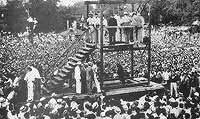
Since then, the practice has been discontinued on the grounds that public executions are a barbaric spectacle.
And yet, we still allow witnesses to executions, particularly relatives or others most affected by the crime. We seem to acknowledge their need for a sense of closure, and for the satisfaction of seeing that retributive justice has been done.
So why not give the entire community that satisfaction?
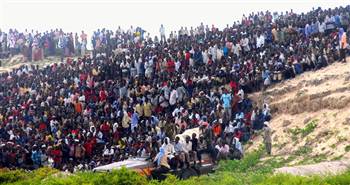
Today in Somalia, crowds gathered to witness the execution by firing squad of the murderer of a prominent businessman at the orders of an Islamic court.
The issue of public execution was recently reignited in America by the debate that erupted when Timothy McVeigh initially requested that his execution be televised. If you google "mcveigh execution television" you will note that his request garnered significant support, as well as vehement opposition. He was killed by lethal injection on June 11, 2001. There were ten witnesses -- family members of his victims and survivors of the bombing he committed.
If it were up to me, I would have allowed closed circuit television feeds of McVeigh's execution, available to adults who wanted to see that justice was done.
Crowds Gather for Execution in Somalia Today
Posted by: Ace at
02:33 PM
| Comments (31)
Post contains 239 words, total size 2 kb.
— Ace Today I'm going by Central Time, in honor of readers in the midwest. Or something. more...
Posted by: Ace at
01:58 PM
| Comments (6)
Post contains 21 words, total size 1 kb.
— Ace ...or I'll blow you up.
20-year-old male who wanted to join the USF soccer team was arrested Feb. 6 after threatening an unidentified staff member in the Athletic Department.According to a report from University Police, Moroccan native and illegal alien Nahil Mouad made "verbal threats of immediate harm" to a USF employee.
The report said Mouad chased after the victim saying he is "from Morocco," is Muslim and is going to "blow up" the unidentified staff member.
A nutter? Seems so. Just a lone nut, and no, I don't mean that sarcastically. There's a lot of doubt in the article about whether or not he is actually dangerous, or just enjoys telling people he might blow them up if he doesn't get what he wants.
Still, there seems to be a certain culturally-engendered casualness about threatening to blow people up.
Must be something particular to those who play soccer, I'm guessing.
Thanks to jdubious.
Posted by: Ace at
01:15 PM
| Comments (16)
Post contains 179 words, total size 1 kb.
A: You Won't Know Until Ten Years After The Fact
— Ace Good post by Blue Crab Boulevard riffing on a good column by Steve Huntley of the Chicago Sun-Times.
Huntley's key point:
Perceiving an inevitability in history (which may not always be there), we see that neither suspension of habeas corpus nor internment was necessary to winning either of the wars. Yet, the point is that in the midst of those conflagrations, neither Lincoln nor Roosevelt knew just what it would take to win. They knew only the catastrophic consequences of losing and were determined — ruthlessly determined — not to let that happen, to do what it took to win their wars. And they are justifiably honored as among our greatest presidents.What will it take to safeguard American lives today?
Maybe we could win this war by being kinder and gentler custodians of Al Qaeda murderers.
Maybe.
Maybe not.
I'd prefer to err on the side of caution. And ruthlessness.
Thanks to Larwyn.
Posted by: Ace at
12:50 PM
| Comments (65)
Post contains 190 words, total size 1 kb.
— Ace Talking with Rob, we got into a sort of theoretical discussion about Supreme Court power. I brought up the fact that there was a radical asymmetry in what was needed for the Supreme Court to create law of its own volition; they merely needed five unelected judges to create law. On the other hand, to overturn a Supreme Court decision, a much more difficult hurdle had to be jumped: a two-thirds vote in both houses of Congress and a 3/5ths majority of all states, acting through their legislatures.
Compare this with the Presidential veto/Congressional override scheme. Congress may pass a bill with one half (plus one) of each house. The President may veto the bill-- but a two-thirds vote by both houses of Congress overrides the veto. Now, a two-thrids vote in both houses of Congress is a hard row to hoe, but it is doable, at least in cases of the most unpolular Presidential vetoes.
There isn't a radical asymmetry between what is needed to block legislation and what is needed to overcome that blockage. An asymmetry, yes, but not a wildly disproportionate one.
In the case of the Supreme Court, anything that five unelected, appointed for life judges decide is the law is the law, and remains so in perpetuity, for all practical purposes. The Amendment process is very difficult (by the Framers' design), but the Supreme Court has arrogated to itself the power to amend the Constitution by a fairly easy mechanism. Five votes.
Why is there nothing in the Constitution similar to Congress' power to override the President's veto? Why is it not spelled out that Congress may override the Supreme Court with, say, a three-fifths (or two-thirds) vote in both houses?
Because, as Rob mentioned, the power of the Supreme Court to overrule the decisions of the political branches of government is nowhere in the Constitution at all. It was asserted by John Marshall in Marbury v. Madison, he himself deciding that, if the nation were ruled by a charter, and the courts were especially competent to interpret that charter, well then, by implication, the Court had the power to overturn legislation and executive actions which the Court believed were in violation of that charter.
But this is assumed authority by the Court. One the nation has acquiesced in, but assumed authority nevertheless.
As the Framers did not seem to ever contemplate the Court having such an enormous power -- a five-man veto over the any law passed in the United States, whether by the US Congress or any state legislature -- it's hardly surprising they didn't build into the Constitution a reciprocal, symmetrical override power to veto the veto. Having not planned on the Court having such power in the first place, they never contemplated the political power to check the Court's power.
You don't invent an umbrella if you never imagined the possibility of rain.
Now, this is all very theoretical and perhaps silly -- given that this is such a big step that no one at all is discussing -- but perhaps it's time for the Constitution to catch up with the Court's self-granted power of reviewing all legislative and executive action by amending the Constitution to provide for a 3/5ths congressional override of any Supreme Court decision. If we have a system of checks and balances -- or rather checks and counter-checks, as the veto/override pairing provides an example of -- where, precisely, is the counter-check on the Supreme Court? The Supreme Court has a check on the political branches, but where, precisely, is the political branches' counter-check?
If the Supreme Court can nullify any congressional or presidential action, doesn't the symmetry of check and counter-check suggest that Congress should have the power to in turn nullfy a Supreme Court decision?
A silly idea that can go nowhere? Well, another silly idea -- abolishing the Electoral College -- has got an awful lot of press, and some degree of traction. Not enough to actually pass the congress, let alone 3/5ths of the state legislatures, but there is a live political movement for this dubious "reform."
Why not reform, and clarify, the power of judicial review? As currently configured -- according to rules of the Supreme Court's own fancy -- the Supreme Court is pretty much the ultimate political power in the country, with no limitations on its power or jurisdiction (save for its ever-dwindling reserve of self-restraint), with only the well-nigh-impossible Amendment process to check and balance it. Does that make any sense? Should the Court have such a potentially limitless power, without even a single clause of the Constitution hinting at such, with the political branches having no reciprocal power to balance the Court?
When John Marshall announced this heretofore unexpected power of the Court, he conveniently forgot to mention any counterveiling power of the Congress to check it. I guess it just slipped his mind.
But that hardly means it should slip ours.
Eh. Kind of interesting, I think. And doable, though difficult, if enough people actually militate for such a change.
Posted by: Ace at
12:35 PM
| Comments (54)
Post contains 857 words, total size 5 kb.
44 queries taking 0.357 seconds, 151 records returned.
Powered by Minx 1.1.6c-pink.

