August 24, 2011
— Ace I condemn Obama for calling himself unpatriotic.
Obama criticized Bush for accruing $4 trillion in debt in seven and a half years; Obama managed that feat in 2 1/2.
I guess Obama's problem is Bush's relative slow-footedness.
This isn't even a "Well he did it too" thing. For God's sake, Obama castigated Bush for piling on that much debt, and rather than cutting it, as he promised, he... doubled it? And in only 2 1/2 years?
Consider that Obama's basic complaint was that so much debt was harmful and, um, "unpatriotic." So, Bush had added $4 trillion in unpatriotic debt. Obama's response is to add $4 trillion on top of that in just more than a half a term?
If the country was already crumbling under the collective weight of Bush's debt, what the hell was the Clown Prince of Socialism doing adding $4 trillion in fresh burden above and beyond the initial load?
more...
Posted by: Ace at
02:17 PM
| Comments (140)
Post contains 204 words, total size 1 kb.
— Ace I guess the really good part is that he's already been "vetted" by the media, eh?
Jon Stainbrook, chairman of the Lucas County Republican Party, said there is "high-level interest in the national Republican Party" in a potential Wurzelbacher candidacy."We are encouraging Joe to run," Mr. Stainbrook said. "He hasn't made any official decision yet."
...
Mr. Wurzelbacher wouldn't confirm or deny a congressional run. "I think it's a very interesting idea," he said Tuesday. "That's as much as I can say."
Thanks to Matt.
Posted by: Ace at
01:38 PM
| Comments (117)
Post contains 108 words, total size 1 kb.
— Ace Because I double-posted.
Posted by: Ace at
01:38 PM
| Comments (30)
Post contains 9 words, total size 1 kb.
— Ace Yesterday Allah caught someone calling himself "Paul Krugman" saying that if the DC earthquake had been bigger, it might have been good for the economy, as it would have resulted in money being spent to rebuild what had been lost.
Allah expressed some skepticism that this was actually Krugman.
But he also noted, if it wasn't Krugman, it would be hard for Krugman to explain what is wrong with the statement, as Krugman is actually an enthusiastic believer in the Broken Windows fallacy (that vandals who break windows actually improve the economy, by keeping glass-makers busy with replacement), and even thought 9/11 could be just what the economic doctor ordered:
It seems almost in bad taste to talk about dollars and cents after an act of mass murder. Nonetheless, we must ask about the economic aftershocks from Tuesday's horror.These aftershocks need not be major. Ghastly as it may seem to say this, the terror attack -- like the original day of infamy, which brought an end to the Great Depression -- could even do some economic good.
Well, it turns out, the new posting about the earthquake was in fact a hoax; the hoaxster admits it. But he also notes that what he said as "Paul Krugman" is quite consistent with what the real Paul Krugman really says, like claiming the Japan Nuke disaster could be "expansionary."
Posted by: Ace at
12:24 PM
| Comments (114)
Post contains 242 words, total size 2 kb.
— Ace

That's not the most interesting tidbit here, either.
Perry is a strong contender among key Republican subgroups. Older Republicans and those living in the South show especially strong support for him, at or near 40%. Conservative Republicans strongly favor Perry over Romney, but liberal and moderate Republicans support the two about equally. Perry's support is also above average among religious Republicans.
For a long time I have been contending that candidates must be viewed in respect to two criteria -- and not just one, as the more ideologically-minded thinkers insist.
The first criteria is ideology, of course.
The second criteria is non-ideological attractiveness. Not "squishiness," mind you. But things like practical results in achieving things that are universally -- not ideologically -- valued.
I call this second criteria "neutral goods." If Obama does manage something in Libya (though that's in doubt), that would be a neutral good, because few actively root against American geopolitical victories.
Clinton's surprisingly (and Republican-thwarting) economic record was a neutral good. No one can really argue a hot economy is a bad thing. Oh, people can grouse it got "overheated" and led to a recession, but every hot economy eventually comes to a recession.
You need as many ways to win in an election as possible. You cannot just place all of your chips on ideology. No more than 30% of the country, if that, consists of ideologically-driven pure conservatives. And probably quite a bit fewer than that, when you get into the details of it -- conservatives from farm states argue for continuing tax breaks for ethanol and general government intervention in agriculture. Older conservatives especially are often quite strident (Hi, Vic!) on the notion that a promise to socialistically subsidize older citizens, by taking taxes from younger ones, is as American as cherry pie.
If a candidate has nothing to offer but that ideology, then you've got maybe 30% of the electorate, plus some small percent of the public (10% at most) which, despite being not very ideologically rigorous or motivated, is motivated by ideology enough to disfavor the Democrats... who they also find to be over-much ideological, and in the wrong way besides.
This was my problem with Christine O'Donnell. Sure, ideologically, she was decent. But what had she actually done in her time on earth? What practical results did she achieve? She managed only to be a guest of last resort on cable news shows, and argue for social conservatism... ineptly.
Michelle Bachmann is no Christine O'Donnell, certainly, but I have the same "But what has she actually done?" problem with her. She says she "fought" against the Stimulus and "led the argument" against ObamaCare. As Tim Pawlenty noted -- and this was a more cutting remark than people generally credited as -- that's all well and good, but we also lost on both of those things.
So if the entire resume is about "fighting" and "arguing," and yet there is no positive tangible result to it... well, I fight and argue, too.
The strike against her in my mind, then, is that she appeals on pure ideology, and we are back at the 30% plus some bonus late-breakers, and not enough to get to a majority (barring Obama truly getting no good news and in fact getting worse news on the economy).
She cannot tell a less-ideological voter, "Sure, you may not agree with me on my political positions, but look at these neutral goods I achieved, things that no one can persuasively argue aren't good in their own right, no matter what your political persuasion."
I think ideological people ignore this at their own peril. It is one thing to be almost entirely ideologically motivated oneself -- we all have our motivations, after all. We all have different buttons and different drives.
But it is another thing entirely to insist, contrary to fact, that the majority of voters needed for a winning coalition are similarly driven nearly entirely by on-paper policy statements and ideological affirmations.
They're not. This is a fact. To pretend otherwise is to run away from the real world and retreat to a happy place of pure fantasy.
Nor is it any answer to hear, as I often do, "Well then, we will simply argue our case with such skill and force that we will convert the less-ideologically-driven voters into more-ideologically-driven voters, who more closely resemble ourselves, and share our motivations and drives."
That is no answer. Of course that is a goal.
But -- as Obama and the liberals need to understand, so too do less practically-minded conservatives -- a goal is not the same as a plan.
Of course I'd love a 51% majority for strong conservatism. Hell, I'd like a 60% majority. And why stop there? An 80% majority would be enough to do all we like.
But that isn't the current state of things and it is indulgent and solipsistic to pretend that it is, or is likely to be so in the near term.
So for a long time I have been arguing that we need a candidate who can appeal to these less-ideologically voters.
People often misunderstand this point, and who knows, perhaps sometimes they misunderstand it intentionally.
They often say, "Oh, you want a squish."
No. No matter how many times I have answered "no" to that claim, I still get it.
No, I don't want a squish. I want a fairly strongly conservative candidate. But, in order to persuade voters who do not share my philosophy, I want that candidate to have a record of non-ideological achievements, things that no one can argue aren't good, in addition to his ideology.
That gives you two chances to win a vote, rather than one. The ideological conservatives in a general election will choose, obviously, the more ideologically conservative candidate. Against Barack Obama, it's safe to say we get most of these.
But the less-ideologically motivated voters will not necessarily vote for the more-conservative candidate. They might; then again, they might not.
Having no strong ideological preference for a candidate, they will base their vote, as they always do, on non-ideological factors.
Charisma. "Seems like a regular guy" (which is in fact code for "not super-ideological like many of the professional politicians I, as a disengaged independent, tend not to like"). Experience -- reassurance that when it comes to the non-ideological skills of management, a candidate can actually work the basic functions of an executive office.
And, most important of all, actual positive results of a non-ideological sort.
It's not that I want a "squish." It's that I want a candidate who is strong on the issues, but who can also turn to a voter and say, "Even if you disagree with me, you can't argue I did something in my time in office that made things better, in practical terms."
Anyway, the point of this is, that while Perry beats Romney by a big spread among "conservative" Republican primary voters, Perry only narrowly loses the "liberal/moderate" voters by 17 to 21.
That's not an insignificant spread. But it's also not big. And this is exactly what I'm talking about, then: those liberal/moderate primary voters should, if we were talking about ideology alone, flock to the man considered (or claimed to be) a moderate, Romney, or Huntsman.
But they're not. They're sort of split between the believed-to-be-conservative Perry and the believed-to-be-moderate Romney. (In fairness, note I'm saying "believed to be" -- I do not actually believe Romney is a "RINO.")
Why? Why should the supposedly knuckle-dragging red-meat-throwing Perry have any appeal for them?
I think it's obvious. They're not voting entirely on ideological alignment. They're supporting someone based on non-ideological factors -- charisma, experience, "seems like a regular guy," tangible results.
I'm not saying Romney has none of those; I'm just saying Perry seems to have enough of those to attract supporters who really should be supporting someone else, based on ideology.
Obama did not win the White House by claiming to be the Liberal True Hope. He spoke vaguely about things. He actually ran on a tax cut, which deficit hawk McCain did not.
He won maybe 35% of the voters on ideology. He won 17% more on non-ideological grounds.
That's why his approval level is at 38 or 39%. (39% today.) If people voted for him to be liberal, why, he's been very liberal indeed. So in theory a majority or near-majority should still be supporting him. Minus the super-leftists for whom he has been too goshdarn conservative.
But they don't approve, because that 17% of his coalition wasn't supporting him to be liberal, but to simply change things in practical, tangible ways for the better. Which of course he has not.
At any rate, that is why I am always opposed to narrow-casting ideology-first-and-foremost candidates. It's not that I disagree with them ideologically -- it is simply that I cannot imagine someone who is not ideologically rightist like me seeing anything in them that's attractive.
I don't want squishes; I want ideology plus. Ideology plus some other factor or factors which may plausibly be predicted to attract support even from a non-partisan or non-ideological voter.
Is Rick Perry that kind of candidate? I think he is. I could be wrong; I'm wrong lots of times. But I know I'm right about the criteria for candidate selection. If I'm wrong, I'm wrong about Perry fulfilling my demand for an ideology-plus candidate; I am not wrong that ideology-plus is what is necessary to win an election.
The Two Minute Pitch: Maybe this is the way I think about this:
Can you create a two minute pitch for a candidate which could plausibly persuade a friend or family member who isn't into politics and really could go one way or the other?
And can you construct a such a pitch only mentioning ideology or partisan fights briefly?
Because bear in mind if they were sold on the ideology or partisanship, you wouldn't have to pitch them at all.
If I think about trying to sell, say, my Aunt Jeneane on Michele Bachmann, my pitch seems to be almost entirely ideological stuff she will just shrug at.
Posted by: Ace at
11:19 AM
| Comments (562)
Post contains 1706 words, total size 11 kb.
— Ace

No metaphor here, folks. Move on.
And if three of the four pinnacles on top of the National Cathedral fall off, and the central tower is now leaning, hey, look, things happen.
I suppose it's rather silly to point this out. Howard "Hacked!" Kurtz vomited a stupid tweet in which he snarked that Republicans would rush to blame this on Obama.
Well, not seriously. It's liberals who, quite seriously, attempt to blame earthquakes and tsunamis on Republicans, after all. Global warming causes tectonic rowdiness, it turns out.
But tell me, Howie, if this happened on Bush's watch -- are you claiming there would not be a lot of liberal media snarking about it?
Posted by: Ace at
10:21 AM
| Comments (217)
Post contains 145 words, total size 1 kb.
Plus: Is Obama's Payroll Tax Cut The Hill To Die On?
— Ace The CBO is required by law to "project" future deficits according to the current law as written -- even if the current law as written is almost guaranteed to be rewritten in perfectly predictable ways.
They can cook up alternative scenarios making different assumptions, per the request of a Member, but their lead report is just based on the current law.
Based on the current law, the deficit is projected to fall.
But as Ed Morrissey notes, this is based on a series of silly propositions.
Certain provisions of the 2010 tax act, including extensions of lower rates and expanded credits and deductions originally enacted in the Economic Growth and Tax Relief Reconciliation Act of 2001, the Jobs and Growth Tax Relief Reconciliation Act of 2003, and the American Recovery and Reinvestment Act (ARRA), expire at the end of 2012;The two-year extension of provisions designed to limit the reach of the alternative minimum tax, extensions of emergency unemployment compensation, and the one-year reduction in the payroll tax all expire at the end of 2011;
Sharp reductions in MedicareÂ’;s payment rates for physiciansÂ’ services take effect at the end of 2011;
Funding for discretionary spending declines over time in real terms, in accordance with the caps established under the Budget Control Act; and
Additional deficit reduction totaling $1.2 trillion over the 2012–2021 period will be implemented as required under the Budget Control Act.
That the Bush tax cuts will be allowed to expire is the most likely item on this list, and even that is somewhat unlikely. Adjusting the AMT is necessary and has always been done with little argument. The third item -- about the Doc Fix not being enacted next year -- is absurd, as we have delayed the cuts to doctors every two years since we supposedly cut their Medicare payment schedules under Clinton in 1996 or thereabouts.
Regarding the Budget Control Act, the most likely scenario is that neither party agrees to cuts, the automatic cuts go into effect, but then Congress passes a law reinstating most of the money scheduled to be cut from Defense. So the projected $1.2 trillion in cuts there will be closer to 700 billion or so.
Plus, there's the laughable idea that the economy is "expected" to grow by 2.3%. Ed comments:
The CBO estimates that the US economy will finish this year at a 2.3% GDP growth rate for 2011, a neat trick for an economy that has grown at 0.8% in its first two quarters, and at 2.7% in 2012. JP Morgan estimates that it will finish at 1.5% this year and 1.3% next year.
Oh and on top of that there is a very strong possibility we actually enter a negative-growth recession -- or in fact already have entered one.
Those "projected" growth rates hide a lot of deficit. Small changes in the "projected" growth rate increases (or decreases) the projected deficit by very large amounts.
Is it possible that a revised GDP projection (on the heels of the deeply disappointing first and second quarter numbers) will impact the estimates for future government tax revenue and, thus, the outlook for U.S. deficits?Put another way: What are the budgetary effects of say a 1 percent decline in real GDP growth?
Here is some useful short-hand* on how to think about this issue:
● If GDP comes in 1 percent lower than forecast for one year with a recovery back to the previous trend line shortly thereafter, the U.S. deficit would be roughly $80 billion larger over the ten-year window.
● If GDP comes in 1 percent lower for one year — and this decrease never gets offset with a stronger recovery (i.e., GDP does not jump back up to the previous trend line, so itÂ’s not technically “recovered”), then the U.S. deficit picture would be roughly $650 billion worse over the ten-year budget window.
● If GDP comes in 1 percent lower every year over the ten-year window, the U.S. deficit would increase by more than $3 trillion.
These are all big numbers, especially when juxtaposed with the savings from the BCA. This is why so many policymakers and analysts are focused on growth these days. GDP projections matter more than probably any other variable when trying to estimate how the U.S. deficit picture will look ten years from now.
And that is why the GOP should constantly agitate for the repeal of ObamaCare as both a deficit-reducing and growth-promoting measure -- a "stimulus" in which we save money rather than spend it.
But note how much the deficit will grow if the CBO's "projections" of near-term growth are off by 1% -- and they very well could be off by a hell of a lot more than that, if indeed the economy is double-dipping.
There's an additional interesting item on the list-- the one about Obama's payroll tax cut being permitted to expire. This is intended as a tax cut for the poor, who usually pay no income taxes at all, and only pay towards their own retirement and senior health benefits (and unemployment insurance) in the form of payroll taxes. But of course those taxes do not cover the full cost of those programs, and Obama's payroll tax cut means the deficit between what is paid and what is received in exchange for payment continues to grow.
Obama is demanding we extend this tax cut; Republicans resist that. The poor, as it is, pay no income tax as it is; it seems strange that they should even pay less for their own social welfare programs.
That said, this is a tricky thing -- while conservatives like to argue that "everyone should pay some taxes," Republican politicians do not often mention this on the stump, because no one wants to hear, especially from a Republican, "Dude, you're getting a tax hike."
Rick Perry mentioned this idea in his book FED Up!, that everyone should have skin in the game, but I doubt very much we'll hear it from him in the campaign.
Late last year, Ramesh Ponuru and Reiham Salam published an article about the growing class war within the Republican Party, the tension between higher-income Republicans and lower-income Republicans. They actually propose getting on board with payroll tax cuts for those too poor to pay income taxes, as a manner of attracting lower-income voters (including lower-income independents and "bitter clinger" Democrats).
he tax that falls most heavily on lower-middle-class voters is the payroll tax. Cutting any tax is a tough proposition in today’s fiscal circumstances. But a tax reform that reduces the burden of payroll taxes on young working-class voters who are trying to start families is well within reach: It would merely require increasing the child tax credit and applying it against both income and payroll taxes, replacing the lost revenue by reducing tax breaks. Among the most appealing targets are the state-and-local-tax deduction and the mortgage-interest deduction, both of which mainly benefit affluent households in high-cost, high-tax states.Such a reform would provide tangible assistance to many lower-middle-class voters — either now or prospectively, when they start families. The vast bulk of parents who pay enough in taxes for a child credit to be worth a significant amount of money are married, and supporting these couples might in a small way address one of the most troubling developments in lower-middle-class life: the ongoing collapse of marriage within that demographic, which is bad for our society and for conservative politicians.
Kevin D. Williamson argues that Obama's payroll tax cut is actually bad policy, but that it's not the hill to die on.
The political trouble here comes when Republicans simultaneously urge the extension of the Bush tax cuts for higher-income taxpayers, but then oppose the extension of a small cut in the payroll taxes designed to help lower-income voters. It's a tricky thing for Republicans to argue we're in favor of keeping tax rates low and leaving money in the pockets of the American citizens in the first instance, but want to raise this other tax.
Obama put us in a neat box on this one. I'm not sure what to do about it.
Lemons, Lemonade: Given that the payroll tax cut actually makes our unsustainable entitlements more unsustainable, by reducing still further the already inadequate funding for these programs -- raiding Gore's metaphorical lockbox, as it were -- some deal could be had in which such taxes were lowered in exchange for equal (or greater) reforms (meaning cuts) to these programs.
But that's not likely to be a plan anyone runs on, either.
Posted by: Ace at
09:48 AM
| Comments (133)
Post contains 1482 words, total size 9 kb.
— Ace He doesn't have the courage to say it straight, but in three tweets he makes the allegation by insinuation, in the typical cowardly manner of what might be called Polite Company Truthers -- those Truthers who want to "ask questions" but don't want to make any assertions which can be fact-checked and which might make them look a little odd at their next dinner party.
But it's very clear what he's saying.
Posted by: Ace at
09:19 AM
| Comments (113)
Post contains 88 words, total size 1 kb.
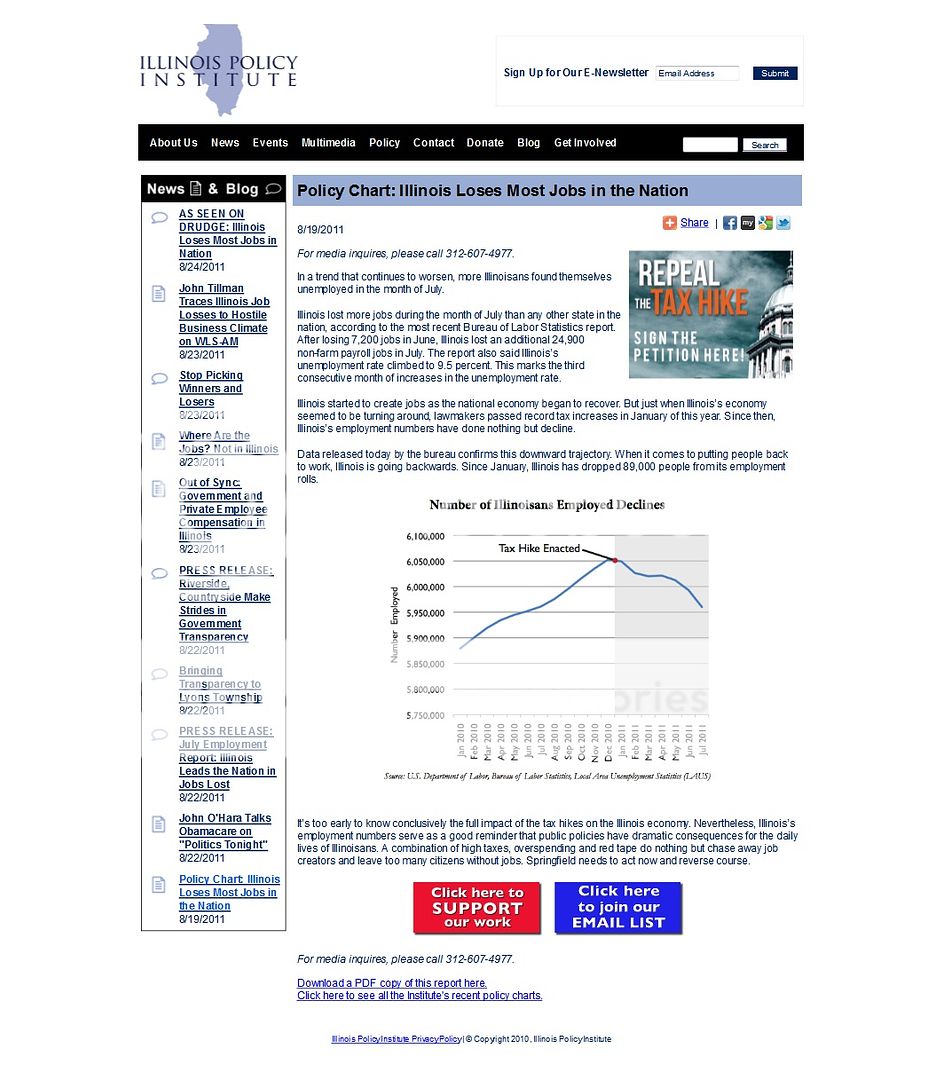
— rdbrewer One would think the pattern is becoming clear: Left-leaning, high-tax, big-regulation, big-government states and countries are suffering the most.
The site was being melted down by a Drudge link this morning, so I did a screengrab and put it here too. You should be able to click on the image to magnify.
Illinois lost more jobs during the month of July than any other state in the nation, according to the most recent Bureau of Labor Statistics report. After losing 7,200 jobs in June, Illinois lost an additional 24,900 non-farm payroll jobs in July. The report also said IllinoisÂ’s unemployment rate climbed to 9.5 percent. This marks the third consecutive month of increases in the unemployment rate.
The best part? The graph that accompanies the article:

Edit: Pssst. Hey, Illinois business. Come on down the pike a bit. Visit lovely Oklahoma. Hell, we love business.
Posted by: rdbrewer at
07:47 AM
| Comments (274)
Post contains 165 words, total size 1 kb.
— Open Blogger I am now willing to entertain their arguments with firm attention. Attention that had been flagging of late. Flaccid, perhaps, from a lack of stimulation.
Said stimulation will soon be at hand, and I for one am positively engorged with wonder at the prospect our basest animal vices exposed!
Indeed, you could say I am throbbing with anticipation for the climax of PETA's newest ground-breaking campaign.
This announcement leaves a public turgid and aching for release from the depredations of KFC, furriers, and professional hot-dog eaters. Release that will be provided, ironically, by professional hot-dog eaters.
PETA: I Salute You!.
...the organization will launch peta.xxx as a pornography site that draws attention to the plight of animals.
The best jokes will be in the comments, I am sure.
Posted by: Open Blogger at
07:06 AM
| Comments (272)
Post contains 160 words, total size 1 kb.
41 queries taking 0.1932 seconds, 148 records returned.
Powered by Minx 1.1.6c-pink.