


May 18, 2013
— Open Blogger I was replying to someone's question on some forum and couldn't get the freaking captcha shit to work and couldn't post it, so rather than wasting all this typing I did on a perfectly good answer, I'm making it a home improvement post.
The dude in question got red tagged on an inspection and wanted to know why. He had a 12-2 Romex and 14-3 Romex in the same box, and a couple of switches feeding lights. His description of his issue was horrible and didn't actually describe the precise situation, but here we go....
"Regarding new construction wiring and running 12/2 and 14/3 wire in the same box."
Are there two branch circuits here or one?
If one circuit. i.e. lights, If the #14 is going to lights and the #12 is the same circuit from the panel powering the lights (power inbound from panel, power outbound to lights), then you'd be REQUIRED to use a 15A breaker on that circuit.
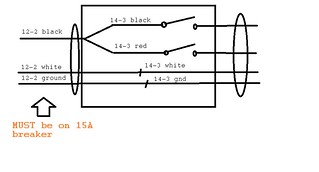
I'll frequently come heavy out of a panel to reduce voltage drop over long runs, or because of derating issues in a hot attic, then drop down in size as it gets near the loads or dives down into walls. General rule for mixing wire sizes on residential work: breakers/fuses get sized to the smallest wire on a branch. If you're bucks down with a bunch of scraps laying around and don't want to invest in a bunch of new wire, yea, you can mix sizes and use them up if you know what you're doing.
Other than blowing out a box fill requirement(3), there's absolutely nothing in the code that prohibits mixing wire sizes on any particular branch as long as the smallest size wire is big enough for the breaker/fuse and doesn't run into derating issues with pipe fill(1), ambient temperature(2) and such.
If there are two circuits (and two breakers/fuses), say a 20A on the 12/2, and a 15A on the 14/3, that too is permitted, BUT if the two branches land on a device (ex. a split feed receptacle, or a stack switch with the hot interconnect tab busted off making it essentially two completely distinct switches), THEN the 15A and 20A breakers MUST be placed side by side and connected with a "handle tie". Separate circuits that do not land on the same devices aren't required to have handle tie on breakers, but its something I usually do anyway so the next guy has a clue about what's going on. The handle tie is a clue that there's multiple live circuits on devices somewhere downstream.
All grounds in a box must be spliced together regardless of wire size(4). The only exception to this is isolated ground circuits...you won't find too many of those in residential situations.
Another possibility for this fellow getting red tagged is he's become a victim of a new electric code change -- starting with the 2011 NEC, switch loops for lights (which electricians have used for 100+ years) where there's not a neutral wire sent down into the box too have been made illegal. You can thank California and its obsession with occupancy sensors for that one. One state's crazy became a national requirement. The current to run occupancy sensors in a switch loop situation had been using the ground as a way to complete a circuit. The current was only milliamps, but when enough of them got added up on any given circuit, they were causing Arc-Fault breakers to trip. All Arc-Fault breakers include 30ma worth of ground fault protection, so excessive leakage on the ground trips them.
(1) In situations where there's more than 3 current carrying conductors in a conduit consult the NEC derating charts to figure out how much the wire needs to be upsized.
(2) When running wire through abnormally warm locations (like attics) you need to take the ambient temperature into account when sizing wire. There's extensive tables in the NEC covering all the temperature ranges and insulation types.
(3) You can't just jam as much shit as you want into an electrical box. The NEC has specific fill limits requiring a certain number of cubic inches of volume be available for each wire in the box. Those values vary by wire size. Sometimes something will be "book legal" and you'll have problems jamming all the shit in anyway. This happens a lot with GFCI receptacles and dimmers that take up inordinate amounts of space.
(4) All the grounds in a box count as one wire for box fill calculations -- the largest one. If you had say 3 14ga, 2 12ga, and 210ga grounds in a box, all that shit counts as ONE 10ga wire for box fill purposes and gets spliced together. Even though all the grounds only count as one, they can take up a shitload of volume and make stuffing a box a real challenge.
Posted by: Open Blogger at
09:10 AM
| Comments (97)
Post contains 835 words, total size 5 kb.
Posted by: @PurpAv at May 18, 2013 09:16 AM (/gHaE)
Posted by: Stephana at May 18, 2013 09:18 AM (nfC6Z)
Posted by: BCochran1981 - Credible Hulk at May 18, 2013 09:18 AM (GEICT)
Hey Purp, a lot of folks down here will run their grounds to an outside water spigot. In fact, that was done here at Casa Backwardio, and this place was replumbed with plastic pipe instead of the original copper tubing. As I've talked with some of the long-time residents of this area (they're all condos), I discovered that everyone has been replumbed.
I've wondered if the ground caused pinhole leaks in the copper pipe. Evidence suggests this to be true. If so, then why is it done? Besides the obvious benefit to plumbing companies, that is.
Posted by: BackwardsBoy, who did not vote for this shit at May 18, 2013 09:20 AM (+z4pE)
Posted by: Burn the Witch at May 18, 2013 09:24 AM (NcPjb)
Posted by: KG at May 18, 2013 09:24 AM (IPz9m)
Posted by: Truck Monkey at May 18, 2013 09:25 AM (jucos)
Posted by: Burn the Witch at May 18, 2013 09:26 AM (NcPjb)
Posted by: Berserker at May 18, 2013 09:27 AM (FMbng)
Posted by: Elizabethe on the phone at May 18, 2013 09:27 AM (GiKhl)
A lot of inspectors will give a DIY a hard time if the works is sloppy and full of issues (often the case). They're trying to give a subtle hint that the DIY is in way over their head.
If you did something that's perfectly legal, and whip out your code book (just having one impresses inspectors) and show them how it was legal, they usually back down. If they don't, there's an appeals process. If they get overturned on appeal, that a major black mark.
Posted by: @PurpAv at May 18, 2013 09:29 AM (/gHaE)
Posted by: USA at May 18, 2013 09:29 AM (VIaw0)
Posted by: BackwardsBoy, who did not vote for this shit at May 18, 2013 01:20 PM (+z4pE)
I believe my electrical inspector told me I had to ground my copper plumbing pipe and any sections isolated by plastic pipe had to be grounded also.
Posted by: Ronster at May 18, 2013 09:30 AM (sa3Ro)
Posted by: NotCoach at May 18, 2013 09:30 AM (jU7Af)
Posted by: Oblivious at May 18, 2013 09:31 AM (XA2k4)
Posted by: Elizabethe on the phone at May 18, 2013 09:31 AM (GiKhl)
Posted by: Helen Thomas' Vibrator at May 18, 2013 09:31 AM (BBWjt)
Posted by: Zombie Bon Scott at May 18, 2013 09:33 AM (A5Abh)
Posted by: Elizabethe on the phone at May 18, 2013 09:33 AM (GiKhl)
Crap, now that I think about it, I believe that it was the phone land line that was grounded to the spigot.
Isn't there some small amount of voltage in that line?
Posted by: BackwardsBoy, who did not vote for this shit at May 18, 2013 09:34 AM (+z4pE)
Posted by: Up With People at May 18, 2013 09:35 AM (krveP)
Its probably due to leakage current on the ground. I've clamped an amp probe on some ground rods where the power to the structure was totally OFF and still read 5-7A.
When someone else has nicked UF or damaged triplex, that shit will travel pretty long distances. Some of it will leak up your grounding system, into YOUR meter, then out through YOUR neutral back to the poco.
Years ago, leakage current of this sort killed a little girl at a public swimming pool. The source of the leak was eventually traced to a sports stadium miles away.
Posted by: @PurpAv at May 18, 2013 09:35 AM (/gHaE)
Yeah, Ronster, your point makes a lotta sense, especially down here where we have a lot of lightning storms. I've been zapped during a storm before, cleaning out a bunch of leaves blocking a gutter downspout.
Let's say, it got my attention.
Posted by: BackwardsBoy, who did not vote for this shit at May 18, 2013 09:36 AM (+z4pE)
They are supposed to cite the code section they're busting you on if you ask.
Posted by: @PurpAv at May 18, 2013 09:36 AM (/gHaE)
The telco does that all the time...they assume the rest of the piping is grounded. But it might not be.
Posted by: @PurpAv at May 18, 2013 09:39 AM (/gHaE)
Posted by: Up With People at May 18, 2013 09:39 AM (krveP)
Posted by: @PurpAv at May 18, 2013 09:42 AM (/gHaE)
Years ago, leakage current of this sort killed a little girl at a public swimming pool. The source of the leak was eventually traced to a sports stadium miles away.
I remember that incident, too. Thanks, Purp.
OK, I'm off, gotta get ready for an early music gig tonite. Y'all have fun and try not to trash the place, 'k?
And remember, if you can't be handsome, you should at least be handy.
Posted by: BackwardsBoy, who did not vote for this shit at May 18, 2013 09:42 AM (+z4pE)
Posted by: Up With People at May 18, 2013 09:42 AM (krveP)
Posted by: @PurpAv at May 18, 2013 09:44 AM (/gHaE)
only two implements in your toolbox, eh?
Posted by: fluffy at May 18, 2013 09:45 AM (z9HTb)
Posted by: Ronster at May 18, 2013 09:48 AM (sa3Ro)
Posted by: Up With People at May 18, 2013 01:42 PM
yeah unless you had federal pacific circuit breakers. Your dishwasher area would look like it got into a fight with a deathstar.
Posted by: Berserker at May 18, 2013 09:49 AM (FMbng)
I had to have the main electrical box at Château de Hrothgar upgraded and the inspectors required two separate ground rods driven in three or four feet and separated by 6 feet. No plumbing connection whatsoever was required.
Posted by: Hrothgar at May 18, 2013 09:50 AM (Cnqmv)
Posted by: NotCoach at May 18, 2013 09:51 AM (jU7Af)
Posted by: Up With People at May 18, 2013 09:51 AM (krveP)
Inspector was wrong...plumber was correct. Inspector got all puffed up and righteous. Plumber called state board. Inspector got his dick slapped.
Posted by: CharlieBrown'sDildo at May 18, 2013 09:51 AM (O6Tmi)
Posted by: Hrothgar at May 18, 2013 09:52 AM (Cnqmv)
Posted by: Regular Moron [/i] at May 18, 2013 10:04 AM (U2UQk)
Posted by: 4TZNh at May 18, 2013 10:08 AM (4TZNh)
Yep. Can't go wrong there.
Once in a while you find some DIY wired multi-unit structure where some ass had circuits shared between different rental units.
BTDT, got the T-shirt.
Posted by: @PurpAv at May 18, 2013 10:14 AM (/gHaE)
Posted by: @PurpAv at May 18, 2013 10:15 AM (/gHaE)
Posted by: Elizabethe on the phone at May 18, 2013 10:21 AM (GiKhl)
Posted by: 'Ette in training, a striving wannabe at May 18, 2013 10:34 AM (zvxqj)
purp,
What is your opinion on the stab in connectors for recepticles and switches? I always use the screw even though it takes more time.
Posted by: Ronster at May 18, 2013 10:37 AM (sa3Ro)
Posted by: Krebs v Carnot: Epic Battle of the Cycling Stars at May 18, 2013 10:39 AM (WxJTH)
Tankless water heater.
I've never used one myself. My friend installed one and it worked fine. I guess the most important thing is to size it for the maximum gpm of hot water you are going to need at any given time.
Posted by: Ronster at May 18, 2013 10:40 AM (sa3Ro)
Posted by: and irresolute at May 18, 2013 10:42 AM (DBH1h)
Propane and NG burn at different temps. They may look identical externally, but will have subtle internal differences for the different gas types.
The tankless may be less hassle since draining it down for winter is a lot easier, its only going to drain out a gallon or so. Whoever plumbs it can just rig up drain valves on the input/output lines, and you can winterize it with a bucket.
Draining down a 40gal tank for the winter is a lot of gallons and a hose kinda deal...where if the water is kinda hard and the bottom sludges up, could take many hours at a trickle rate through the gunk.
Posted by: @PurpAv at May 18, 2013 10:42 AM (/gHaE)
Posted by: NotCoach at May 18, 2013 10:45 AM (jU7Af)
Draining down a 40gal tank for the winter is a lot of gallons and a hose kinda deal...where if the water is kinda hard and the bottom sludges up, could take many hours at a trickle rate through the gunk.
This will not happen if the water heater is flushed as recommended on a yearly basis. Heh.
Posted by: Ronster at May 18, 2013 10:47 AM (sa3Ro)
Posted by: NotCoach at May 18, 2013 10:49 AM (jU7Af)
Posted by: locomotivebreath1901 at May 18, 2013 10:49 AM (6iKP6)
They fail. Frequently. When I was rewiring my crib, probably half the shit grade receptacles/switches had the wire fall right out of them as I eased them out of the box.
There's commercial grade stuff that has back openings where internal clamps are torqued down with a screw. Those are fine, and particularly convenient for stranded wire and situations where there's ain't much wire left in a box and adding a pigtailed on length and a wirenut would make stuffing the box almost impossible.
Avoid the poke in ones like the plague. I've only seen a few devices that were poke-in only. Leviton made some, and there were some Square-D breakers many years ago that uses the poke-in shit...throw them away
Posted by: @PurpAv at May 18, 2013 10:50 AM (/gHaE)
Posted by: NotCoach at May 18, 2013 10:58 AM (jU7Af)
My development is about 20 years old and backstab failures have been multiplying like cockroaches the past 10 years.
Whenever some neighbor knocks on my door looking for help with original install stuff, its almost invariably a backstab failure these days.
Anything that draws enough current to get the spring fingers hot eventually anneals the metal and the spring gets weaker. It becomes a vicious cycle.
Posted by: @PurpAv at May 18, 2013 11:01 AM (/gHaE)
Posted by: Ronster at May 18, 2013 11:04 AM (sa3Ro)
Yes. Last year a neighbor had a 3-way fail. The wire was completely loose and arcing. I just pulled it out made a loop and screwed it down since the switch contacts were still good.
The other issue is their physical robustness. The cheap shit doesn't have a full metal backstrap and when people start yanking cords, I've seen'em break right in half.
Posted by: @PurpAv at May 18, 2013 11:05 AM (/gHaE)

Posted by: NotCoach at May 18, 2013 11:06 AM (jU7Af)
Being 85% efficient, they save a lot of money over electric tank-type water heaters...not so much over gas-fired types. The only real downside is the 6 second delay between opening the faucet valve and the production of hot water - that's in addition to the lag due to the length of plumbing to the fixture.
I also use mine to supply the heated tile floor in my bathroom.
Mine are mounted outside, which saves on the expensive vent pipe. They are freeze-protected down to 5 degrees F.
They use a lot of gas (about 200,000BTU/H), so 3/4" gas pipe and suitable regulator is recommended to feed them.
I bought my Takagi units on sale at pexsupply.com
Posted by: snopercod at May 18, 2013 11:07 AM (LvTrc)
Shit where the switch/receptacle is kinda floating around with long screws holding it in rather than firmly joined with the box/mud ring will slowly work on those spring fingers as the device shifts around.
I spend an inordinate amount of time getting it right with BE1/BE2 extenders, washer/caterpillar packing, etc so the device ain't floating around.
Posted by: @PurpAv at May 18, 2013 11:10 AM (/gHaE)
Posted by: snopercod at May 18, 2013 11:11 AM (LvTrc)
Posted by: tsrblke (Phone) at May 18, 2013 11:16 AM (MTSwl)
Yea, I got some in my crib...stacked switch and "tamper resistant" receptacle. They're not kid proof, they're fucking human proof.
If you experiment a bit with insertion angle, you'll find a sweet spot where they'll kinda work.
If they really wanted to protect kids from electrocutions, Cutler Hammer makes a "combo" Arc-fault/GFCI breaker.
Its really just an Arc-Fault that has its GFCI protection trip level set to 5ma rather than 30ma. I've used them a lot when keeping really old two conductor Romex in place. The 5ma GFCI protection allows you to put 3-prong receptacles in on old 2-conductor wiring
Posted by: @PurpAv at May 18, 2013 11:24 AM (/gHaE)
Posted by: PepeLp at May 18, 2013 11:25 AM (kwIcm)
The NEC is silent on receptacle orientation. You may have some local amendment requiring particular orientation though.
I've seen immediate turn cords where they expected ground down, and others where they expected ground up. No matter which way they're oriented, there'll be something that screws you.
Posted by: @PurpAv at May 18, 2013 11:28 AM (/gHaE)
I never would have believed it, but I had some cheap (builder) receptacles that basically fell apart when I was replacing trim. I am convinced the the building inspector on the original job found a few 100 dollar bills in the main box right before he signed off.
Posted by: Hrothgar at May 18, 2013 11:30 AM (Cnqmv)
Part of that, I think, was that the original wiring was undersized and fabric covered. I did everything with 12 ga (hot Houston attic) modern cable.
In other words, what I did was vastly better than the original; even if I made a few mistakes, the house was a thousand times safer.
===
Back-stabbers: yeah, I avoid those kinds of devices myself. I do have a fondness for the combination types, where you poke the wire into the hole, then tighten down the screw. Perfect, and you don't have to form the loop around the screw. Just be careful not to put two different wire gauges next to each other
I'm also fond of the push-type connectors that are replacing wire nuts. (Wago, I'm told, is the preferred brand, although Ideal is easier to find.) Much easier to use, and much more compact in a crowded box. Apparently, those use a more secure arrangement than the devices did. And, unlike switches and outlets, they're not subject to being wiggled in normal use.
My current house has some old aluminum wiring. I occasionally have to splice into that, or replace a scorched wire nut. (!)
The preferred method is a short stub of screw-type bus terminal in a purple plastic box (Alumicons). They're easy to use, come preloaded with anti-oxidant, and are reasonably compact. Only thing is, you're supposed to use a $70 torque screwdriver to set them. Uh huh. (Or there's a crimp connector applied with a thousand dollar specialty hydraulic tool from AMP. With their day long training. Uh huh.) Again, though, for my purposes, anything I do is better than the existing crap.
Posted by: DJMoore at May 18, 2013 11:31 AM (ayoGu)
Posted by: AE at May 18, 2013 11:37 AM (Dt2lZ)
I got a $150 SnapOn torque screwdriver. Its awesome for getting torques on the small stuff right...but it was $150 too.
Posted by: @PurpAv at May 18, 2013 11:39 AM (/gHaE)
I always write a message on the panel cover when I go heavy that sounds like this:
"The breakers in this panel have been correctly sized due to derating and/or downstream smaller wire in the branches. DO NOT fuck with this shit unless you REALLY know what you are doing!"
Posted by: @PurpAv at May 18, 2013 11:43 AM (/gHaE)
Posted by: Rufus T. Firefly at May 18, 2013 12:17 PM (PwV7G)
Posted by: Rufus T. Firefly at May 18, 2013 12:42 PM (PwV7G)
Posted by: toby928© at May 18, 2013 01:24 PM (QupBk)
Posted by: VADM(Red) Cuthbert Collingwood (Mentioned in Despatches) at May 18, 2013 01:52 PM (p4U6S)
The handle tie requirement so someone will have to shut off both breakers to work on a device that has two circuits on it.
ex. a split feed duplex receptacle where one half is on one circuit, the other half is on another.
If you don't turn both breakers off, you get a big surprise when you grab that receptacle and pull it out of the box and one half is still live.
People do this kind of thing all the time when they want more than 15/20A available in one spot. Very common for dishwasher/disposal hookups. The washer'll be on one circuit, the disposal on another.
Posted by: @PurpAv at May 18, 2013 01:56 PM (PqMHM)
Posted by: Endeavor to Persevere at May 18, 2013 02:05 PM (zZJJp)
Posted by: Rufus T. Firefly at May 18, 2013 02:06 PM (PwV7G)
Electricians call that the apprentice ;->
"Oh, you got lit up eh? We got us what they call a teachable moment now that your attention has been focused properly. Here's why it happened and how to avoid that in the future..."
Posted by: @PurpAv at May 18, 2013 02:32 PM (PqMHM)
Posted by: Walknot at May 18, 2013 02:41 PM (cey9b)
Posted by: 'Ette in training, a striving wannabe at May 18, 2013 02:58 PM (zvxqj)
I probably run more circuits than necessary, but I now have serious compartmentalization if something goes wrong. Oh, and every circuit entering the panel is properly run around the perimeter of the panel to the breaker, neutral bus, and ground bus. Lots of right angles in there.
Posted by: Captain Ned at May 18, 2013 03:16 PM (i+Fm3)
Posted by: Jean at May 18, 2013 03:24 PM (VHfsw)
Posted by: @PurpAv at May 18, 2013 03:44 PM (PqMHM)
The thing is, when you're derating for high ambient, or a packed conduit, or correcting for objectionable voltage drop, the larger size wire IS the "correct wire".
In some cases, 10ga on a 15A breaker is correct. My attic's peak has temps over 145 degrees on a hot summer day. It was mandatory per the NEC to run the string of lights down the peak on 10ga wire.
Posted by: @PurpAv at May 18, 2013 03:49 PM (PqMHM)
Meeting the bare minimum electric code requirements is like passing a class with a D- ;->
Posted by: @PurpAv at May 18, 2013 03:52 PM (PqMHM)
Posted by: Rats Alley at May 18, 2013 05:31 PM (XACbv)
Not at all. The NEC has reasons for why they want it done that way, it is much smaller and more clear cut than the tax code, doesn't change as much as tax code and doesn't generally change due to the capricious and arbitrary whims of paid off politicians.
I actually LIKE the NEC. The tax code... not so much.
Posted by: FrankReality at May 18, 2013 05:39 PM (Bn9It)
15A is fine for lighting and general receptacles when there's enough circuits. The code minimum that allows one 15A to serve a modern day bedroom is weak though. A wide screen, a couple of desktop computers and a space heater will trip a 15A breaker.
I like to put at least two lighting circuits in a room (you're never completely in the dark on a breaker trip) and have that room's receptacles spread around over several different circuits (you can turn off one, and still have power to run tools and worklights without running lead cords).
Its more work to interleave the branches around between different rooms that way, but the end result is a lot more usable.
The hair dryer breaker trippy thing was dealt with some years ago with a code change mandating 20A dedicated circuits on the bathroom receptacles.
In older places its still common to find a single 15A branch running the garage lights, garage receptacle, multiple bathroom lights/fans and receptacles, as well as outside receptacles. My place was built in 89' and that shit was still legal then...
...the dedicated bath 20A receptacles were one of the first things I reconfigured when I started rewiring the joint to modern specs.
Posted by: @PurpAv at May 18, 2013 05:59 PM (PqMHM)
Posted by: snopercod at May 19, 2013 06:30 AM (LvTrc)
Hide Comments | Add Comment | Refresh | Top
64 queries taking 0.2237 seconds, 225 records returned.
Powered by Minx 1.1.6c-pink.


Posted by: BCochran1981 - Credible Hulk at May 18, 2013 09:13 AM (GEICT)