


April 13, 2011
— Ace I think he's wrong. Not to go all Obama on him, but he's presenting an honest-to-goodness false choice.
First he quotes former Slate colleague Jacob Weisberg offering a Devil's Endorsement of Ryan's plan -- that's a term I just made up, to describe a pretend-endorsement of an opponent's side which is really a slam and an attempt to win points for your own side.
Ryan’s alternative to Medicare hardly seems as terrible as Paul Krugman makes out. Seniors would enter the health care world the rest of us live in, with co-payments, deductibles and managed care. Eventually, cost control would require some tough decisions about end-of-life care and the rationing of high-tech treatments that have limited efficacy. But starting with a value of $15,000 per year, per senior—the amount government now spends on Medicare—Ryan’s vouchers should provide excellent coverage. His change would amount to a minor amendment to the social contract, not a fundamental revision of it.
Ah. Ryan's Plan = Death Panels. And to the extent I'm saying nice things about it, it's only because Ryan's plan exposes the Death Panel charge for the hypocrisy and lie it always was. Take that, cons!!!
Right, Jacob. Sure. I really believe you are on my side on this.
Anyway, Kaus uses this as a jumping-off point for his Rationers/Treaters theory:
That’s why I’m convinced the major fault line in the health care debate in the coming decades won’t be between those who do and don’t want to diminish the government’s role–by, say, replacing the open-ended benefits Medicare recipients now get with a Ryan-style limited subsidy for purchase of health insurance. Sure that’s one debate, and it’s happening now. But the bigger fault line will be the line that is just emerging, between those who want Americans to keep getting whatever health care will make them better–which is more or less Medicare’s current, costly posture–and those who accept some system, whether public or private, that would deny them some treatments because of their expense: The Treaters vs. the Rationers.
Not so. Costs in the medical sector are exploding for a multiplicity of reasons but the major one is the lack of cost discipline -- when very few people who are the end users of the service, and service selectors, are actually paying anything for it, they have absolutely no reason to question the price and no reason to ask for less expensive options.
It is well-known that doctors will give you a discount if you're paying out of pocket... but what they're really doing is overcharging all the people who aren't bothering to check the price.
Furthermore, when there is almost no cost at all for a thing then people will naturally tend to overuse it.
The problem with health insurance is that it's not insurance. This cannot be stated enough times. Health insurance is not insurance. Insurance, by definition, insures you against a small-ish risk. You pay a small-ish amount of money so that should that risk come to pass, you will be insulated against it monetarily (i.e., you'll get an insurance pay-out to cover the huge expenses).
Current health care insurance is not insurance. It is simply your employer paying a third party to pay for all of your medical needs, whether they are a "risk" (catastrophic illness) or a "known, definite, predictable cost, same as weekly costs for food" (eye exams and eye glasses every year, flu shots every winter, check-ups every year, routine arm-breaks and ankle-twists and back-spasm care...).
It is not "rationing" to restructure MediCare such that it is through a private insurer and furthermore that there are co-pays on most items and a decent-sized deductible. (The deductible serves as a risk marker -- the risk to the insurer is that you'll hit your deductible and they'll be on the line for most everything above that; but below that line, you pay for most of your care.) That simply imposes cost-awareness and price-sensitivity and cost-benefit-thinking to an industry which is exploding with costs because for 90% of its consumers such considerations are wholly absent.
A deductible of $5000 may sound like a lot, and sure, it is. But at least below that $5000 level there will be some cost-discipline imposed by the end-user, rather than doctors and hospitals and drug companies making up their own prices because the end user isn't checking, and his actions bind his third-party payor.
And, frankly, anyone above the poverty line has $5000, or could have $5000 in a loan, to cover his medical expenses should he become catastrophically ill.
You're dying and you can't put off buying a newer used car? I think you can.
At any rate, this isn't "rationing." Rationing is the system the Democrats want, which is where we create an illusion that the government is paying for everything, but in reality, we cut costs on the back end by stepping in stealthily and guiding doctors and even patients away from such care options.
It is better to be upfront about these things. If you're catastrophically ill, you'll get everything paid for, above a certain amount. Below that? You have a 55" freakin' inch HDTV and you can't spend $2000 out of pocket on your own health, your own body, your own life?
Really? Is that where we are?
Now, insurance, as I said, is not insurance. It is your employer deciding to give you $5000 in bonus salary but the form of this salary is paying for your standard, routine medical expenses.
But that's what the poor, who don't have insurance, by and large, consider "insurance," and they don't understand that true insurance would not be disguised salary, as what we term as "insurance" now, but catastrophic health insurance.
And for the poorest, we can provide that.
But most of the poor wouldn't end up using that (as most people are fortunate enough not to be seriously ill), so they wouldn't even realize they were so insured, and so, then, most crucially, they wouldn't realize they had their Politician-Benefactors to thank for it.
That's why every goddamn government "insurance" scheme offered always makes sure it covers a large portion of even trivial expenses -- so that the public knows who to thank.
The prescription drug coverage bill made sure it did this. Bizarrely, it covered a lot of low-level drug costs, then created a "donut" for less-subsidized costs for middle-level drug needs, and then covered everything above a high level.
That makes no sense, does it? Cover the minor costs then create a donut in the middle with much less covered costs? Shouldn't it have been structured so that low level costs were born entirely out of pocket, and then middle level costs were covered half, and then high level costs were covered almost completely?
Sure that would have made sense... but too many people would have wound up not getting any government money for their low-level drug costs and so they wouldn't know who to thank.
ObamaCare is like this. They could have set up some kind of catastrophic health insurance plan which would be relatively cheap-ish but would take care of people when they got really sick. But up to that level, you'd pay your own way.
But then the poor people wouldn't even realize that ObamaCare existed (unless they got seriously ill). So of course we have to structure it so that routine check-ups are covered. The peasants need to know which dukes to thank for their munificence.
Same with care for the elderly. There is no reason that comparatively well-off seniors shouldn't be paying their own medical costs up to a certain level. Changes like that would not only save trillions, but bring some cost discipline to a field in dire need of it.
But no, we always have to make sure that as many people as possible are getting a government check as frequently as possible. So everyone knows who just bought their vote.
Posted by: Ace at
08:52 AM
| Comments (79)
Post contains 1361 words, total size 8 kb.
— Ace Gee this seems familiar.
[T]here just aren't enough rich people to generate the kind of revenue needed to substantially reduce deficits.To show the disparity, consider some recent calculations by the Congressional Budget Office. Raising all six income tax rates by 1 percentage point would yield an additional $480 billion over 10 years. By contrast, raising the top two rates by 1 percentage point would yield just $115 billion.
...
All told, [Obama's proposed tax hikes only for conveniently small groups of people] -- which would affect individuals making at least $200,000 and couples making $250,000 and up -- would reduce deficits by just under $1 trillion over 10 years.
That's only about a third of the deficit reduction that would occur if lawmakers just let all of the Bush-era tax cuts expire.
A country can sustain huge subsidies for a hugely populous cohort only if it's with the other hand taking huge amounts of tax revenue from that same cohort.
The Democrats have always sold social welfare programs the same way -- they want to subsidize the poor, which is nice, but not particularly popular, so they always entice the middle class with promises that the middle class, too, will receive the same subsidies. (Well, less so, because they have to take a big skim out of that to subsidies the non-tax-paying poor, but the middle class gets some back.)
The trouble is that they have escalated benefits for the middle class far beyond the tax revenue the middle class is willing to contribute, or Democrats dare ask them to pay. Therefore our current DOOM: We're paying out huge amounts of money to the middle class (which is popular) but only taking from them enough to partly pay for those benefits (which is also popular).
Two wonderfully popular elements to the Democratic plan of perpetually offering more welfare to the middle class, and the only downside is the country is going to be destroyed.
So the Democrats must do what they have always avoided doing: They must either tell the middle class that their popular subsidies are going to get slashed, or they must tell the middle class they will have to pay much higher taxes in order to fund the subsidies that aren't really subsidies, in as much as it's just the middle class sending a tax check to Washington and Washington sending them back a much-diminished portion of it, with big skims taken out to subsidize the poor, various boondoggles that result in campaign contributions, and administrative sloth and inefficiency.
The whole Democratic appeal is based on the notion that you can have more money than we have. For a long time, due to favorable demographic forces (the huge bulge of young people in the Baby Boom), the fact that the system was or would be paying out far more than it was taking in was disguised.
But now, as those previously tax-contributing Baby Boomers are about to cash out, en masse, that favorable, concealing demographic bubble is about to have the opposite effect.
I don't know what Democrats can do about this, except do as Harry Reid does and put us on a path of financial armageddon. Because, as a party, they simply have nothing else.
Thanks to Andrew's Dad for tipping me to this last night.
Oh: By the way, the deficit shot up almost 16% (15.7%) the first six months of this year alone and due to the magic of compounding interest it only gets worse from here.
Oh: And the Republicans are no better, because they won't cut spending or tell the public the truth.
My position on taxes and spending is evolving, I have to admit. If the Republicans won't cut spending, as they apparently will not, always promising to get serious on cuts after the next election cycle (and then, when that cycle has passed, declaring the next cycle is even more important so we mustn't cut until after that one, too), then I have no choice but to support broad-based, significant tax increases.
Since I don't want the country to be destroyed.
If we have two parties which are determined to spend this much money, then there is no alternative than to bring "revenues" (as I guess I'm supposed to call them) to match this level of "investment."
And maybe when the public actually gets a big tax hike they'll start to reconsider whether subsidizing themselves is a smart idea.
Until they're compelled to make that choice, I just see DOOM being the popular choice.
Posted by: Ace at
06:09 AM
| Comments (262)
Post contains 762 words, total size 5 kb.
— Monty (Part one of this series can be found here.)
It's a deceptively simple question: "What is money?"
Classically, the answer comes in three parts: it is a unit of account, a store of value, and a medium of exchange.
But what does that really mean? And there seems to be so many different ways of describing money -- are they all the same thing? Note: we are not talking about finance, which is a different and vastly more complicated subject. We are simply talking about money, as both an idea and an economic reality.
more...
Posted by: Monty at
05:09 AM
| Comments (77)
Post contains 1336 words, total size 8 kb.
— Gabriel Malor The debt ceiling is the next major fight in Washington (assuming that the gimmicky rump FY2011 spending passes) and both parties are now maneuvering. The Republicans say they want structural spending reforms in exchange for voting to raise the debt ceiling. The idea is that if the federal government is going to keep overspending its credit card, it must change its spending habits.
Democrats, on the other hand, say they want a "clean" vote to raise the debt limit, free of "ideology." As far as the Democrats are concerned, overspending is simply not a problem related to the debt ceiling.
Both parties recognize that raising the debt ceiling is a political hot potato. Polls uniformly show Americans opposed to raising it. That's why, back in December, Harry Reid didn't want Democrats to have to make the tough vote alone:
Reid also said that he would like to push off raising the debt ceiling until next year — when Republicans control the House, but that he has not discussed the matter yet with his caucus.“Let the Republicans have some buy-in on the debt. They’re going to have a majority in the House,” said Reid. “I don’t think it should be when we have a heavily Democratic Senate, heavily Democratic House and a Democratic president.”
Republicans are well-positioned to take major concessions over the debt limit (assuming they actually want some, I'm looking at you Speaker Boehner, dammit). The public is on our side. More importantly, the Democrats are pursuing the same strategy they always do.
Compare and contrast:
"I will not support an increase in the debt ceiling without real and meaningful changes in spending in the short-term and in the long-term. We've got to change the way we spend the people's money. ... The President sends the budget to Capitol Hill that will double the national debt in the next 10 years. And simply expanding the credit card is not the right answer."
""It will be hugely dangerous for the Republican colleagues to play a game of chicken on the debt ceiling. You would see an economic catastrophe if the United States defaulted on its debt."
The first is GOP Rep. Mike Pence, who offers a cogent explanation for what it will take to increase the debt ceiling. The second is Dem Rep. Chris Van Hollen, who simply pushes the panic button.
The Democrats are hoping that they can make enough people afraid that the Republicans will feel pressured. But there's no reason to believe that will happen.
Again, compare and contrast:
"Yes, it would be catastrophic to have the nation default upon its debt. But I think in some respects it presents a false premise. ... We could put America on the path today to spend less. We don't have to default."
"The consequences of not raising the debt ceiling would be Armageddon-like in terms of the economy. We do not need to play chicken with the economy by linking the raising of the debt ceiling to anything."
The first is GOP Rep. Jeb Hensarling. The second is White House press secretary Jay Carney.
There are actually two propositions here:
A. The debt ceiling must be raised or the U.S. will default on its loans, which will have substantial consequences.
B. U.S. government spending is out of control and routinely busts the debt limit, so spending must be curtailed.
Here's why the GOP can win on this: Americans believe both propositions. Look back up at the GOP quotes above. That's an argument that wins. Democrats want to keep these two propositions entirely separate, but they can't explain why (other than the unspoken reason: they want to keep spending money we don't have). So instead of explaining, they simply adopt extreme rhetoric as to the first one, as if that means the second should be ignored.
Posted by: Gabriel Malor at
03:41 AM
| Comments (67)
Post contains 651 words, total size 4 kb.
— Gabriel Malor Where's the kaboom? There was supposed to be an earth-shattering kaboom!
Posted by: Gabriel Malor at
02:53 AM
| Comments (91)
Post contains 19 words, total size 1 kb.
April 12, 2011
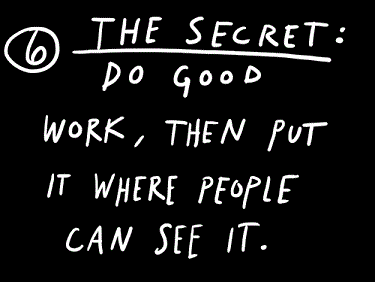
— Maetenloch How To Steal Like An Artist
Some pretty good advice on how to be artist or just a creative and productive person in general. I wish someone had shown me this when I was still in college high school - it could've reduced my angst and self-loathing by at least 17%.
2. Don’t wait until you know who you are to start making things.There was a video going around the internet last year of Rainn Wilson, the guy who plays Dwight on The Office. He was talking about creative block, and he said this thing that drove me nuts, because I feel like it’s a license for so many people to put off making things: “If you don’t know who you are or what you’re about or what you believe in it’s really pretty impossible to be creative.”
If I waited to know “who I was” or “what I was about” before I started “being creative”, well, I’d still be sitting around trying to figure myself out instead of making things. In my experience, it’s in the act of making things that we figure out who we are.
As Flaubert said, “Be regular and orderly in your life, so that you may be violent and original in your work.”So if you're in need of some inspiration, read the whole thing. Then get out there and start creating.I’m a boring guy with a 9-5 job who lives in a quiet neighborhood with his wife and his dog.
That whole romantic image of the bohemian artist doing drugs and running around and sleeping with everyone is played out. ItÂ’s for the superhuman and the people who want to die young.
The thing is: art takes a lot of energy to make. You donÂ’t have that energy if you waste it on other stuff.
Posted by: Maetenloch at
05:24 PM
| Comments (760)
Post contains 1084 words, total size 9 kb.
— CAC Top secret image showing Boehnerman, budget cutting superhero, genetically modified and designed by the best and brightest our party has to offer. Here we can see BOEHNERMAN getting his final check-up before being unleashed on the Democrats.
Watch out Obama:
Posted by: CAC at
03:46 PM
| Comments (261)
Post contains 80 words, total size 1 kb.
— Ace McCain talking tough.
But he shouldn't have said "draconian." Draconian is what you call something you're opposing.
Other words he used -- "significant," "tough medicine" -- are the right words.
Although, who knows: Maybe he's trying to wake people up to the fact that those "draconian" measures we typically oppose are exactly what we need now.
“We are at a critical juncture in American history that unless we enact draconian measures, then the results are very obvious, and that is a fiscal meltdown. No country can borrow 40 cents out of every dollar it spends – even the largest and most powerful nation in the world. No nation can continue on that track. So, tough medicine is required,” McCain said during a press conference at the U.S. Capitol on Tuesday.
The alarm is ringing, but America is currently hitting the Snooze button in ten year chunks.
Posted by: Ace at
03:45 PM
| Comments (70)
Post contains 170 words, total size 1 kb.
— Ace

A week ago, I noted that John Boehner rejected what he called Democratic "smoke and mirrors" on the budget. "Cuts" that weren't really cuts at all, just something to present to the public as "cuts."
Win-win: You get the political benefit of cutting and you get the political benefit of not cutting, because you really didn't cut.
I urged Boehner to expose these tricks so that the public could understand what a real cut was and what a real cut wasn't. So we could not be deceived by the Democrats, or, as it really would wind up happening: So we could not be deceived by Republicans who need to show their constituents cuts but also don't really want to make those cuts.
I asked him to declare "I will not perpetrate a fraud on the American public." I'd hoped such a vow would bind him from doing just that.
I assumed, wrongly, that having taken a position against "smoke and mirrors," he would not foist upon the public a deal containing almost nothing but that.
Once again, I thought well of a Republican and am burned because of it.
Well, according to an analysis, our "$38.5 billion in cuts" is actually about $15 billion in cuts as what is counted as "cuts" is a large pile of stuff that wasn't going to be spent anyway or which (as is the case with earmarks) is about what money is spent on, not how much of it, in total, is being spent.
The specifics show that finding nearly $40 billion in cuts during the 2011 fiscal year required clever accounting and, for the White House, a willingness to concede on rhetoric to find gains on substance.For example, the final cuts in the deal are advertised as $38.5 billion less than was appropriated in 2010, but after removing rescissions, cuts to reserve funds and reductions in mandatory spending programs, discretionary spending will be reduced only by $14.7 billion.
As Rand Paul said -- and I didn't think he was right when I first heard this, but he was, in fact right -- we'll actually spend more in 2011 then in 2010.
This is a "cut"? In what sense?
This is absolutely horrible. You know what we've got? Another stimulus, but a covert one.
And apparently it's a stimulus that's baked in the cake and will keep getting spent year after year forever.
Boehner-Obama Deal Leaves FY11 Spending $773B Above FY08 Level—About as Big an Increase as Obama’s StimulusTuesday, April 12, 2011
By Terence P. Jeffrey
(CNSNews.com) - The budget deal cut late Friday by President Barack Obama, Senate Majority Leader Harry Reid (D.-Nev.) and House Speaker John Boehner (R.-Ohio) will allow $3.7555 trillion in federal spending in this fiscal year.
That is $773 billion more than federal spending was in fiscal year 2008--the fiscal year before Congress enacted a bailout for the banking industry requested by President George W. Bush and a $787-billion economic stimulus law request by President Barack Obama.
That $773 billion in spending that the federal government will do this year over and above the federal spending level of 2008 equals 98 percent of the $787 billion stimulus signed by President Obama in February 2000—on the premise that it was a one-time, short-term spending escalation needed to pump up the economy in a time of recession.
My heart is really leaving me on this. I am finding it increasingly hard to care who "wins" and who "loses." If the system is rigged against what I actually want politically, then there is no point in my engaging with the system at all.
John Podhoretz finds the cuts may even be lower than that $14 billion and change...
The total amount actually cut appears to be somewhere between $8 and $14 billion.
And he expects there might be a populist revolt against the sham cuts -- which puts us all in a difficult spot, because Boehner and Co. have already sold this as "mission accomplished" and now we will get blamed for undoing a deal already struck.
But what choice do we have?
Could the Deal Fall Apart? My God I hope so. Several conservative Senators could abandon it, for example, and in the House, the GOP only has a 24 seat cushion. If the Tea Party representatives abandon the deal, can Boehner crib together a lump-party of GOP establishment appropriators and enough liberals to pass it?
The 15 Blue Dogs will vote for the deal, because then they can pretend to be conservative budget-cutters in purple and red districts, so Boehner will have those 15.
Extra Special Bonus: "The budget baseline," the starting baseline for the next year's funding, was moved up in this deal, above what it was in 2011, making it easier for Democrats (and Republicans!) to spend more in 2012.
You F'd Up, You Trusted Us:
Morons and moronettes, I'll be brief. The issue here is not whether we broke a few promises, or took a few liberties with your money - we did. But you can't hold a whole party responsible for the behavior of a few, sick twisted individuals. For if you do, then shouldn't we blame the whole two-party system? And if the whole two-party system is guilty, then isn't this an indictment of our political institutions in general? I put it to you - isn't this an indictment of our entire American society? Well, you can do whatever you want to us, but we're not going to sit here and listen to you badmouth the United States of America. Gentlemen!
Thanks to Eric "Otter" Cantor.
More Details: At CBSNews.
Many of the cuts appear to have been cuts in name only, because they came from programs that had unspent funds.For example, $1.7 billion left over from the 2010 census; $3.5 billion in unused children's health insurance funds; $2.2 billion in subsidies for health insurance co-ops (that's something the president's new health care law is going to fund anyway); and $2.5 billion from highway programs that can't be spent because of restrictions set by other legislation.
About $10 billion of the cuts comes from targeting appropriations accounts previously used by lawmakers for so-called earmarks - pet projects like highways, water projects, community development grants and new equipment for police and fire departments. Republicans had already engineered a ban on earmarks when taking back the House this year.
Republicans also claimed $5 billion in savings by capping payments from a fund awarding compensation to crime victims. Under an arcane bookkeeping rule -- used for years by appropriators -- placing a cap on spending from the Justice Department crime victims fund allows lawmakers to claim the entire contents of the fund as "budget savings." The savings are awarded year after year.
Let's talk about earmarks first -- it has long been known (often written on the internet) that earmarks don't actually spend new money, at least not in the year they're promulgated. An earmark is not an appropriation. It is a directive to a department or agency to spend money in its general slush-fund, money that was already appropriated, on a specific measure.
Now, the conservative internet has campaigned against earmarks for two reasons: They're often a vehicle for corruption and once something gets funded once, it tends to get funded forever. So an earmark, while not actually spending new money in the year it's introduced, may wind up spending new money down the road.
But again: An earmark does not actually spend new money. It directs an agency to spent money already in its slush-fund kitty.
So cancelling earmarks is not actually cutting the budget. All it is is cutting the restrictions on an agency as to how to spend the money it has.
The $10 billion in canceled earmarks should not be considered "cuts." No less money is being spent because of such cancellations. The agency is just freer to spend as it (or the President) directs.
And this one?
Republicans also claimed $5 billion in savings by capping payments from a fund awarding compensation to crime victims. Under an arcane bookkeeping rule -- used for years by appropriators -- placing a cap on spending from the Justice Department crime victims fund allows lawmakers to claim the entire contents of the fund as "budget savings."
Just by putting a cap on the $5 billion allows you to claim the $5 billion you're spending isn't being spent? That is plainly an accounting trick.
So, so far, we have $15 billion in "cuts" which are not cuts no matter who you are.
Another Bonus: Here's an awesome cut from that CBS article:
$1.5 billion from the president's new $8 billion initiative to spur high-speed rail development.
So, um, the president proposed $8 billion to satisfy Joe Biden's sexual obsession with playing Conductor Man and we held that line... to just $6.5 billion in new spending on this dodgy item.
Posted by: Ace at
12:37 PM
| Comments (755)
Post contains 1501 words, total size 10 kb.
— Ace I've been avoiding this because it's embarrassing to keep linking and swiping but it's important stuff.
By a 20 point margin, the public favors the budget deal. 58% to 38%.
Now, here's the weird, frustrating thing:
By a 48 to 35 percent margin, the public thinks Democrats are more responsible than the GOP for the late Friday night agreement, which prevented a shutdown of some government services and offices.
What? Both sides came to a deal but by 48% to 35% they credit one side as responsible for it? This is a poll of adults, not likely voters, but it shows this continuing, frustrating identification with the Democratic Party that almost half the country has.
Now, as for the deal being popular: I would say that gives the GOP a green light to push for further cuts in the debt ceiling debate and 2012 budget. Maybe the country thinks $38.5 billion is the exact amount necessary to cut and will punish anyone seeking more, but there's no reason to think that's likely the case; it's more likely that if they liked $38.5 billion they'll like $60 billion or $100 billion or even a trillion even more.
I am frustrated with a certain segment of the public that is just apolitical and seems to have few strong opinions at all, other than their apparent belief that democratic processes are "disgusting."
A weekend survey by the Pew Research Center for the People & the Press and the Washington Post finds that “ridiculous” is the word used most frequently to describe the budget negotiations, followed by “disgusting,” “frustrating,” “messy,” “disappointing” and “stupid.”Overall, 69% of respondents use negative terms to describe the budget talks, while just 3% use positive words; 16% use neutral words to characterize their impressions of the negotiations. Large majorities of independents (74%), Democrats (69%) and Republicans (65%) offer negative terms to describe the negotiations.
I can imagine that many political-attuned people might describe the negotiations that way because they're either frustrated that the other side won't give or their own side isn't fighting hard enough; that's an understandable thing.
But look at all the "independents" describing the negotiations negatively. Many independents -- and I mean here the apathetic, unexamined-life sort of people who are independent not due to a true informed choice but rather because they haven't even bothered figuring out what they believe -- are calling the negotiations "disgusting."
What do they mean? Presumably -- this has always been my sense -- they don't like political controversies because they tend to force them to take a position, which is what they don't want to do, and they want to be left out of it. They seem to like their politics in background, not fussing them. They don't like when there's news happening and people trying to persuade them; they want to just be left out of it.
So when a big issue is on the table, instead of actually taking a position, they tend to take the position that both sides are bad and they should just come to a compromise and shut up.
It's frustrating that they're like that. Sorry to bother you with great matters of national policy that will affect future generations for 100 years. So sorry we brought this matter to your attention.
On the other hand, this kind of doltish, uninformed voter (again, I speak of the lazy independents, not the true independents of considered choice) will tend to go along with anything once it's passed.
It's passed? Oh, no more arguing? Good, I'm in favor of it then.
This means that with this critical subgroup we can, as the hardliners say, do an awful lot of stuff they don't like, or don't think they like, but the moment the deal is done they'll tend to approve it, because they just tend to approve the status quo and whatever result is imposed on them. As long as they are spared the arguing.
The budget deal is only, at best, a tentative first step, but there are some boons in it I didn't know about.
The CR terminates funding for more than 55 programs, for a total savings of well over $1 billion. In addition, the bill terminates two programs funded in ObamaCare (the Consumer Operated and Oriented Plan (CO-OP) and the Free Choice Voucher programs).
Small-ball stuff, price-tag wise -- 55 programs eliminated but only $1 billion saved? Nevertheless, it's a good thing to start cutting back on all these government programs.
As for the ObamaCare stuff, that's important symbolically. It is some progress towards repeal, even if not much.
In addition, four "czars" were defunded -- Health Care, Climate Change, Automobiles, and Urban Affairs. Two of those are redundant and the other two are, what's the word I'm looking for, stupid.
Here's one more good thing in the budget: Defense's budget was raised by $5 billion increase from FY10.
Now, I actually think that even the DoD must face some cuts, so I'm not applauding the increase in spending per se. But if DoD actually got a $5 billion boost, that means the cuts to everything else are $5 billion higher, right?
If the total cuts were $38.5 billion, but defense got a $5 billion boost, the rest of the cuts would have to be $43.5 billion, right?
Still not a lot, still not enough, but it's something.
Posted by: Ace at
11:08 AM
| Comments (226)
Post contains 914 words, total size 6 kb.
41 queries taking 0.3004 seconds, 148 records returned.
Powered by Minx 1.1.6c-pink.

