


August 22, 2011
John Ziegler: Having Failed To Embrace Pawlenty, Romney Is the Party's Only Hope of Defeating Obama
— Ace In the original post, I said I hoped that Perry would grow on the public to the extent he'd match most of Romney's appeal.
Romney v. Obama: 48-46; Perry v. Obama: 47-47; Ron Paul v. Obama 45-47; Bachmann v. Obama 44-48.
To some extent, but only some, this rebuts Ziegler's main point that Obama is still the candidate favored to win and that we must focus almost exclusively on electability.
But, as you can see from the numbers, Obama is not a "sure loser" as has become the fashionable belief among many conservatives. Our best candidate (at the moment) only beats him by a pipsqueak two points, and our best candidate (in the future, I believe) merely ties him.
...
One guy's opinion, of course, but I'm a numbers guy, and the numerical case for Romney is strong.
Romney isn't my guy. Perry is. (And before Perry, Pawlenty.) My belief -- or hope, I guess -- is that part of Romney's appeal is that he is familiar to independents and Republican leaners, and therefore not "scary" or otherwise objectionable. And that Perry might be able to similarly become familiar to such voters, and also neither scary nor objectionable.
But that is a hope, only. At the current moment, it is true, as Ziegler says, that Romney is the strongest candidate, at least by the numbers.
Ziegler begins by castigating Republicans into thinking Obama is an almost certain loser, a belief which is then taken by us to mean we have a free hand in putting notions of "electability" firmly out of mind and simply indulging in a hunt to find the fieriest, most implacable foe of liberalism. The long opening of his long, long essay is a refutation of the idea that Obama is a sure loser. He is vulnerable, but only against a candidate that the majority of the country finds unobjectionable and well-qualified.
That's the reason he supported Pawlenty (and my reasons as well).
But the party refused to consider Pawlently's on-paper electability. (I should say here that "on paper" is not equal to "real world," and the party was perhaps wise in deciding that while Pawlenty looked good on paper, he didn't seem as appealing on the stump or on the stage.)
Which leaves... Romney.
When exactly did Republicans seemingly become so delusional?
The first sign that the GOP base had left the gravitational pull of the rational earth in the Obama era was when professional blowhard Donald Trump shot to the top of the presidential polls on the strength of his bogus birth certificate crusade. Fortunately, that particular problem took care of itself (at least for now), but the overall situation may have actually gotten worse. The most troubling part is that the vast majority of the party's rank and file seems to have no idea the peril its prospects of unseating President Obama are really in.There is no doubt that Obama is very vulnerable, far more so than most observers (including me) believed likely when he was swept into office by a tidal wave of biased media coverage less than three years ago. His approval ratings are in the low forties, and in many of the battleground states he appears to be a heavy underdog. The census-induced changes in the Electoral College slice his margin of error to almost nothing, and the economy shows very little sign of improving enough to rescue him. He has also left a trail of damningly false televised statements which should make for great attack ad fodder.
And yet the Republican Party appears on the verge of making Obama's reelection about as likely as the circumstances surrounding his presidency would make possible. Consequently, this golden opportunity to help the country largely dodge the Obama bullet is on the verge of being squandered.
While the vast majority of conservatives (including many prominent commentators) would find that notion laughable, the evidence overwhelmingly indicates that, thanks largely to their predilection for seeing reality through overly optimistic and star-spangled glasses, they are dangerously out of touch.
The first misunderstanding that has led to this dangerous case of Republican hubris is the nature of the polling data. When the average conservative thirsting to see Obama be a one-termer hears that his "approval rating" is in the low forties (or even lower) they seem to think this means that almost sixty percent of the voting public has decided that they are unlikely to vote for him next year, but this is far from the truth.
Plenty of people have no problem saying now that they "disapprove" of a president in 2011 and still decide not to vote him out of office in 2012. In fact, saying they "disapprove" of the president's job performance doesn't even mean that they want him replaced at the instant they are asked.
The best way to think of this may be to consider the president as the national spouse. Plenty of wives may say at any given moment (especially when the honeymoon is long over and things seem to be going poorly) that they "disapprove" of the job that their husband is doing, but that doesn't mean they are necessarily going to leave him for someone else, particularly when there is no other specific option available at the time.
Another red herring in the political data is the "Obama vs. Generic Republican" number, which could not be more deceiving. Currently, Obama regularly loses nationally to this fictitious candidate, but if anything, these numbers show just how unlikely it really is that he will actually be defeated. When a poll respondent processes that question they conjure up the image of Republican who has no major blemishes and has yet to have their entire careers picked apart by a media all too eager to destroy them.
...
Currently, despite all of his recent problems, no named candidate comes close to beating Obama in an actual head to head matchup except Mitt Romney.Of course, none of the leading or even potential Republican candidates comes close to fitting the 'generic" description either. Ironically, the one candidate who came by far the closest, Tim Pawlenty, ended up, through little fault of his own, being the very first to be knocked out of the race.
The early demise of the Pawlenty campaign tells you everything you need to know about how this delusion/ignorance regarding political realities is stunting the Republican nominating process in a way Obama should only be able to dream about. Pawlenty was the one candidate who clearly would have made the election an unambiguous referendum on Obama. That is a battle which, even with the media on his side, the president cannot win unless the economy makes an unexpected recovery.
Pawlenty's campaign was doomed by some of the very qualities which made it so attractive to those who understand how a national presidential election works in the modern age. He was seen as "boring" by a Republican electorate that is clearly looking to be highly stimulated. But in his case 'boring" also meant "electable."
Ziegler is very down on Perry, for the reasons people typically say they're down on Perry: He's too similar to Bush; as a Texan (and a born and bred one, unlike Bush), he won't play in the swing states of the mideast, which will be inclined against him for reasons of cultural animus; and he tends to say "scary" things which gladden Tea Partiers but turn off the middle, which wants a correction to Obama, and not an equal-but-opposite Revolution, with the nation now veering hard to the right after veering hard to the left just three years ago.
I keep thinking that this stuff is first-blush resistance and will not persist. If the country found the culture of Texas to be palatable in 2000 and 2004, why would they suddenly find Texas to be a barbaric rowdy-land with any citizen of that state culturally and politically suspect?
Due to Bush, I suppose, but this chain of thought relies on the proposition that the public literally cannot tell one man from another, and will think that Perry pretty much is George Bush, a proposition I find sort of daffy.
As for fiery rhetoric -- well, you need some of that. And, for good or for ill, Perry is in fact suddenly not quite so down on Social Security as he was a couple of years ago.
But I do take Ziegler's point. In a recent poll, Romney edges Obama by one in Florida while Perry loses by five. Should that situation persist into 2012, then I'll have to revisit my own assumptions about Perry's electability, and take a second look at Romney.
Ziegler thinks Palin will run, by the way, but for reasons Palin supporters will sharply diagree with:
I continue to believe that Sarah Palin has no choice but to get in the race. While I am no longer in contact with her or her team after I came out against her running, everything I observed from the "inside" indicated to me that she was very open to running and nothing since then has changed my mind about that.Her brand depends on her running because if she doesn't, her followers will feel let down and she will have no apparent next act. Once there are two new nominees on the 2012 ticket, she is old news with no office to change her narrative. By 2016 she would be ancient history with either a Republican president in office or with a brand new crop of highly qualified challengers ready to pounce on what should be the slam dunk of replacing a term-limited Obama.
My prediction is that she gets in and runs almost exclusively an air war intended to create the appearance of a real primary campaign without any of the hassles. She knows that her vote is pretty much set in stone and it won't be impacted much, if at all, by creating a traditional organization. If she is as smart as I think she is, her goal would be to exceed low expectations and finish a respectable second to Romney and thus use the campaign to change minds about her for the future. In a sense, she would then become a hybrid of Romney and Mike Huckabee after 2008: technically "unemployed" but well known and respected enough to sustain her viability into the future.
...
If things break her way, she could end up as the last Tea Party Star standing up against Romney (not counting Ron Paul) and it would be possible that Romney would not be popular enough with the base to reach the vote threshold needed to put her away. Still, she could not beat Romney in a protracted battle because, as Obama proved in 2008, winning a delegate battle is still all about organization, an area when Romney would dominate Palin, who frankly may not even want to actually win the nomination.
On that point -- Sarah Palin's plans -- "sources" close to her say that the September 3rd rally is "unlikely" to be an announcement. And might be more of a "campaign test," as Ed Morrissey calls it.
The event will pose a significant test for Singleton and the rest of the all-volunteer army of Palin devotees who have for months been quietly paving the way for a presidential run that would be fueled by a dedicated core of political novices.
I have suggested myself recently that Palin is honest when she says she's still making up her mind, and that these various campaign-like events are a vehicle for stoking interest and gauging interest; presumably, if she finds a strong demand that she run, that will prompt her to do so.
On the other hand, there are the numbers. From Rasmussen, which is not a Democratic polling firm:
If Election Day was right now, President Obama would defeat the former Alaska governor 50% to 33%, according to a new Rasmussen Reports national telephone survey. This marks the first time that the president has risen out of the 40s in hypothetical matchups with any of the major GOP presidential hopefuls....Last month, Obama posted a 47% to 38% lead over Palin, the GOPÂ’s unsuccessful vice presidential candidate in 2008.
Palin earns support from 62% of Republicans, while 88% of Democrats back the president. Voters not affiliated with either party prefer Obama by a 51% to 30% margin.
Obama holds a narrow 44% to 38% lead over Palin among male voters, but women prefer the incumbent by a sizable 56% to 29% margin.
I continue to not understand how committed Palin supporters simply discount numbers like this, as if we're just making this shit up to spite them. Or how public attitudes towards Palin will shift dramatically in the next year, despite these attitudes being persistent for almost three years now.
I don't get the plan here -- will she start saying different things? Or saying them in a different way? If she did, wouldn't she be a different candidate, and hence not the Sarah Palin currently being urged to run?
What is the mechanism proposed by which such dreadful general election numbers will reverse themselves in a year?
I really do get the feeling this has become faith-based. Not truly religious, mind you, but based at heart on faith that Palin will be able to fix all this "once she decides to run" despite the strong evidence that during the past three years of partially running for President she's made no progress whatsoever in improving her public standing, and in fact has seen further erosions of support.
This is why these arguments over Palin get so heated, I think. At heart, her supporters wish the non-supporters to have faith in her, and we simply don't.
As I've said ad nauseam, if political strategy were capable of reversing years of public disregard of Sarah Palin, surely we would see that strategy already in motion, and already bearing fruit.
I just can't buy into this idea that I'm to have "faith" that she has a "secret plan" which for unexplained reasons must wait another several months for implementation, and could not have been executed in 2009 or 2010.
There is no secret plan. There is no trap about to be sprung, there is no brilliant strategy about to be executed.
Again, if there were, there is no earthly reason it couldn't have gone into effect a year or two years ago.
The Secret Brilliance of Her Resignation: When Palin resigned, I said she had essentially foreclosed any possibility of seeking the presidency.
But a lot of people disagreed, sharply. An idea percolated on the right of the blogosphere that she had brilliantly "changed the game," that she had "shot the hostage" (a reference to a gambit in the action movie Speed) and that, by forfeiting her office, she had in fact elevated her chances of becoming president, now able to preside over national issues without being bothered with lawsuits and the the daily routine of governance.
I said this theory was all wet at the time. I was called a RINO, asshole, etc. for saying so.
Well, not to rub too much salt in this particular wound, but I was right.
The "game" was not "changed," and the "hostage" might have been "shot," but so was Palin's status as a top-tier presidential prospect.
But this seems simply ignored, and those who insisted that the resignation was a Machievellian masterstroke now invite skeptics to join them in believing in a new plan -- this one, secret -- which will do for Palin what the resignation was supposed to.
That a resignation would be regarded as a good move for a presidential prospect was always daffy wishcasting.
At some point, results and empirical data must mean something. Palin was predicted by many to have "changed the game" and become the front-runner for 2012 in mid-2009. It's now 2011, and her position has eroded still further, but predictions continue to be made that this time the ducks are all in a row and she's ready to take off.
Posted by: Ace at
11:20 AM
| Comments (810)
Post contains 2743 words, total size 17 kb.
— Ace Breaking.
I put the long Ziegler/Romney/Perry/Palin post into draft, as this is a breaking story, so it should go up now. But I will re-publish the other one soon.
This is good/bad.
Although Ryan was expected to be the candidate of Establishment Intellectuals, many people so accused of being such actually were down on him, due to the political courage -- and equal political danger -- of the Ryan plan.
While I would normally be counted as part of Ryan's natural constituency, I couldn't get a lot of passion for the candidacy, now. Partly that's because I've already sold myself on Perry, of course.
Posted by: Ace at
11:07 AM
| Comments (93)
Post contains 122 words, total size 1 kb.
— Ace In a comment to the last post, Ben wrote:
When Republicans win it's because the public is angry or acting irrationally.When the Democrats win it is a repudiation of Republican principles and ideas.
In an election where some 63 democratic house members lose to republicana and two republican congressmen lose their seats to democrat, it is a anti-incumbent election.
When Democrats prevent Republican legislation it is a principled stand.
When Republicans prevent Democrat legislation it is because they are petulant.
When Democrats cannot pass their social engineering programs, it is because the country is ungovernable.
When Democratic policies are unpopular it is because the President(or democrats) did a poor job selling or explaining the programs.
It goes on and on.
At Hot Air, this NYT quote finds them doing just that, yet again.
Dale Weiss, a 64-year-old Democrat, approached the Republican running for Congress in a special election and, without provocation, blasted the president for failing to tame runaway federal spending. “We need to cut Medicaid,” she declared, “but he won’t do that.” She shook her head in disgust. “He is a moron.”After nodding approvingly for a time, the Republican candidate, Bob Turner, signaled for an assistant to cut off Ms. Weiss. Frustration with Mr. Obama is so widespread, he explained later, that he tries to limit such rants to about 30 seconds, or else they will consume most of his day. …
The race was widely viewed as a sleepy sideshow — a mere formality that would put David I. Weprin, a Democratic state assemblyman and heir to a Queens political dynasty, into a seat known for its deep blue hue.
Instead, the race has become something far more unsettling to Democrats: a referendum on the president and his party that is highlighting the surprisingly raw emotions of the electorate.
Raw emotions, see? Irrational. We're just all crazypants because we don't understand that Obama's policies will bear fruit in the year 2057 when we finally land a man on Mars.
I'd be curious to ask a media type -- put Anderson Cooper on the spot, say -- if he could name a single election in which Republicans won in which he'd say the public embraced Republican policies, and weren't simply reacting emotionally to a "flawed Democratic candidate" (Kerry, Gore) or a "poor messaging campaign" (the 2010 midterms) or having "a temper tantrum" (the 1994 Republican capture of Congress).
I don't think they'd confess that even with Reagan, who is long dead and therefore safe for the Democrats to praise. But the media would say the public was simply reacting to the poor economic and foreign policy record of Jimmy Carter, rather than affirmatively choosing the Reaganite policy prescriptions.
And, even to the extent they did, they'd be responding to his "simplistic" messages.
I have never in my life understood the liberal claim that Republican messages are "simplistic" and easy to explain to the dummies whereas Democratic messages are complex and involve all sorts of higher-level cognitive functions which the public cannot easily digest.
The Democrats want to give people free shit and make other people pay for it.
Um, this is complicated?
You know what's complicated? Trying to argue that higher taxes on the rich cause the secondary effect of a punitive environment for wealth creation and wind up discouraging economic risk (no reward, in this case, means no risk) and therefore tends to create a flat or negative growth rate.
Compare that to "free shit" which we're going to make "corporate fatcats" buy for you.
Complicated: I realized there is one way in which Democratic policies are "complicated."
Most Democratic policies are designed to hide the fact that the middle class will end up funding them in one way or the other. If you're spending trillions, you cannot avoid taking a large chunk of that from the middle class -- and the middle class is where the money is, in aggregate.
Rich people have a lot of money, as individuals, but there aren't many of them; the number of super-rich is tiny.
But the middle class has a fair amount of money as individuals, and 60% of the country is middle class.
So the "complexity" in Democratic schemes comes mainly in the form of a deliberately obscure funding mechanism which is crafted precisely to hide the fact that bulk of the funding for Democratic schemes is coming right out of the hide of the middle class.
Like ObamaCare, for example.
But the public often -- not enough, but often -- sees through this and even if they don't get the exact details of the complicated forced-subsidy scheme, they can figure out whether they're going to be net winners in these games or net losers.
When a majority of the middle class accurately deduces they are being asked to pay (or give up some of their own health-care benefits) to fund someone else, the media calls them either stupid or irrational for failing to be deceived by Democratic claims.
Actually, they wised up. And the media is angry at them for wising up.
Posted by: Ace at
09:43 AM
| Comments (253)
Post contains 890 words, total size 6 kb.
— Ace The standard Obama line -- the standard Democratic line, for 30 years running -- is that any disapproval of their policies, and the disastrous results thereof, is actually due to confusion on the part of the public. If the Democrats are guilty of anything, it is only of failing to explain their policies with sufficient simplicity for a cretinous mouth-breathing knuckle-dragging Nation of Imbeciles to comprehend.
Obama takes that to the next level, and, with the patience of a particularly even-tempered saint, now explains the United States of Morons can't tell "President Obama" from "the Republican held House of Representatives."
President Barack Obama says his low approval rating is a reflection of public unhappiness with Congress.Obama tells CBS in an interview broadcast Sunday that he's "impacted," just like Congress, when people aren't happy with Washington.
He says he understands that his arguments that the country would have been worse off if he hadn't taken certain actions don't resonate with the millions of unemployed people.
He doesn't seem to understand himself that the Republicans have served as a check on Democratic power for only six months -- and the current economic conditions are the result of the two years prior, when Democrats held all branches of government with large majorities.
I just realized something clever.
Obama tells the public to wait patiently, because his Policy Magic will take three or four or, who knows, six years to finally kick in and start having a positive impact on the economy.
On the other hand, he's also trying to sell the case that the very meager Republican policy gains kicked in almost immediately and have caused the plunge back to recession.
Obama's medicine seems to be of the mid-to-long-term variety, whereas Republican poison takes effect quickly, with the results immediately evident in the body public.
Posted by: Ace at
09:01 AM
| Comments (187)
Post contains 331 words, total size 2 kb.
— DrewM Via Lachlan Markay
In politics, having the right enemies can be as, if not more, important than having the right friends.
The governor has pushed through a string of tort reform laws, including a 2003 measure putting a monetary cap on non-economic damage awards. He passed another law in the most recent Texas legislative session, making it easier to dismiss some lawsuits and putting plaintiffs on the hook for legal costs in certain cases that are defeated or dismissed.The campaign for tort reform in Texas began in the 1990s, well before Perry was governor, but the Republican can legitimately claim some credit for the results. ItÂ’s a story Perry proudly tells on the stump, casting himself as the man who mastered a legal system run amok and made Texas friendlier for business.
He lists tort reform among the core economic proposals of his presidential campaign and mentioned it in his announcement speech. On a Friday visit to a Florence, S.C., hospital, Perry recalled that “back in the ’80s and ’90s, Texas was a very litigious state,” but now: “We passed the most sweeping tort reform in 2003 and it still is the model in the nation.”
John Coale, a former trial lawyer who has donated tens of thousands of dollars to Democrats over the years, agreed that Texas had once been the “golden goose” for plaintiffs’ attorneys.
“Now, the pendulum has swung in the other direction, where it’s a very bad place now,” Coale said.
“If Perry’s the nominee, the trial lawyers will come out of the woodwork to support Obama, where I don’t know that they would now,” he predicted. “Most of the guys I know don’t like [Obama], think he’s screwed up the economy or taken Bush’s bad economy and made it worse. But when your livelihood, your money’s on the line, it concentrates the mind.”
I've only seen a couple of Perry speeches so far but each time he's included a reference to his tort reform record in Texas as part of setting the conditions for economic growth.
While the instinct is a good one and gives you a sense of his approach to how the law should work, it's not clear to me if it's really an issue that plays at the national level. Most lawsuits are heard in state courts and under state laws. That's not something a big Tenth Amendment guy like Perry is likely to try and mess with even if he could (and it's far from clear he could).
Still, it's a great talking point and annoys all the right people so as far as the primary goes at least...point to Perry.
Posted by: DrewM at
08:19 AM
| Comments (272)
Post contains 461 words, total size 3 kb.
— DrewM Looks like Obama's little "Time-Limited, Scope-Limited Military Action" is winding down as the rebels have taken most of Tripoli.
Libyan government tanks and snipers put up scattered, last-ditch resistance in Tripoli on Monday after rebels swept into the heart of the capital, cheered on by crowds hailing the end of Muammar Gaddafi's 42 years in power.The 69-year-old leader, urging civilians to take up arms against rebel "rats", said in an audio broadcast that he was in the city and would be "with you until the end". But there was little sign of popular opposition to the rebel offensive, two of Gaddafi's sons were seized and it was unclear where he was.
Reuters correspondents saw rebel forces hunt sharpshooters from building to building. Sporadic gunfire and shelling kept civilians off the streets, waiting anxiously for the fighting to end after a brief outpouring of jubilation late on Sunday.
"Revolutionaries are positioned everywhere in Tripoli," said a senior rebel in the city, who used the name Abdulrahman.
The situation is still fluid but people are starting to tally up the winners and losers.
Personally, I think this is a big "Meh".
Yes, it's great if you are a Libyan and are tired of living in what should be a very rich country but one that has been run as the personal playground of a madman for 42 years. It's still more likely than not that it all ends in tears but like everyone else, Libyans deserve a shot at liberty and they got it the old fashion way...they earned it in battle.
And yes, from the Berlin disco bombing to Pan-Am 103, America had some unfinished business with Quadaffi. Good for Obama for playing a part in getting in on the action.
Beyond that..meh.
Obama will try and take some credit for this but only because he's a shameless SOB and he's desperate for any good news.
Before people (and by "people" I mean Democrats and the media--BIRM) rush off to give Obama credit as a modern day Stephen Decatur, let's take a stroll down memory lane.
Obama could have intervened earlier and perhaps avoided 4 months of fighting by launching a few missile and air attacks in late February when the rebels were first on the march. Instead, he took a pass and waited for almost a month until the UK and French forced the issue at the UN. His dithering and indecision reportedly annoyed Hillary Clinton so much there was talk of her looking for an exit from the administration.
Speaking of Hillary!, she was the face of this operation almost from the start. Remember how Obama got his (Cameron and Sarkosy's really) UN Resolution and skipped town for South America and then disappeared from view for a few days? In his absence it was Clinton who announced the take over of the mission by NATO and along with members of the military, was out front briefing the public on what was going on and why we were doing it.
Now President "What War?" is going to swoop in and take the credit? Obama might pass on a victory lap because things could still go to hell there but some form a victory dance will be too irresistible to him. "Thanks Hills, I have it now".
Clearly sexism is at work here!
Of course there will be an inconvenient question or two along the way. Remember what Obama eventually said about why we went to "war but no war-war" in Libya.
Ten days ago, having tried to end the violence without using force, the international community offered Gaddafi a final chance to stop his campaign of killing, or face the consequences. Rather than stand down, his forces continued their advance, bearing down on the city of Benghazi, home to nearly 700,000 men, women and children who sought their freedom from fear.At this point, the United States and the world faced a choice. Gaddafi declared that he would show "no mercy" to his own people. He compared them to rats, and threatened to go door to door to inflict punishment. In the past, we had seen him hang civilians in the streets, and kill over a thousand people in a single day. Now, we saw regime forces on the outskirts of the city. We knew that if we waited one more day, Benghazi - a city nearly the size of Charlotte - could suffer a massacre that would have reverberated across the region and stained the conscience of the world.
Gadaffi's mere threat to kill people prompted what turned out to be almost 5 months of bombing. Meanwhile in Syria, Bashir al-Assad actually kills thousands and it take Obama longer than that to finally call on Assad to go in a written statement released between his bus tour and dashing off to the Vineyard.
So yay for Obama and NATO, they finally managed to knock off a 3rd rate dictator no one really cared about in a country with almost no US strategic interests at stake.
Meanwhile, Syria, a country and regime very much at the heart of events in the Mideast, continues to burn with almost no action by the US and its allies.
Such is the "Obama Doctrine".
Posted by: DrewM at
07:04 AM
| Comments (260)
Post contains 883 words, total size 6 kb.
— DrewM I like this piece mostly because it includes something I've suggested...go after the out of control regulatory state.
In fact, the Obama administration’s anti-business, hyper-regulatory, pro-tax agenda has fueled economic uncertainty and sent the message from the administration that “we want to make it harder to create jobs.” There is no other conclusion for policies such as the new Environmental Protection Agency regulations, including the “Transport Rule,” which could eliminate thousands of jobs, or the ozone regulation that would cost upward of $1 trillion and millions of jobs in the construction industry over the next decade. The administration’s new maximum achievable control technology standards for cement are expected to affect nearly 100 cement plants, setting over-the-top requirements resulting in increased costs and possibly thousands of jobs being offshored. There is the president’s silence as the National Labor Relations Board seeks to prevent Boeing from opening a plant in South Carolina that would create thousands of jobs. Such behavior, coupled with the president’s insistence on raising the top tax rate paid by individuals and small businesses, has resulted in a lag in growth that has added to the debt crisis, contributing to our nation’s credit downgrade.
Obviously we have to go after spending but it's not as easy as it sounds. Have you ever seen a politician get asked a very basic question, "you say you want to cut spending so which three specific programs would you cut?". They almost never have a good answer for that because "cutting spending" is popular in theory but cutting a specific program? Not as much. There's usually some sob story Democrats (and lots of Republicans) will drag out to show how mean a particular cut is.
If they do name a program, it's often a small but obnoxious one. Remember McCain going on about federally funded studies about bears or something during the 08 campaign? Funny line and a worthy goal but we're not going to balance the budget cutting goofy studies. It also gives too many voters the impression we are just a few "waste, fraud, abuse and foreign aid" cuts away from balancing the budget.
Reducing regulations is also easier to connect to job creation. It's hard for people to get the idea that out of control government spending is costing jobs (especially given the Keynsian bias of the media) but you can usually show how the cost of
some stupid regulation costs actual jobs.
Plus there's the quaint notion of freedom and limited government too. There are still people who would prefer not to have government regulators involved in nearly every aspect of their lives and business. At least I hope so.
It seems this is how the GOP plans to combat Obama's designed to be rejected "jobs speech" he plans on giving once he gets back from vacation.
In lieu of more wasteful stimulus spending, we should go all-in on ways to invigorate growth. The Congressional Budget Office has found that for every one-tenth of 1 percent of additional economic growth, the budget deficit is narrowed by nearly $300 billion. Economic growth will help reduce the deficit and get people back to work.That is why this fall the Republican Party will pursue a legislative agenda that boosts economic growth through reducing the regulatory and tax burden. We will make sure that Washington policies are less restrictive to businesses small and large. Our goals include repealing the “3 percent withholding rule,” which serves as an effective tax increase on those who do business with the government, and overturning the EPA’s proposed regulations that inhibit jobs in areas as varied as cement and farm dust. We plan to prevent the NLRB from inhibiting where a business chooses to create jobs. We well know that the Republican majority was not elected to raise taxes or take more money out of the pockets of hardworking families and business people. We were elected to change the way Washington does business and spends money.
Nothing is going to come of this with the Democrats in charge of the Senate and Obama in the White House but clearly the battle lines are being drawn for November 2012. Changing the terms of debate to cutting spending is a good thing but to get out of this economic crisis, we're going to need economic growth and a lot of it. It's good to see the GOP preparing that battlefield.
Posted by: DrewM at
05:33 AM
| Comments (127)
Post contains 765 words, total size 5 kb.
— Monty
 SSDI is very nearly tits-up. But donÂ’t worry! All is well! All we have to do is squeeze those rich bastards a bit more and everything will be fine!
SSDI is very nearly tits-up. But don’t worry! All is well! All we have to do is squeeze those rich bastards a bit more and everything will be fine! The trustees who oversee Social Security are urging Congress to shore up the disability system by reallocating money from the retirement program, just as lawmakers did in 1994. That, however, would provide only short-term relief at the expense of weakening the retirement program.Note to tenured professors: you might want to brush up the old resume. I’m just sayin’. The “let’s pretend” game goes on. Yeah, Portugal is boned right along with Greece. Spain isn’t far behind, and Italy may be following along shortly. Feeding the masses on unicorn ribs. In the Harry Potter books, someone who feasts on Unicorn blood is doomed to live in a half-dead/half-alive state for all eternity. Sounds about right. Which leads us to.... Life after debt.
“The markets have highlighted a fundamental shortcoming in Keynes's ideas: He assumed that governments would always be able to borrow. If they cannot, then Keynesian economics is dead in the water.”And Keynesians, as always, assume that the government will spend the money they borrowed wisely, which has not been the case.
This is a fact -- the Age of Debt is drawing to a close. Deleveraging is the only answer to our problems, and it’s going to be a long and painful process. The “dismal science” brings some pretty dismal news. CalSTRS is about $56 Billion short. Just tax those rich bastards for the difference! Unless they leave the state or fail to pony up. Then...well, I guess we’ll have to make chumps out of the average working man. Again. For the children! Software runs the world. I guess this should make me happy, since I make my living by writing software. But software is written by humans, who make mistakes and fail to appreciate the complex nature of the beast they’re creating. Our software infrastructure is terribly frail, riddled with security holes, and performs poorly at boundary conditions. The more we rely on it, the more danger we expose ourselves to when it fails. Emergent behavior in software systems confounds even people who write the code: financial trading algorithms, industrial control systems, mathematical and physics simulations, and so on. Unemployment hitting the young the hardest. When your own ideas fail, the “tu quoque” is always a handy rhetorical dodge. Keynesianism has been pretty conclusively proved to be a dud, but the liberal statists always have another player who’ll come in and give it the old college try. Those “gains” from QE2? Bye, bye, baby. You can only prime the pump for so long before you have to accept that your well is dry. The only solution to the problem is to drill a new well -- a hard, expensive, time-consuming process. Gold now at $1880. $2000/oz or bust! The good news? Only stupid people will be surprised when the student-loan bubble bursts. The bad news? There are a lot of stupid people out there. The business of money. There is truth to this: we have a lot of talented people who, instead of working in fields with more value-add, have chosen to make their living by moving fiat money around from place to place. The problem in part is that fiat currency, as a manufactured good, behaves in the short term as any other scarce good; but in reality it is not scarce (being fiat, and thus creatable on demand), and this creates asymmetries in the supply/demand dynamic. Natural scarcity is where real economies flourish; artificial “scarcity” is doomed to fail at some point because the urge to create more of the scarce good (fiat money) is irresistible -- and far too easy. There ain’t no such thing as “retirement” any more. If you have enough money, you can quit working and relax. If not.... Age-mandated retirement was an unsustainable idea right from the start, really -- a dream based on a mistaken assumption of how the economy and demographics would work over the long term. Productivity is shrinking. In some ways, America’s economic trajectory is like that of a ballistic missile -- as it reaches the apex, it either rolls over and begins to fall, or it reaches escape velocity and leaves the atmosphere. If we have too much drag, we fall. If the engine cuts out too soon, we fall. If we enounter too much turbulence, we go out of control and then we fall. Achieving escape velocity requires good engineering, good weather, and good luck. Productivity does not rise without limit. We may have reached the upper bound of what we are able to do with current technology. A plateau cannot be held indefinitely; we either rise, or we fall. Thus, to grow, we need to add more power to the economy -- but it’s not clear to anyone right now how we can do that. Debt-driven consumerism may be tapped out as a motive force, which means we need to look for something else. The "eurobond" idea still seems like wishful thinking. There’s nothing in it for Germany, which will have to backstop everyone else’s debts. A federal employment subsidy? There are a few problems with this:
- The federal government is broke.
- The subsidy would almost certainly go to cronies, pet causes (the “green” debacle) and Donk fellow-travelers.
- The subsidy would have to be extracted from either taxpayers (which would slow growth and offset any gains from the subsidy) or from issuance of new debt (which would add new layers of debt onto the mountain we've already built).
This stupid article also assumes that companies can hire new workers “just because” -- that old canard that businesses exist to provide employment and not to produce things that generate a profit for their owners and investors. Employment is a side effect of a business, not the purpose of it. Regulatory and tax reform would do a lot more to stimulate hiring than some redistributionist cash subsidy. You will have a hard time finding anything written about capitalism more stupid and meretricious than this. And I’m sure you’ll be as shocked as I am to find that it was written by an academic. From Haaaaavahd, no less.
Alexander Keyssar is the Stirling professor of history and social policy at Harvard’s Kennedy School and the author of “The Right to Vote: the Contested History of Democracy in the United States."History and social policy, baby. Deep into the fever-swamps of leftist ideology. What are the odds that this dude has ever held a private-sector job? Note: stupid decisions in the past have consequences in the future. Reality doesn't give us many do-overs. This is why carpenters formulated the "measure twice, cut once" rule. Strike FAIL. Georgia chopsticks. more...
Posted by: Monty at
04:20 AM
| Comments (180)
Post contains 1163 words, total size 10 kb.
— Gabriel Malor Being truthful is okay. But it can get you just so far. If you're serious about getting things done, what you really need is public relations.
Posted by: Gabriel Malor at
02:47 AM
| Comments (60)
Post contains 34 words, total size 1 kb.
August 21, 2011
— Maetenloch World Sex Ratios - Or Why You Should Go Long on Russian Bride Futures
Thanks to violence, drinking, and sex-based abortion the ratio of men to women varies quite a bit from country to country.
The United Arab Emirates is practically a sausage party with 275 men per 100 women while Djibouti is man-starved with only 80 men per 100 women. So morons make your vacation plans accordingly.
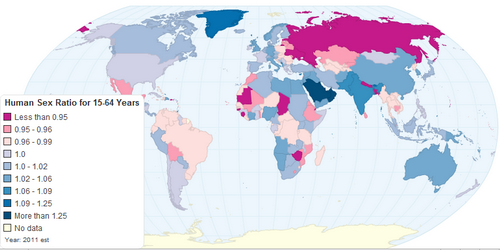
In terms of population China has the most unattached men in the world, and it's only going to get worse - there are currently 117 boys under 15 years old for every 100 girls there. Meanwhile Russia and many of the former Soviet republics are women-heavy.
So just based on demographics alone I foresee some bride arbitrage going on in the near future with a lot of matches like this:

Of course this may result in the dreaded ursa-dragon hybrid, so we must be wary. more...
Posted by: Maetenloch at
05:14 PM
| Comments (617)
Post contains 776 words, total size 7 kb.
44 queries taking 0.3194 seconds, 151 records returned.
Powered by Minx 1.1.6c-pink.

