


January 18, 2014
— andy Whenever-you-get-around-to-it edition.
Posted by: andy at
04:48 AM
| Comments (391)
Post contains 10 words, total size 1 kb.
January 17, 2014
— andy The Washington Examiner's Tim Carney joins Ace and the crew to discuss Tim's recent column on the latest developments in the GOP civil war. They also discuss the latest trillion+ dollar spending bill, the latest developments on Obamacare, and the rush to blame "stand your ground" for a shooting in Florida before finishing up with quick hits and questions from the Moron Mailbag.
Submit your questions & comments here: Ask the Blog
Referenced in this episode:
- Conservative insurgents strike blow against GOP Establishment
- A health industry expert on ‘the fundamental problem with Obamacare’
- Bailing Out Health Insurers and Helping Obamacare
- Florida Theater Shooting Induces Another Round of “Stand Your Ground” Mania
[MP3 Download] | Subscribe:  [RSS] |
  [iTunes]
Follow on Twitter:
AoSHQ Podcast (@AoSHQPodcast)
Ace (@AceofSpadesHQ)
Drew M. (@DrewMTips)
Gabriel Malor (@GabrielMalor)
John E. (@JohnEkdahl)
Andy (@TheH2 and @AndyM1911)
Open thread in the comments.
Apologies [ace]: This podcast contains no semi-admiring mentions of Hitler. We just had so much to get to, we forgot.
Posted by: andy at
12:30 PM
| Comments (278)
Post contains 170 words, total size 3 kb.
— CDR M

Man, Keith Koffler nails it. The root of Obama's imperious Presidency.
Obama is, for a politician, a relative loner who doesnÂ’t want to be bugged by members of Congress. Of either Party.He has no famous chums in Congress. He has few relationships of any sort with lawmakers. Really what he wants to do is make his decisions in the Oval Office, have a few meetings, give some speeches on college campuses and high schools, and play golf. And then send Jay Carney out to talk about how Republicans are intransigent, politically motivated hacks who donÂ’t even wear deodorant.
Posted by: CDR M at
05:05 PM
| Comments (992)
Post contains 685 words, total size 7 kb.
— Ace
I don't imagine this column will be well-received, generally, although his basic point is sound enough.
Before excerpting his piece, I think it's important to know what his claimed area of expertise is. From the quick bio at the end of the article:
Tom Nichols is a professor of national security affairs at the U.S. Naval War College and an adjunct at the Harvard Extension School. He claims expertise in a lot of things, but his most recent book is No Use: Nuclear Weapons and U.S. National Security (Penn, 2014).
So his area of expertise is war doctrines and geostrategy, I guess.
Now here is his basic point. But it's a long article, so this excerpt isn't nearly the sum of his argument (or of his cri du coeur, more like):
I am (or at least think I am) an expert. Not on everything, but in a particular area of human knowledge, specifically social science and public policy. When I say something on those subjects, I expect that my opinion holds more weight than that of most other people.I never thought those were particularly controversial statements. As it turns out, they’re plenty controversial. Today, any assertion of expertise produces an explosion of anger from certain quarters of the American public, who immediately complain that such claims are nothing more than fallacious “appeals to authority,” sure signs of dreadful “elitism,” and an obvious effort to use credentials to stifle the dialogue required by a “real” democracy.
But democracy, as I wrote in an essay about C.S. Lewis and the Snowden affair, denotes a system of government, not an actual state of equality. It means that we enjoy equal rights versus the government, and in relation to each other. Having equal rights does not mean having equal talents, equal abilities, or equal knowledge. It assuredly does not mean that “everyone’s opinion about anything is as good as anyone else’s.” And yet, this is now enshrined as the credo of a fair number of people despite being obvious nonsense.
WhatÂ’s going on here?
I fear we are witnessing the “death of expertise”: a Google-fueled, Wikipedia-based, blog-sodden collapse of any division between professionals and laymen, students and teachers, knowers and wonderers – in other words, between those of any achievement in an area and those with none at all. By this, I do not mean the death of actual expertise, the knowledge of specific things that sets some people apart from others in various areas. There will always be doctors, lawyers, engineers, and other specialists in various fields. Rather, what I fear has died is any acknowledgement of expertise as anything that should alter our thoughts or change the way we live.
What has died is any acknowledgement of expertise as anything that should alter our thoughts or change the way we live.
This is a very bad thing. Yes, itÂ’s true that experts can make mistakes... [But to] reject the notion of expertise, and to replace it with a sanctimonious insistence that every person has a right to his or her own opinion, is silly.
Worse, itÂ’s dangerous. The death of expertise is a rejection not only of knowledge, but of the ways in which we gain knowledge and learn about things. Fundamentally, itÂ’s a rejection of science and rationality, which are the foundations of Western civilization itself.
Okay. Everything he just said there is true. And I agree that the False Equality of the Know-Nothings -- those who claim that there is literally nothing outside of their own knowledge base worth knowing, and yes, some flirt with this idea or announce it explicitly -- is basically a half-assed defense of ignorance.
However. Here is why people are so quick to dismiss the expertise of an expert:
Because experts themselves do not recognize the limitations of expertise, and need to be reminded of them.
Every field of true academic study has some parts which are more provable -- and proven -- and some parts which are very gray areas, in which "knowledge" largely consists of speculations, theories (which fall in and out of vogue), rules of thumb, and wild-ass guesses.
And here's the thing: Depending on the field of study, we reach that gray area more rapidly than we do in others. The writer uses the example of medical doctors. He would like to analogize his own field to that one. Let me say I reject that analogy. I can't put an exact figure on it, but my rough guess would be that around 70% of medicine can be said, at this point, to be a mature science. The processes are understood, the diagnoses sound, the recommended treatments well-tested and shown to be useful.
But around 30% of medicine is still guesswork, and that 30% includes some Very Very Big Questions that no one has the answers to, including the possibility of extending the human lifespan by arresting the built-in limitation on cells' ability to make good new copies of themselves, or regenerating lost limbs, or curing cancer -- really curing it, not just treating it -- and so on and so forth.
I do not believe that geostrategic war doctrine can be said to be at such a state of maturity. I would imagine the ratio of the Well-Understood to the Not Well Understood is nearly the opposite of what I'd guess it is in medicine -- 30% well understood, 70% guesswork and trial-and-error.
And yet you will rarely hear an expert in a field which is more art than science (or, even more trial-and-error guesswork than actual settled science) confess to such.
No, the defense of expertise is almost always made by recourse to analogy with a practitioner of a field in which most questions are well-settled, be it medical science, or automotive repair, or plumbing, or rocket science.
You rarely hear an expert say, "You wouldn't doubt the word of a psychologist about your neuroses and mental blocks, would you?" Because of course we would do just that.
That's not say the opinion of an expert in a less-mature field like psychology should be dismissed. Even in a field that is more guesswork than proven rule, an expert certainly has thought more about the subject, read more about the subject, and engaged in more trial-and-error practice in the field than a layman. Much, much more.
Nevertheless, while he may have a much stronger foundation for his speculations and guesses than the layman, ultimately the psychologist telling you that you have to confront your Maternal Separation Issues is only making a well-informed guess.
And to suggest otherwise is to deny his own ignorance.
This is what this writer objects to -- that people he talks to, non-experts in the field, will not readily confess to their own ignorance. They will make bold assertions based on little more than gut reaction and swagger.
Fair enough. People ought to be much more cognizant of when they are speaking out of their depth, and much more willing to confess that.
But that goes for experts as well. There are things they know well, nearly as facts. And then there are things they know... well, in their own guts, but they could never prove it, within the field itself or outside of it, because some things (like predicting human behavior or a country's response to a nuclear strike) remain almost entirely within the realm of speculation.
And here's the problem: Most experts have an agenda. They have a point of view. They have particular beliefs not just about the technical areas of expertise -- how to do something -- but about the broader, and much less technical, questions of What should we do?
And how could they not? They entered the field because it greatly interested them. Of course they have particular ideas of What We Ought To Do About All This. For a lot of them, that's probably why they entered the field in the first place.
Because here is something about humans: They don't find their greatest pleasure in telling you how to do something that you've decided should be done. That role -- of the consultant explaining the technical processes by which you can achieve your goal -- is an important one, but it's not the highest aspiration of almost any human.
No, the greatest pleasure a human being can feel in this realm is not telling someone how to do something that other person has decided to do. The greatest achievement is telling that person What he ought to do.
People love being Chiefs. They will tolerate being Indians, but they all long to be Chiefs.
And this is why people too quickly reject "expertise" -- because they frequently sense, correctly, that the expert has moved out of the realm of explaining how to achieve a goal that the citizens of the country have decided upon to the much more fun and egotistically satisfying realm of telling us what we ought to do.
And experts will frequently exploit layman ignorance to Fudge the Data and Hide the Facts in order to advance their personal political goals.
Look at Obamacare. A month ago I was rounding up all the lefty "experts" saying that they all knew that Obamacare would, of course, throw millions off cheaper, better insurance they already had and compel them to purchase pricier, worse insurance. Duh, they said collectively. How else could the numbers work?
Well, we said "Duh" two or three years ago too and we were called liars and ignoramuses for doing so. If they always knew this -- and I think most of them did -- then they deliberately lied to the public about the actual facts in order to compel an outcome they favored.
In order to sell their particular idea of what should be done, they lied about the adverse consequences many (most?) would actually suffer under their preferred regime.
From the IPCC's political/media "summary" of the science of global warming -- they take out all the caveats and skepticism and confessions of known unknowns that appears in the actual scientific report -- to Obamacare to, yes, how much of a "cakewalk" the War in Iraq would turn out to be, "experts" have a rather pronounced tendency to make all assumptions in favor of their preferred speculations and desired outcomes, and a very real track-record of hiding those assumptions from the public they wish to convince to take a gamble on their pet theories.
Laymen know this. Laymen know that "all professions are a conspiracy of the laity."
And laymen also know something else: In a democracy, the common citizen must decided upon the course of the nation, whether the citizenry is right or wrong about it.
The layman resents the never-ending agitation for a "democracy" in which all important decisions are made by a Council of Experts (generally government bureaucrats and academic gadflies with their own very serious bias issues) and then simply announced to the public.
In all these ways, the layman suspects he is being bullied into taking a position he does not favor by the invocation of the word "expert," and not just bullied-- often, he feels like he is being straight-up conned.
I actually do respect knowledge and expertise. And I do think it is a lamentable thing that this nation now hold such things in lesser respect than they once did.
But the self-declared experts must also take some of the blame for this state of affairs.
You only get to lie to someone so many times before he stops listening to you entirely.
And you don't need to be an expert to know that.
Posted by: Ace at
11:26 AM
| Comments (418)
Post contains 1954 words, total size 12 kb.
— Ace No seriously. I won't google-prove this but every day I see Feminists insisting on two propositions that seem contradictory to me:
1. We are serious people who should be taken seriously for our serious thoughts and serious criticisms about society.
2. We're being oppressed by a societal preference for shaving or grooming our mons junk.
Let me say something obvious: Your preferences about such small-potatoes personal-taste questions are not "political," nor are they "cultural" nor "sociological" or whatever you wish to term them. They are simply personal choices, which have as much to do with politics as my infamous love of risotto.
These are trivial things which trivial people chatter about because they can do no other.
American Apparel, which likes flattering trivial people by making Important Declarations that their trivial bugaboos are important (for example, they recently sold a t-shirt adorned with line-art of a menstruating vagina, which, for reasons I cannot fathom, is an Important Declaration about sex-buckets), now makes another Important Declaration: display mannequins in store windows should feature very-visible pubic hair.
First of all let me note the "shocked" reaction from onlookers is not actually due, mostly, to this Important Declaration in favor of renormalizing 70s-style bushes. Much of the shocked reaction (if it is shocked, as opposed to "annoyed at people who are Trying To Hard to Shock me") is due to the fact that mannequins, which for years have been denuded of all sexual features -- they feature the de-sexed form of women only, which permits an onlooker to judge how a garment might hang on a naked human body without actually seeing a naked human body -- are now being invested with anatomically-correct sexual features.
The deliberately anodyne desexualization of a department mannequin is designed to inform a consumer without injecting overt sexuality into the matter.
Adorning a mannequin with a big-ass merkin and nipples (yup, they've got those too) sexualizes that which had been for 100 years been desexualized. No one thinks "sex" when he sees a department store mannequin (well, a few perverts with specialized interests, sure, but no one else) because sex is removed from the picture.
People are not so much "shocked" as annoyed at the publicity stunt -- why do I need to see nipples and pubic hair to get a sense of how clothes might fit me?
Now, American Apparel wants Feminists everywhere to praise them for featuring "real women's bodies" or something, and Shocking the Straights with the Terrible Secret that women tend to have pubic hair.
And yet... when I look at the American Apparel mannequins, I do not see "real women's bodies," now do I? What I see, yet again, is an almost comically-idealized figure which sets the standard that a Barbie-like frame is the ideal, and not just an ideal, but indeed a normative standard to which we should all aspire.
So why isn't American Apparel featuring more likely female bodyshapes? Where are the chubby girls? Where are the skin-and-bones girls with not much bust or hip?
These are "real women's bodies," and much more common than the Genetic Lottery Winners or Straight-Up Fantasy Bodies that serve as the template of every American Apparel mannequin.
But no, it's all the same Negative Body Messaging Oppressive Male Gaze Patriarchal Standards of Feminine Beauty we always get, isn't it?
So, they took a mannequin with impossibly long-legs and and very unlikely combination of 6% bodyfat and yet generous breasts and slapped a merkin on it.
Yaayyyy Important Declarations about normalizing "real women's bodies."
Posted by: Ace at
10:11 AM
| Comments (438)
Post contains 608 words, total size 4 kb.
— Ace Well! Why didn't you say so the first time? Now I'm totally stoked about paying far too much for skinny-network high-deductible overpriced health care!!!!
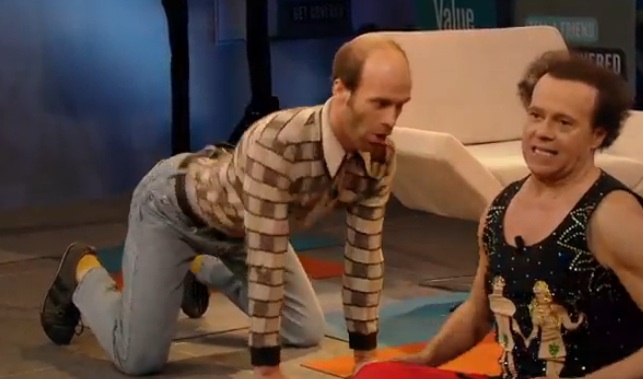
"Setting this positive and structural foundation for your life,"
whatever that could possibly mean
You can, but probably should not, see what this might have looked like by cueing the below video to around the twenty minute mark (which comes early in the video -- bear in mind, it's three hours of this sort of thing).
OUT: Footie Pajama Guy
IN: Richard Simmons, Disco Contortionism, and cocaine-fueled gay nightmares
The downside of the Viral Mentality (and is there an upside...?) is that those who think in terms of "make it go viral" seem indifferent to whether you're "Going Viral" in a good way or a bad way.
Our celebrity-smitten, Instant FameWhore culture does not seem to distinguish any longer between becoming admirably famous or simply becoming famous.
I'm sure the left will tell us in a week that we're all homophobes for wondering precisely who out there looks to Richard Simmons as an aspirational model, and that they totally Double Secret Probation tricked us into talking about this, because that was their object all along -- "Get talkin'," you know.
And yet... and yet. Oscar Wilde famously said he'd rather be talked about badly than not talked about at all, but this is a comparison between two inferior choices, isn't it? Obviously one would like to be talked about in a positive way over either of those two possibilities.
But not to those possessed of the Viral Mentality. The Kardashian Imperative says the only important thing is that you are talked about, period. Famous, infamous, lauded, notorious... who cares? The only important thing is that people know your picture.
Correction: There are not three hours of this.
There are more than six hours. 6:18, in fact.
Posted by: Ace at
09:05 AM
| Comments (514)
Post contains 362 words, total size 3 kb.
— Ace Of course.
From The Hill:
Obama and congressional Democrats are pushing for an across-the-board hike in the minimum hourly wage, from $7.25 to $10.10. But Republicans are cool to the plan, warning it could hurt the economy.
Federal contractors represent only a fraction of the nationÂ’s employees. Businesses that together received more than $446 billion in federal contracts employ some 2 million workers, only some of whom are paid the minimum wage. Still, an increase for that segment of the workforce could generate momentum toward a raise for all workers now paid the lowest amount allowable by law.
An executive order to that effect would be tantamount to setting a minimum wage for federal contractors, they said. “Profitable corporations that receive lucrative contracts from the federal government should pay all of their workers a decent wage,” the lawmakers wrote. Obama in recent days has vowed to make 2014 "a year of action," even if it means relying heavily on administrative authority to pursue policy goals in lieu of congressional action.
At first blush, I thought it was possible this would be permissible (if not advisable) under our Constitutional scheme, given that he was directing the Executive itself to make these payments.
But despite that trying-to-be-fair impulse, I'd still like to see legal opinions on this. After all, the President will not be paying these wages out of his own funds. The excess wages will, of course, be paid for by taxpayers, and absent an act of Congress raising the federal contractor minimum wage, this seems probably illegal.
As usual, of course.
"Year of Action," guys.
Thanks to @comradearthur.
Posted by: Ace at
08:25 AM
| Comments (292)
Post contains 292 words, total size 2 kb.
— Ace In the below excerpt, Walker talks about how we ought to talk.
... that the Left, they want you under their thumb. They want to control you. They want to control your lives. They want you to be dependent on the government. We should say weÂ’re the ones, not only for the poor, but for young people coming out of college, for working class families, for immigrants, for others out there. We should say we are the ones who empower the American Dream.WeÂ’re the ones who say you can do and be anything you want, but itÂ’s because we empower you with the ability and the platform to do that. Then itÂ’s up to you to make that happen. The other side tells you they want to help you, but in the end they want to keep you limited in how far you can grow.
We want to make sure everyoneÂ’s a part of the recovery. WeÂ’re not going to leave anybody behind, but weÂ’re going to do it by empowering people to control their own lives and destiny.
He expresses his frustration at Mitt Romney's campaign, and why Romney lost:
It was, I mean, it’s so frustrating. I mean, you think in modern American history we’ve never had someone running for re-election with an unemployment rate so high that ultimately won the election. I believe Mitt Romney is a good man. I think he would have been a good president, but I think he was mis-served by many in his campaign, many of whom believed, I think incorrectly, that Ronald Reagan won under similar circumstances almost exclusively on the idea that the question was making the election an referendum on Jimmy Carter. In fact, I quote the famous line that Reagan used, “You’re better off today than you were four years ago.” The problem is the Romney camp thought that was the entire focus of the campaign.They failed to see that Reagan’s campaign…… that statement was the closing argument in one of the last debates. It was a way of wrapping things together, but his campaign was much more than just being against Jimmy Carter. It was much more aspirational and Americans could see — and to this day 33 years later — you can still look back and say that and vote for Ronald Reagan. I remember, I was a teenager, had just become a teenager and voted for Ronald Reagan — limited government, you know, smaller government, lower taxes, strong national defense. You knew what you were getting. You knew how a Reagan administration, a Reagan presidency was going to be better for you....
I think that was a huge disservice, but that’s what happens when you fail to make your case positively, affirmatively — make your case about how life will be better if they elect a Republican.
Althouse (where I saw this) comments favorably on Walker's pitch, particularly on his recognition of the "aspirational" nature of a presidential candidacy.
Minor elected officials don't have to worry about the aspirational. They can afford to be entirely transactional-- vote for me, I'll do the things you want me to do. You don't have to look up to me, and you don't need to know I have a coherent vision of the Platonic Ideal of America. In exchange for your vote I'll do these things.
Period.
And that's fine for House members. Senators tend to need a little of the aspirational -- a little of the "poetry" of campaigning, as opposed to the "prose" of voting on legislation -- and governors need even more.
Presidents need a whole lot.
In fact, you can be a completely unaccomplished, never-did-nothing parvenue from the corrupt districts of Chicago and get elected President if you offer mostly the aspirational (with some vague promises about the transactional -- like how much of the federal kitty you're going to redistribute to your coalition).
He's right that Mitt Romney failed to deliver that. Mitt Romney, as far as conservative policy, offered us transactional promises. Not aspirational ones, transactional ones.
For example, he promised us he'd make illegal aliens self-deport. A fine transactional guarantee for those who seek to eject illegal immigrants. But nothing aspirational about it -- he didn't really even try to sell that as a humane and good policy. He just said he'd do it, because Republican primary voters demanded it.
He reported himself as "severely conservative." Another transactional promise. Hey, vote for me; I'll be stingy. Aspirational? Of course not. Who describes himself as "severely" anything?
The one area where I got excited -- and thought Mitt Romney was getting it on this aspirational thing -- is when he began talking about a "government-centered society," contrasting that (not as much contrast as I'd've liked, but it was there) on a society centered around the individual and family.
He began talking less about purely transactional bargains and more about a unifying theory of why conservatism works, and why statism in its various forms do not.
Because statism does not value the individual, only the masses in their corporate collective. Because, as I think Romney said, the larger the state, the smaller the citizen.
While that was good stuff, he didn't really add too much to it, nor find a way to link most of his announced policy preferences into that coherent narrative.
This aspirational stuff is triply important:
First, because it flatters those already inclined to vote for you by telling them not only that they're right -- and everyone loves hearing that -- but by telling them they're right in this novel, exciting way they hadn't previously considered. This gins up enthusiasm in the base, and that translates to more votes.
Second, because it gives people who don't necessarily agree with you another possible reason to vote for you. Someone may not agree with you on most of your transactional promises... but if you've announced a larger thematic rationale for your candidacy, he might like that, and he might even vote for you despite disagreeing with you on details.
And third, because a coherent framework of ideas and vision is a plausible method of persuading the on-the-fence, marginally-invested voter.
On this last point, we don't just nominate candidates to do the mechanical bits of governance. We don't just elect Presidents to sign the bills we like and veto the ones we don't.
We want candidates who can do more than that -- we want candidates who can take our beliefs and persuade more of our countrymen that we're right.
And we want them to do that better than we can ourselves, because most of us aren't terribly good at it, and even if we were halfway good at it, we don't have a the commanding heights of the White House to proclaim it.
I don't see much in the interview where Walker actually offers an aspirational vision. But there's time for that, and at least he recognizes that need.
Congrats to John Hawkins for landing that interview.
And... this has been a longer week for me than the calendar would indicate, so I am officially f*cking off for the night. And I'm going to be f*cking off MLK Day too. (It would be racist of me not to, you know.)
Open Thread.
Bonus: Oh Dear Lord.
And another bonus: Democrats want to study "hate" on the internet.
The future tense of the verb "to study," in the Democrat Dictionary, is "will legislate and restrict freedom."
More:
please make it stop god i promise i will be good
Posted by: Ace at
02:02 PM
| Comments (417)
Post contains 1267 words, total size 8 kb.
January 18, 2014
— Open Blogger Happy Saturday.
Now that were through the challenge of competing with America's favorite sport, I thought we might give this car thread thing another try. This week we are honored to have Moron CountrySquire contribute his take on the big reveals at the 2014 Detroit Auto Show.
Take it away, Countrysquire...
The 25th North American International Auto Show opened to the automotive press this week, and featured the world debut of several important vehicles. Car and Driver lists what they consider to be the 12 most important ones, so letÂ’s have a look at a few of those.
The big story at the show was the 2015 F-150. This has long been the best selling vehicle in the U.S. and FordÂ’s cash cow, both figuratively and literally. What is noteworthy about the new F-150 is not the LED headlights, 360 degree camera, damped tailgate, or even the new 2.7 liter EcoBoost engine, but the fact that the cab and bed are constructed of aluminum. Ford is claiming that this will make the new truck up to 700lbs lighter than the current one, so this is a BFD. No word yet on fuel mileage estimates, but it has to be a significant increase over the current model.

more...
Posted by: Open Blogger at
07:21 AM
| Comments (366)
Post contains 627 words, total size 5 kb.
January 17, 2014
— DrewM Just starting now on all the cable nets.
If this is really what he's going to propose, it's the dumbest thing this idiot has done yet. That's an impressive achievement given his record.
1. Give Privacy Act rights to foreigners....
The first reform strikes me as ludicrous. Why should foreigners have any privacy rights against the United States government? Privacy is a constitutional right that a citizen has against his own government — I have no more a right of privacy against Saudi Arabia’s government than a Saudi Arabian should have against NSA surveillance. Under the Privacy Act, an American has the right to see the information held on him or her by the government — will Dr. Zawahiri, the head of al-Qaeda, have a right to request his government file now?
The suggestion shows that the Obama administration seems to worry as much about the rights of potential terrorist suspects as it does about the Americans who are their potential victims.
I want tight controls on what the US government can do to Americans. Foreigners? That's WHY we have an intelligence community.
Added: He's going to announce that we'll stop spying on some foreign leaders. Unilateral disarmament isn't just for nuclear weapons!
Lot of hamstringing our FOREIGN intelligence here.
For that reason, the new presidential directive that I have issued today will clearly prescribe what we do, and do not do, when it comes to our overseas surveillance. To begin with, the directive makes clear that the United States only uses signals intelligence for legitimate national security purposes, and not for the purpose of indiscriminately reviewing the emails or phone calls of ordinary people. I have also made it clear that the United States does not collect intelligence to suppress criticism or dissent, nor do we collect intelligence to disadvantage people on the basis of their ethnicity, race, gender, sexual orientation, or religious beliefs. And we do not collect intelligence to provide a competitive advantage to U.S. companies, or U.S. commercial sectors.In terms of our bulk collection of signals intelligence, U.S. intelligence agencies will only use such data to meet specific security requirements: counter-intelligence; counter-terrorism; counter-proliferation; cyber-security; force protection for our troops and allies; and combating transnational crime, including sanctions evasion. Moreover, I have directed that we take the unprecedented step of extending certain protections that we have for the American people to people overseas. I have directed the DNI, in consultation with the Attorney General, to develop these safeguards, which will limit the duration that we can hold personal information, while also restricting the use of this information.
I updated this because I thought what he was proposing was more limited than it first appear. This is a pretty amazing retreat for the US.
More from Obama's speech:
Given the unique power of the state, it is not enough for leaders to say: trust us, we wonÂ’t abuse the data we collect. For history has too many examples when that trust has been breached. Our system of government is built on the premise that our liberty cannot depend on the good intentions of those in power; it depends upon the law to constrain those in power.
Unless you know, Congress won't let him to something he really wants to do.
Chutzpah, thy name is Obama.
Posted by: DrewM at
07:18 AM
| Comments (411)
Post contains 557 words, total size 4 kb.
41 queries taking 0.2288 seconds, 148 records returned.
Powered by Minx 1.1.6c-pink.

