


July 28, 2011
— DrewM The rules committee is going to meet at 11pm to tweak it. We might get a sense at that point what Boehner is going to have to add or remove in order to get the votes tomorrow (Friday).
Meanwhile, Harry Reid's Democratic Senate didn't do a damn thing today.
And contra the "Screw Boehner" crowd makes a quick bullet point case for passing the Boehner plan.
Now, about the Senate. Can Harry Reid actually move a piece of legislation, whether it comes from the House Republicans or one of his own? No. The Senate Democrats’s contribution to the week’s efforts has been a letter saying “no way” to a plan that has yet to emerge from the House. Meanwhile, America slides toward meltdown.And finally, let’s discuss the House Republicans who are standing on the brink of sending to the Senate — who will pass it — and the president — who will sign it — a piece of legislation that is consistent with their principles, if not perfect. Instead of simply voting yes, they have formed a variety of unproductive coalitions: the Coalition of the Willfully Ignorant (who claim you don’t need a debt-ceiling increase or that markets won’t care and their will be no fallout) and the Coalition of It’s Someone Else’s Problem (because I just want to have an issue and campaign). Result: They suffer a political loss and America loses.
Wow. Hope somebody either blinks, or thinks.
Via Andy...Market futures are down. It's a live feed (delayed a bit) but as of 11:15, Dow Futures are down 94.
Tomorrow (Friday) is 2Q GDP report day. Should be fun. And by fun I mean, awful.
Posted by: DrewM at
06:45 PM
| Comments (531)
Post contains 298 words, total size 2 kb.
— Maetenloch Could The US Simply Mint Its Way Past The Debt Limit?
So what happens if Congress fails to raise the debt ceiling by the August 2nd deadline?
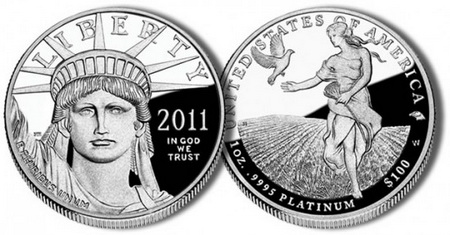
Well Yale law professor Jack Balkin says that Obama could just order the US Treasury to mint $2 trillion worth of platinum coins and then have the government write checks against them:
Sovereign governments such as the United States can print new money. However, there's a statutory limit to the amount of paper currency that can be in circulation at any one time.Ironically, there's no similar limit on the amount of coinage. A little-known statute gives the secretary of the Treasury the authority to issue platinum coins in any denomination. So some commentators have suggested that the Treasury create two $1 trillion coins, deposit them in its account in the Federal Reserve and write checks on the proceeds.
This sounds crazy but Matthew Yglesias points out that this is explicitly allowed under the law:
It’s right here in 31 USC § 5112 “Denominations, specifications, and design of coins.” It’s super-prescriptive about all kinds of things until you get to section (k):So barring a last minute agreement it's entirely possible the US may start issuing Zimbabwe-esque denominations of platinum coins.(k) The Secretary may mint and issue platinum bullion coins and proof platinum coins in accordance with such specifications, designs, varieties, quantities, denominations, and inscriptions as the Secretary, in the Secretary’s discretion, may prescribe from time to time.
Posted by: Maetenloch at
05:25 PM
| Comments (469)
Post contains 765 words, total size 7 kb.
— Open Blogger The great thing about the debt ceiling is that everybody's got an opinion. My thanks to the head Ewok for granting me the floor to express mine.
Posted by: Open Blogger at
03:38 PM
| Comments (623)
Post contains 683 words, total size 4 kb.
— Ace One snag: It includes 1% cuts, per year, to SS and Medicare too, which is probably unworkable right now.
WASHINGTON, July 13, 2011 /PRNewswire-USNewswire/ -- Congressman Mack today welcomed the support of Tea Party Senator Rand Paul (R-KY) as he signed on to the "One Percent Spending Reduction Act," legislation - also known as the "Penny Plan" - that was introduced by Senator Mike Enzi (R-WY) last week, and authored by Congressman Connie Mack (R-FL) last spring in the U.S. House of Representatives.Mack stated: "The support for the Penny Plan is growing almost daily on both sides of Capitol Hill as we draw closer to President Obama's August 2 deadline to raise the debt ceiling and continue Washington's reckless spending. Senator Paul's election last year was another clear example of the voters saying 'enough is enough' with the way Washington spends their money and having Senator Paul's support for the Penny Plan should send say to those voters, 'We heard you loud and clear.'"
Presently the Mack Penny plan enjoys the support of over 40 co-sponsors in the U.S. House, the backing of the Republican Study Committee's 103 Members, and two key U.S. Senators.
The Penny Plan balances the budget by:
-- Cutting total federal spending by one percent each year for six
consecutive years,
-- Setting an overall spending cap of 18 percent of gross domestic
product in 2018, and
-- Reducing overall spending by $7.5 trillion over 10 years.If Congress and the President are unable to make the necessary cuts, the bill's fail-safe triggers automatic, across-the-board cuts to ensure the one percent reductions are achieved.
Last week Senator Enzi stated: "This proposal is simple, effective and real. That's a winning combination that I hope my colleagues can get behind. If they can't, I hope the people who elect them will."
Mack added, "At President Obama's news conference last week, he talked about hard-working American families having to make tough budget decisions at home - so is it too much to ask the federal government to do the same and eliminate one penny out of every federal dollar spent?"
ArthurK. just alerted me to this plan, which I hadn't heard about; Truman North wanted to write about a similar idea but I didn't believe him (that is, I didn't believe the magnitude of the cuts in ten years).
I don't know how you actually just cut SS and Medicare for current retirees without simply losing all political power next year and having those changes undone.
However, as far as every other account...
Posted by: Ace at
02:23 PM
| Comments (535)
Post contains 459 words, total size 3 kb.
— Ace Supposedly it will still be had later tonight, but that assumes they have a decent shot at passage.
A later update at NRO said that some "long-standing" conservative members, not the Freshmen, have been particularly hard to get on board.
From commenters, I hear that 24 are confirmed "no" which means Boehner can't lose another one.
Updates: From Hot Air, FoxNews' Ed Henry says Boehner doesn't have the votes.
But we sort of knew that, or else he would have called the vote.
Posted by: Ace at
01:54 PM
| Comments (165)
Post contains 93 words, total size 1 kb.
— Ace You couldn't pay all the entitlement programs, for example.
He has a cutesy way to define "entitlement programs," by the way -- he sneaks "farm aid" into there, which is usually not considered an "entitlement," and more than likely he is then dishonestly sneaking other accounts into that category -- but even so, this demonstrates the scale of the problem.
It is alarming that even conservatives engaged with the news and at least conversant with the numbers continue to suggest that this is a just a discretionary spending issue, and that we can balance things just by cutting some in those accounts.
We can't. It's bigger than that. And I don't know how you reform entitlements with the Democrats controlling the Senate, and making their 2012 campaign pledge to not reduce a dime of spending in these accounts.
By the way, a tactical shorter-duration shutdown might still be a good idea as far as forcing Obama to compromise further with us... but based upon math, not even shutting down government (including federal jails, the FBI, the military, etc.) for an entire year would actually get us balanced.
Posted by: Ace at
12:37 PM
| Comments (241)
Post contains 243 words, total size 2 kb.
— Ace Here is what I think the shut-it-down-now crowd is missing.
In 2012, there is a good, and rising, chance, of not merely having a united Republican government -- we had that from 2003 to 2007, and it was a failure -- but of having a united conservative government.
We have not had this since... I have no idea. As what "conservative" means shifts each decade, I think it's accurate to say we've never had that.
Milton Friedman observed you could never have better politicians. They'd always be louts, who shift according to the public mood.
Actually some would say that is a feature, not a bug, of democracy, as ultimately The People will have their say -- and sometimes The People will favor recklessness and indulgence, but that is, in a democracy, their choice, and it is hard to conceive of a democracy (or a democratic republic) in which The People are somehow precluded from being short-sighted, or stupid.
Friedman said you would have better policy not when you had better politicians -- they would tend to be mere weather vanes for whatever absurdities the public convinced themselves of this week -- but when you had better voters.
And by "better voters," he meant voters willing to take a stance and not vote on silly promises of more and costlier free lunches, but would in fact vote for the good of the nation, taking the Big Picture view of things.
When the voters would not reward politicians for stupid, freedom-eroding, wealth-diminishing pandering, but instead punish them for such, then, and only then, would we have "better politicians."
But the politicians would not be actually better in the sense of a changed heart. They would act better, however, because the public had changed the incentive system for them. Always acting in their own political self-interest, they would choose good policy only when the public rewarded them for good policy, and turned them out of office for bad policy.
Are we there? Honestly, I think we are getting there. The public seems to be in a Tea Party-ish mood. No, the public has not wrapped its head around what "cutting government spending" really means, but they at least have the impulse to do that. They favor that as a general proposition, a vague one to be sure, but they understand that's the right thing.
For those who cry the House Republicans are selling out the Tea Party: Let me remind you the House passed the Ryan Budget, one of the most controversial and politically risky documents in the history of the United States.
I'm not exaggerating. For 50 years the rule has been "do not touch entitlements, ever." Choose financial ruin for the nation before you choose that.
And the politicians followed that rule, set out for them by The People.
Bush tried a modest reform of Social Security. When political ruin did not immediately befall him, some of his aids bragged, "We touched the third rail of politics and didn't get electrocuted."
Liberal strategists said (in a cute quote): "That's only because we haven't turned the power on yet." Well, they turned it on, and The People turned against the plan, and Bush and Congress retreated.
To pretend to be addressing the deficit, Clinton made a show of lowering doctor reimbursements for Medicare.
But The People rejected this, and every year since then the "doc fix" has been passed, "suspending" the legally required cuts in doctor reimbursements.
The only way it has been politically palatable to change entitlement has been to expand them and make the system even more unsustainable.
I don't know if real reform is even possible yet -- I suspect it is becoming possible, because the crisis is on the horizon, and people are beginning to understand we have to do something.
But my point is that while previous attempts to actually cut government spending have been politically costly, with The People rising up in protest, and politicians running away in fear, lately The People's response has been somewhere between muted and mildly supportive, and politicians have not run away.
Many people want the Republicans to shut the government down over the debt ceiling to prove they are capable of actually cutting the budget. That is, they are sick of rhetoric and empty promises; they want proof that this will be translated into actual action.
So this debate is partly (largely) about the size of government, and rate of spending, but it is also partly about the Republican Party proving that it is really serious this time about cutting spending and bringing us towards solvency, and a more limited, modest, affordable government.
But from my point of view, they have proven their intent here. With a change of incentives, they are, as Milton Friendman predicting, changing their behavior.
So I am a little less worried than some that the GOP will continue to be the big spending party that it became during the Bush years.
Some question if they have the intent to cut government. I think that has been partly answered -- not completely, as no one knows what will happen in the future, but to some extent, the current crop of Tea Party Pressured Republicans have demonstrated their seriousness about cutting spending.
Not as much as I'd like. But a fair amount.
And Christie, Walker, Daniels, and Kasich all took on the public employee unions and... well, they're not the most popular guys in the world, but they won. They'll probably have enough support to be reelected. (Except for Kasich, who is in genuine danger, but he's got time.)
The question more for me (and for many others) is whether they have the power right now to translate that intent into action, and I don't think they do.
Some say they do have it: Shut the government down. Force Obama to sign anything to get his bureaucrats a paycheck.
I'm not sure it will work out for us. If we are punished politically for this -- say the economy double-dips into a fresh recession (as it seems to be heading towards), and it winds up being believed it was Republican brinksmanshp that caused that -- we could lose 2012, and thus the long game.
Now, I actually don't know if we would get "blamed." Honestly, I believe that is overstated. I do sort of agree with people who think we wouldn't get blamed.
But it is a big chance. And there is the old maxim: When your opponent is self-destructing, just stay out of his way.
Currently it looks like we can keep the House (rather easily, it is largely believed) and have a better than even chance of winning the Senate. I also think we'd probably win the White House.
If we did this, we could set economic policy in the US for two or four years, unchallenged by the left.
The only arguments we'd be having is how much to cut. We'd have to argue with the Maine Twins and Scott Brown, of course.
But the whole debate would move from "should we cut?" to "how deep can we cut?"
I also don't fear the filibuster on this issue, because of... Budget Reconciliation, the maneuver Obama used to dishonestly pass ObamaCare.
Doesn't Budget Reconciliation hold that a measure which reduces the deficit cannot be filibustered but instead may pass on a mere 50 votes (with a tie-breaking vote by the VP, if necessary)?
We currently are holding the line on spending.
That's not good enough, of course. Government doubled in size in the last decade and 30% since Obama took office.
But if holding the line can set us up for real reform in 2012...
This is what I think the Establishment is thinking. As Obama has continued to deteriorate in polls -- and the economy has deteriorated along the way, and offers little hope of improving enough to be a net positive for him in November 2012 -- I have started to think we can win in 2012, and win it all.
With actual conservatives leading the show.
Given that my prognostication for 2012 has shifted from "Obama probably wins" to "Obama probably loses," a lot of my tactical thinking has changed to.
I'm not saying you should buy into this thinking. But you may see Krauthammer, Sowell, and other talking about the long game, so I thought I'd add my arguments about it.
This is shifting to a question of tactics. I don't think I disagree with the Shut it Down Now crowd as far as endgame, but I have changed my mind about the pathway to get there.
Posted by: Ace at
11:57 AM
| Comments (302)
Post contains 1449 words, total size 8 kb.
— Ace I guess I'm sold.
Sort of.
Is the Boehner legislation the best legislation possible? Of course not! You don't get your heart's desire when you control only one house of Congress and face a presidential veto.The most basic fact of life is that we can make our choices only among the alternatives actually available. It is not idealism to ignore the limits of one's power. Nor is it selling out one's principles to recognize those limits at a given time and place, and get the best deal possible under those conditions.
That still leaves the option of working toward getting a better deal later, when the odds are more in your favor.
There would not be a United States of America today if George Washington's army had not retreated and retreated and retreated, in the face of an overwhelmingly more powerful British military force bent on annihilating Washington's troops.
Later, when the conditions were right for attack, General Washington attacked. But he would have had nothing to attack with if he had wasted his troops in battles that would have wiped them out.
Similar principles apply in politics. As Edmund Burke said more than two centuries ago: "Preserving my principles unshaken, I reserve my activity for rational endeavors."
One thing, this idea that we're going to get more later: We're not, and we shouldn't talk about false hopes.
That sort of thing can only really happen if we're willing to shut the government down, and we're plainly not.
I'm not speaking now in terms of "should." Like I'm not saying we should not be willing to shut it down.
I'm speaking in simple terms of factual observation -- we will not shut it down, so we cannot actually force that better deal on anyone.
Posted by: Ace at
10:56 AM
| Comments (278)
Post contains 315 words, total size 2 kb.
— Ace Um... why not reassure the markets and announce this right now?
It's almost like they're looking for a crash, to increase their political whip-hand.
Posted by: Ace at
10:45 AM
| Comments (74)
Post contains 70 words, total size 1 kb.
— Ace An update to the last post.
I was just about to write that while Perry's 10th Amendment stance is designed to get him off talking about social issues and permit him to talk about economic issues, it usually doesn't work out that way.
(Actually: "designed" isn't the right word. Perry has been talking up the 10th Amendment for years. So it's cynical to say the position is "designed" for this effect.
But it is accurate to say the position would have a sanguine effect for him in permitting him to focus on truly federal concerns... if he could manage to sell people on it.)
It didn't for Mitch Daniels, for example. What tends to happen is that positions that look like deviations from the social conservative orthodoxy become discussion-bait and wind up making the candidate talk even more about the issue.
In a primary, if you want to talk less about abortion or gay marriage, you have to say "I'm against them, completely." Then conservative activists have fewer questions.
When Perry made his 10th Amendment statement, he referenced New York State passing a gay marriage law, and added "...and that's fine with me."
Now he's been asked if gay marriage is "fine" with him, and he's had to clarify:
Gov. Perry spoke with Family Research Council President Tony Perkins today to addresses the Aspen remarks ...“I probably needed to add a few words after that ‘it’s fine with me,’ and that it’s fine with me that a state is using their sovereign rights to decide an issue. Obviously gay marriage is not fine with me. My stance hasn’t changed.”
It's an interesting play; we'll see if it works. Like many other candidates before him -- most of whom failed -- Perry is offering a position that will be strong in the general election, but might be problematic in the primary before it.
It's my tentative guess it works for Perry, partly because it's a position with a good conservative pedigree, and partly because it is my understanding that Perry is a good campaigner. I've never seen the man in action, but from all reports, he's good at this game.
Campaigning is a skill. We may look down on it but almost every man actually elected president was skilled at campaigning and campaign messaging and all the parts of politics that ideologically-motivated people tend to disparage as superficial.
Electoral history is littered with candidates who were "good on the issues" and brought a lot of ideas to the table, but weren't particularly good at persuading people to embrace these ideas.
If the Presidency were an appointed post, such people might make for good presidents. But it's not; the candidate has to make the sale. And candidates who lack the skill of personal salesmanship don't get elected.
"Dear Yankee:" A Texans Introduction of Rick Perry to the Yankee Press: I read this yesterday, and people are talking about it.
Generally I don't like posting stuff like this because this is pure electioneering but people are referencing it in the comments so here it is.
This reinforces the take I've had about Perry (from other people) that:
1. He's conservative.
2. He's a good campaigner and unlike some people actually likes doing it. (Which is valuable: People who like what they're doing are better at doing it, almost always.)
3. He tends to be politically "tough." Toughness is important. I guess what I mean is "willing to be mean when called upon to be mean."
That's important too. We saw what happens in 2008 when a candidate is so intoxicated with his own "honor" he won't be mean to his opponent.
One thing I'll say in Romney's favor -- he was widely disliked by other candidates in 2008 for throwing a lot of sharp elbows and doing a lot of campaign-whispers hits on other candidates.
But I'd've sure preferred Romney doing that in 2008 to Obama, rather than John McCain calling him his "friend" all the time.
Perry doesn't seem mean, but apparently is mean.
Politics ain't beanbag, as they say.
Posted by: Ace at
09:18 AM
| Comments (341)
Post contains 693 words, total size 4 kb.
44 queries taking 0.2595 seconds, 151 records returned.
Powered by Minx 1.1.6c-pink.

