


January 22, 2014
— Open Blogger
- Obamacare May Not Be Substantially Reducing The Number Of Uninsured
- NY To Use Eminent Domain To Seize WW 2 Vet's Property
- VDH: Obama's Recessional
- Government Conspiracy Theories Aren't Crazy
- Teen Expelled For Performing In Pron Allowed Back To School
- Argentina Trying To Keep Capital Inside The Country
- 20% Of Households On Food Stamps
- Post-Racial? Try Post-Responsible
- Target Dropping Healthcare For Part Time Employees
- The United States Of Paranoia
- 55 Million Abortions Since Roe
- Protect Firefox Browser From The US Government
- Should Christie Resign From The RGA
- Wendy Davis Doubles Down
- I Simply Don't Have The Thighs To Pull These Off
Follow me on twitter.
Posted by: Open Blogger at
05:55 AM
| Comments (340)
Post contains 112 words, total size 3 kb.
January 21, 2014
— Maetenloch
Truth: The Latest Weapon of the Patriarchy
Because the true facts about Wendy Davis' life are just another front in the War on Women and she's not going to take any more mansplaining attacks from her opponent, Greg Abbot, or anyone else.
We're not surprised by Greg Abbott's [her Texas governorship opponent] campaign attacks on the personal story of my life as a single mother who worked hard to get ahead. But they won't work, because my story is the story of millions of Texas women who know the strength it takes when you're young, alone and a mother. I've always been open about my life not because my story is unique, but because it isn't.
The truth is that at age 19, I was a teenage mother living alone with my daughter in a trailer and struggling to keep us afloat on my way to a divorce. And I knew then that I was going to have to work my way up and out of that life if I was going to give my daughter a better life and a better future and that's what I've done. I am proud of where I came from and I am proud of what I've been able to achieve through hard work and perseverance. And I guarantee you that anyone who tries to say otherwise hasn't walked a day in my shoes."
Here is a picture of Greg Abbot. He hasn't walked a day in her shoes - or at all since a tree fell on him 30 years ago, paralyzing him and requiring almost a year in rehab. Clearly he knows nothing of suffering.

But Wendy "Storyteller" Davis is doubling down:

And Stephen Green has a diabolical suggestion for Abbot:

Posted by: Maetenloch at
05:59 PM
| Comments (710)
Post contains 1402 words, total size 15 kb.
— Ace I love Wikipedia. I actually love it. I get lost for hours in it.
It's just so amazing: Virtually every subject you could possibly have an interest in, briefly explained, all at your fingertips.
A gigantic hyperlinked encyclopedia.
So, here's what I discovered today. Actually, I discovered four things, but this is the most interesting, I think.
Anyone ever hear of the "frequentive form" of a word? It's a process by which one inflect a word to indicate repeated or intense action.
This is actually a thing in English. Or at least it was. In older versions of English, you could just add -le or -er to a verb (usually a verb) to indicate a repeated action of that verb. You'd have to make some minor spelling changes to make sure the word flowed properly.
Now, we can't do this anymore. I can't say that I wankle instead of "wank" to indicate the repetitive mechanical fury with which I abuse myself, whirring and sparking like a misfiring industrial robot.
But you used to be able to do this in English, and everyone would understand what you were saying, because people understood the convention of adding -er or -le to a verb to indicate frequency or intensity.
But some "frequentive" forms of words became so widespread that they became words in their own right, which survive in English to this day. A great list is here, but here are some of my favorites:
bat --> batter. Repeatedly bat.
pat --> patter. Repeatedly pat. Like rain on a roof.
swathe --> swaddle. Repeatedly swathe.
wrest (as in seize) --> wrestle. Vigorously, continue "wrest" someone.
daze --> dazzle.
crack --> crackle. Okay that one is obvious, but did you know there was a specific rule for forming the frequentive form? So shut up.
bob --> bobble.
jig (the dance step or skip) --> jiggle.
float --> flutter. (How awesome is that?)
gleam --> glimmer. It's so obvious now, isn't it?
wade --> waddle. There you go. Makes perfect sense.
pool --> puddle. I guess it probably had a "poodle" transitional form.
Okay, now guess where jostle comes from, employing the rules and pattern above.
If you guessed
joust --> jostle
...then you guessed right.
Here's my absolute favorite. They slightly changed the spelling here, as they did with "swathe" and "puddle."
But you know where slither comes from?
Guess.
Well, here's the answer:
slide --> slither
Is this awesome or am I just easily amused?
The Problem Is... Per "Tom Delay," in the comments:
The problem with wikipedia is it's a a vast sinkhole of information. You
look up one thing and suddenly it's 4 hours later and you're reading an article on Antman.
Literally LOLed, because yeah, I've done that. And I did end up on Antman.
On this timesuck phenomenon of the "Wikiwander," Last Refuge of a Scoundrel sends this blogger's recounting of the various odd places that Wikipedia hyperlinks have taken him.
Posted by: Ace at
03:46 PM
| Comments (615)
Post contains 504 words, total size 3 kb.
— Ace I frequently point to Cuccinelli's too-red-for-blue-Virginia social positions as a reason for his loss.
Here's the other big a reason: McDonnell was a popular governor. What should have happened is this: McDonnell campaigns with Cuccinelli, tells people "This guy is going to keep Virginia on the same prosperous path I kept it on, vote for him."
That didn't happen, because McDonnell was rendered a liability (or at least not particularly valuable) due to his acceptance of pricey gifts from donors.
He's now been indicted in the matter by a federal grand jury. His wife has been indicted as well.
The charges against the couple were outlined in a document filed by the U.S. Attorney for the Eastern District of Virginia that details how McDonnell and his wife accepted more than $135,000 in gifts and loans, trips, designer clothing and other items from Jonnie Williams Sr., former CEO of Star Scientific....
The 14-count indictment, filed Tuesday, charges McDonnell and his wife, Maureen, with a wide array of official corruption. Specifically, the McDonnells were charged with wire fraud, conspiracy and obtaining property under the auspices of their official offices.
Maureen McDonnell was also charged with obstructing the government's investigation.
I'm sure there'll be no such shenanigans under the new reign of Terry "Snow Wouldn't Melt In My Mouth" MacAuliffe, and I'm sure that if there were, Obama's Justice department would similarly lodge a large list of redundant charges (all criminalizing the same basic actions).
Posted by: Ace at
03:17 PM
| Comments (114)
Post contains 263 words, total size 2 kb.
— Ace Well, I'm too engrossed in the comments today so I'm not really finding stuff on my own.
Chris Christie seems to have suggested he'll be attempting to decriminalize pot in New Jersey.
This is from his gubernatorial inaugural address. A cynic would imagine Christie would prefer a policy controversy to suck the oxygen away from the scandal controversy. (Even though many of the claims there seem to be total bullshit, with no evidence for them (except Mayor Zimmer's hand-scrawled notes, which could have been written at any time) and even thought Democrats are admitting their goal is to slime up Christie as they eventually did to Romney, to make him non-viable as a candidate.)
Even by the cynical interpretation, we're at the stage where a politician now proposes decriminalizing pot as a distraction from something politically damaging.)
Is Christie on the level here? I think probably yes, in the sense that this is his actual belief about the right policy.
“We will end the failed war on drugs that believes that incarceration is the cure of every ill caused by drug abuse. We will make drug treatment available to as many of our non-violent offenders as we can and we will partner with our citizens to create a society that understands this simple truth: every life has value and no life is disposable,” Christie said during his inaugural speech this morning.The governor expressed desire to help those struggling with drug addiction in a bipartisan manner. “And, while government has a role in ensuring the opportunity to accomplish these dreams, we have now learned that we have an even bigger role to play as individual citizens. We have to be willing to play outside the red and blue boxes the media and pundits put us in; we have to be willing to reach out to others who look or speak differently than us; we have to be willing to personally reach out a helping hand to a neighbor suffering from drug addiction, depression or the dignity stripping loss of a job,” said Christie.
Everything is changing so fast. The old rules aren't the new rules. We're in "interesting times," as the Chinese curse goes.
But, you know, the Chinese word for "crisis" is actually made up for the words for "danger" and "opportunity," as Al Gore and other people who wish to appear intelligent always say, erroneously and stupidly. (It's actually composed of the words for "danger" and "critical point." You know, critical, as in "crisis.")
Posted by: Ace at
01:28 PM
| Comments (414)
Post contains 430 words, total size 3 kb.
— Ace He's got a pen, a phone, and a pathological hatred of the American system of democratically-informed, check-and-balance governance.
It’s not that O’s going to somehow unilaterally repeal the sanctions in effect. A la the employer mandate, he’ll simply refuse to enforce existing law, using executive orders and waivers to make sure that funds that Congress wants choked off will somehow find their way to Iran if the mullahs play ball. The counterargument here, I guess, is that presidents always have some latitude in how they enforce sanctions. Right, but this isn’t a quibble about how best to carry out a mutually agree-upon policy; it’s a case of the executive and legislature being seemingly at loggerheads on the core question of whether U.S. policy should involve more pressure on an enemy or less — at a sensitive moment of international diplomacy to boot. Against that backdrop, systematically relaxing sanctions would amount to O substituting the policy he favors for the one favored by Congress. That’s actually bolder than his decision not to enforce the mandate, which Democrats were happy to see him do (even though they had passed the mandate in the first place) since it averted an extra ObamaCare-related political headache for them this year. By relaxing Iran sanctions, he’d potentially be defying his own party too.
After the Soviet Union fell, Russia implemented a system of limited government (well, limited as regards the Russian experience of government, anyway). Yeltsin -- and then Putin -- found that the limited government didn't suit them, and thus the early nineties were marked by this sort of headline, every single month:
Yeltsin Declares Sweeping New Powers
or:
Putin's Party Votes Him Sweeping New Powers
Well, Putin is now officially a tyrant.
It can't happen here?
Why can it not happen here? It happens, literally, everywhere else.
Posted by: Ace at
12:27 PM
| Comments (323)
Post contains 341 words, total size 2 kb.
— Ace Check out this problem:
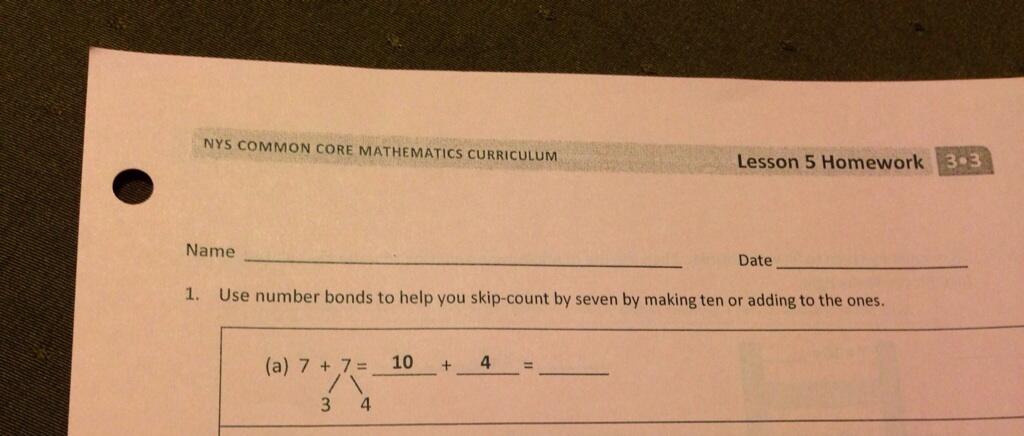
If that isn't big enough on your screen here, hit the twitchy link to get a bigger picture.
What they're asking kids to do is this: Rather than simply memorize the fact that seven plus seven equals fourteen, they're training kids to recognize possible shortcuts or easier paths to computation. If a kid realizes a seven is made up of 3 plus four, and remembers that three plus seven equals ten, then he can "simplify" the problem as ten plus four, which gives fourteen.
Here's the problem: The shortcut/easier path of computation is actually more complicated than just learning that seven plus seven equals fourteen.
This is Cargo Cult stuff. They did the same thing with their new innovations in Whole Word learning (reading a word at a glance), when they got rid of Phonics (sounding a word out, letter by letter), and doomed a generation to being bad readers.
Here's the Cargo Cult part:
Professional Highly-Educated Education Researchers noted that high-level early readers were usually just identifying words at a glance -- reading in a "whole word" way. While kids using Phonics read more slowly. Phonics kids were slower readers and struggled with it more.
So hey -- let's stop teaching kids this slow method of reading called Phonics and just teach them "Whole Word" reading!!! Win, win, win!!! It's easier for the students, and even easier for the teachers, as they don't have to teach the step-by-step Phonics method of reading. They can just say the word "horse" is horse and keep saying it until these stupid kids start learning that "horse" means horse.
Here's the problem: This is Cargo Cult mneliaty. Yes, the high-lanrneig, early-raednig kids are in fact using the Wlohe Wrod raenidg mhoted, just as you, reading that gibberish I just wrote, employed Whole Word reading -- looking at the first and last letters of the word and using context and years and years of experience in how the written language works, and what words are expected to come in which place in a sentence to read, fairly easily, a bunch of misspelled words as the words I intended.
But the high-learning, early-reading kids are only doing that because they started reading earlier than the other kids. All kids -- including the early readers -- go through the Phonics phase. One of my earliest recollections (maybe my earliest) is sounding out the word "BAKERY" when we were getting some bread or donuts. My parents were pretty impressed. (I was nineteen years old.)
Now, having gone through the Phonics phase at age 3 or 4, by age five I was reading quite a bit, especially Peanuts (I had whole books, decades' worth of Peanuts cartoons). And I had moved from "mostly Phonics" to "mostly Whole Word reading," at least as far as common words. The unfamiliar words I still had to sound out, Phonics-style.
So sure-- the accomplished 6-year-old readers are indeed mostly using whole word, at least for common words. Spoiler alert: That's because they already went through the Phonics phase at age 4 or 5.
The Cargo Cult mistake of these "Educators" is to think that Whole Word reading is a shortcut to teaching reading. No-- Whole Word reading is the endpoint of learning to read. First you read letter by letter, then syllable by syllable (as you have begun to compile, in your Reading Memory, a large list of common syllables). Then you start just reading Whole Word.
You have to go through the letter-by-letter process to get to the Whole Word level. As I'm learning a new language myself at an older age, I've gone through this recently myself -- it took a long time for me to get a sense for how the French language worked in terms of grammar and orthology, but as I've read more and more, I can now read faster. I'm beginning to take "Sight Pictures" of sentences (well... not sentences, but at least clauses) as I long ago learned to do with English.
By denying kids their first step in reading -- teaching them to read letter-by-letter -- educators have not advanced Whole Word reading. They're retarded it. You can't do whole word until you're an ace at letter by letter.
They're making the same mistake here with this jackass method of teaching math. The method they're teaching is what I'd term a secondary insight. Yes, I know what they're trying to teach. I do this myself sometimes, to make life easier on myself.
Did someone have to teach me this? No, it's a simple enough insight once you are fluent with the basic memorized rules of math. Once "three plus four equals seven and three plus seven equals ten" is drilled into your head enough times, you naturally start thinking in terms (or can start thinking in such terms, if that's your preference) whereby you perform somewhat complex operations on simple math problems to make them easier for yourself.
It's unclear to me if this actually simplifies anything, though I do do this sort of thing, occasionally, myself.
But once again the "Experts" are demonstrating their Cargo Cult mentality when it comes to pedagogy. Because kids will start intuiting these things after they've mastered the rote-memorization and drilling routine of arithmetic and the times tables, hey, let's just cut out the middleman and teach the Advanced Secondary Insights explicitly! And skip all that tedious rote-memorization and drilling!
Again, as someone learning a language from scratch, I can tell you two things:
1. I despise rote memorization and drilling, those endless repetitions of stupid very basic sentences designed to teach one or three specific rules of grammar and spelling.
2. No matter how much I despise these things, and I do despise them, make no mistake -- this is the way you learn.
You cannot "intuit" the proper order of prepositions in a sentence. You cannot Cargo Cult your way there. You simply have to memorize the correct order of direct object pronoun, indirect object pronoun, reflexive pronoun, and "en" or "y" according to the type of sentence it is, and then write a whole bunch of stupid-ass sentences which employ the rules of pronoun placement.
It's hard, it's not fun, it's annoying as balls, I dread it every time I do it, and it frequently feels like it's insulting your intelligence... but it's not. It's how basic, elementary things are learned. And only once the basics are learned does a student begin gaining the power to make his own insights and deductions.
At least normally-intelligent students can make sound insights and deductions once they've learned the basics.
At the brain trust of the Department of Education, however, past experience counts for nothing at all, and we're just going to keep trying the same old shit ("Let's pretend all kids are high-learners and teach them the tricks that high-learners have intuited after years of competency at this task!") every single year to justify their paychecks.
No one gets an award for suggesting we try the old, established, well-proven methods of teaching. You only get awards and recognition for proposing new ones.
Whether they work or not. And hey, who cares if kids learn anyway? The important thing is that promotion.
I have seen the future, and the future is spelled Kah-Buum.
Teaching Kids How to Think and Other Lies: It is an article of faith among educators -- most of whom are not really very good at thinking themselves -- that they should be "teaching kids how to think," rather than engaging in rote repetition and drilling.
I don't believe you really can be "taught to think," not really. Like all other skills, it comes from practice.
At some point students can -- or must -- begin teaching themselves. At least, if they're to become true students.
All these jackass methods suffer not only from the Cargo Cult mentality, but actually retard "learning how to think," by attempting to codify deductions, rather than relying on students to make them on their own.
Look, let's be realistic: Some people just aren't going to be standout thinkers. By denying them the basics in favor of teaching them something that fundamentally just can't be taught (especially by people who aren't good at thinking themselves), you're both not teaching them the basics, and also not teaching them "how to think."
Yesterday I made a deduction that thrilled me. I wrote the word "penchant" in a post. I never really knew the strict English definition, but I knew, in a ballpark way, it meant "tendency towards."
I realized it's a French word. The French form their gerunds -- their "ing" versions of verbs, as the verb "to run" becomes the gerund noun "running" -- by adding an -ant to the word's stem.
So, "interesting" in English is "interessant" in French with an -ant stuck on the root of interester, the verb "to interest."
So I realized that "penchant" was probably a gerund form of a verb which must be "pencher." I think I've seen it before, but I never looked it up. Taking a guess at what the word must mean, I guessed pencher probably means "to incline," which would make the French (and English) definition of "penchant" "an inclining towards," or, in better English, "an inclination towards."
Then I looked it up. Pencher does in fact mean "to incline or rise," and finally, after a whole life of just vaguely knowing what the English word "penchant" means, I confirmed it does mean "inclining towards" (or "preferring" or "having a habit of" -- all derived from "inclining towards").
I was actually a little thrilled. I felt empowered.
But honestly-- how would you go about teaching that? Well, you can only tell students that -ant is our -ing. Once they've learned that (and had it drilled in their heads by reading French texts, in which -ant is very common), they can, at their own initiative, wonder things like "Gee, does 'penchant' imply a verb 'pencher'?"
But how do you make a lesson of this? At most, what you'd do is tuck this in the back of a chapter, in those "For Further Thought and Exploration" parts of the textbook, where you ask students to guess at the meaning of "pencher" based on their vague knowledge of the English "penchant."
But would you design a whole lesson around this mode of thought? Would you drill this sort of thing into kids' heads, like teachers are now doing with "number bonds"?
No. You give students the sandbox of basic information to play in, and hope they make sandcastles.
And that's how you learn to think. Not by a teacher telling you, "This is how you learn to think."
Posted by: Ace at
11:15 AM
| Comments (533)
Post contains 1798 words, total size 11 kb.
— Ace I am always on about this: The Democrats' attempt to portray themselves as Just Like You, while portraying the Republicans as Not Like You.
Well, I don't mind that. Because the Republicans are meanwhile attempting to portray themselves as Just Like You, while the Democrats are Not Like You.
The problem is the media. The media has its own take here. The media's take is that the Democrats are right, they are Just Like You, and the Republicans are Not Like You.
This is why every progressive protest is portrayed by the media as made up of "common, ordinary Americans" -- the now-ritual listing of "teachers, welders, Post Office mailmen, factory workers, and even grandmothers;" the media writers consciously and deliberately attempt to cast every progressive rally as drawing from all segments of society, so that every reader can see a little of himself in one of the descriptors -- while conservative protests and rallies are described as being made up of as narrow a caste as is possible ("rich, white, older, Christian Conservative" -- what, no "grandmothers" in there?), sprinkled liberally with human exotica ("and several protesters carried misspelled signs calling for the end of the Federal reserve") that readers can despise and thereby feel superior to.
Well, kids, we get to play the game too. And while feminists might support Wendy Davis' decision to leave her kid with her father while she pursued her own personal goals, this will make her appear Not Like You to many women, who tend to view children as one's highest calling, rather than second or third or fourth highest as Wendy Davis does.
More: As someone who's pro-choice myself, noting this fact is uncomfortable for me, but it is nevertheless a fact: Since Roe v. Wade, 55 million fetuses (or babies) have been aborted.
40 years ago today, seven men on the Supreme Court decided in favor of a case presented to them from a 27 year-old, unknown, post-abortive lawyer, Sarah Weddington. That case was Roe v. Wade and, along with its companion Doe v. Bolton, it legalized abortion in all 9 months of pregnancy, for any reason, in the United States.Today, this 27 year-old is writing to you as a survivor of that decision. The undeniable fact is that nearly a third of my generation is missing. We are missing brothers, sisters, cousins, friends, husbands and wives.
Posted by: Ace at
10:11 AM
| Comments (396)
Post contains 407 words, total size 3 kb.
— Ace He's proposing making a touchdown worth 7 points, period, automatically, but you have the option to gamble that extra point on a conversion. If you make the conversion, you gain a point (up to
 and if you fail, you lose the point (down to 6). As it is now.
I wouldn't do this.
The problem with extra points is not the play itself. The play takes five seconds. Even if there's no dramatic interest in the play, who cares? It takes all of five seconds.
The problem with extra points is TV timeouts for commercials.
Early in NFL games, after a touchdown is scored, broadcasters often cut to a commercial, then come back from break for a five second extra point try, then kickoff (which takes another ten seconds or so, and often results in no runback). Then they take another break.
This can mean that after a touchdown, four or five minutes go by before you see anything like an offensive play. You'll see two and a half minutes of commercials, then a nearly-automatic extra point, then a kickoff which usually goes out of the endzone or is downed with no runback, then two and a half minutes of commercials, and then, finally, football again.
The problem isn't the extra point itself, which should be preserved just out of tradition. The problem is the grueling number of minutes which pass between a touchdown and the next offensive series. Eliminating the five-second play of the extra point does nothing about that (except save five seconds).
If the NFL wants to address this problem, they should make sure their future contracts with broadcasters specify the following:
No television timeout can be taken between the touchdown and point after attempt. (If a team calls a time out to strategize for the conversion, they may extend that into a TV timeout.)
Only two minutes of commercials are permitted after a touchdown and point after; after this, a kickoff occurs, and only one minute of TV timeout is permitted between the spotting of the ball and the next snap.
That's actually more like broadcasters handle commercials at the end of the game. They really pack commercials into the front half of the game; they're a bit less greedy in the second half.
This problem can be fixed by the NFL being slightly less greedy and thereby imposing rules on broadcasters to be slightly less greedy too.
Ummm... Open Thread? Hedley Lamar says this entire post is based on an incorrect premise:
Do they seriously cut away to commercials between touchdown and PAT in NFL games? I don't think I've ever seen that in college unless someone calls a timeout.Normally if anything, it's Touchdown, PAT, (commercial), kickoff (commercial).
Hmmm... Now that he says that... He may be right.
Adam Smith's Invisible Pimp Hand has a better suggestion:
Just move the ball to the one yard line, that would make the two point conversion more tempting. I think there were only five extra point misses this year.
Wow, that's true. Moving a kick from the 2 to the 1 does nothing at all, but moving an attempt for a conversion from the 2 to the 1 does make it much easier. You can always just do the jump-over-and-poke-it-over-the-line thing. And the fact that you can do that so easily means that teams have to defend against that primarily, which then opens up some passing opportunities too.
A lot of people suggest moving the kick back to the 20 or 25 or 30 or whatever to make an extra point more like a not-so-gimme field goal attempt.
Here's the problem with that: It eliminates the possibility of the surprise two point conversion attempt. Yes I know, rarely is a two point conversion a surprise. Usually it's clear when a team is going to attempt it.
Still, on rare occasions, a team will fake an extra point and go for the two points.
Moving the ball back to the 25 virtually eliminates all two-point conversions unless the team can announce, beforehand, it's going for the 2 point play, in which case the ball is placed at the 2 yard line. Which is fine... except in that case there's no such thing as the surprise/fake extra point play. The play is announced to the refs before.
But I do like this "move it to the one" idea.
With one caveat: I think the "Poke the ball briefly over the plane of the endzone" is sort of a cheatey exploitation of the rules, and causes a lot of fan disquiet, because it's usually a judgement call and whether or not points were actually scored (whatever the refs may say) remains in question.
I don't think the NFL should create more opportunities for such ambiguity and argument over whether someone scored or not.
Frankly, I hate the whole "break the plane" of the endzone rule. It doesn't feel like a real score to me, and always ends up with a ref review (which is itself often inconclusive).
The rule should really be that you literally touch the ball down on the field of the endzone, or else you establish the ball is in the enzone by having the ball carrier establish his presence in the endzone (one foot for runs, two feet for passes).
Posted by: Ace at
08:46 AM
| Comments (493)
Post contains 907 words, total size 5 kb.
— DrewM The NYC/DC snowstorm seems to have killed all the news this morning so here's what's leftover.
1. Dynamic Candidates Can Lead To Dynamic Policy Ideas
The "tea party" vs. "establishment" fight is moving from simply politics to policy.
Sen. Rubio ran against then-Republican Governor, now Democrat-candidate, Charlie Crist. Crist was supported by the National Republican Senatorial Committee. Rubio was supported by then-Sen. Jim DeMint. Sen. Lee defeated then-Republican Senator, now DC-Lobbyist, Bob Bennett. Once again, Sen. Lee didn’t have Washington support, but instead the support of grassroots conservatives like the Club for Growth.So, in short, the folks talking about inspiring ideas are also the ones who ran inspiring campaigns and won despite having the deck stacked against them. The folks who avoided inspiring ideas in order to “not be the issue” ran dull campaigns and lost despite a reasonably favorable electoral landscape. There may be a fact pattern here.
...
[NY Times Columnist Ross] Douthat wants to ask the question of how the Republican Party breaks free from its allegedly rejectionist base. HeÂ’s asking the wrong question. The question is whether the Republican Party can break its cozy relationship with WashingtonÂ’s Ruling Class of lobbyists, consultants and defenders of the status quo enough to embrace these bold policies, differentiate itself from the Democrat Party of Big Government, and appeal to the vast majority of Americans who have thrown up their hands in disgust.
Keep the pressure on, don't buy into the "focus on the Democrats only" nonsense.
2. Senator David Vitter Running For Governor Of Louisiana.
Bobby Jindal is term limited so Vitter is going to take a shot at the race next year.
3. Ezra Klein Is Leaving The Washington Post To Start Up His Own Venture.
I'm sure a lot of surprises about starting and running a business under the big government he loves so much will be fun for him.
Reportedly he wanted a $10 million/year budget for 36 staffers staffers to stay at the Post.
As I asked on Twitter, Wherever shall the Washington Post find a new leftwing blogger with no real world experience and a faux veneer of non-partisan expertise?
4. Is the Department of Defense finally waking up to the fact the LCS program is a disaster and it's time for a real frigate in the fleet?
Seems so. And CDRSalamander is going all Richard Sherman to the Navy's Erin Andrews in celebration.
Lotta time and money wasted on something that was pretty obvious to most observers a long, long time ago.
Better late than never I guess.
Now, about the F-35.
Posted by: DrewM at
07:32 AM
| Comments (289)
Post contains 476 words, total size 4 kb.
41 queries taking 0.1898 seconds, 148 records returned.
Powered by Minx 1.1.6c-pink.

